

Cinereous-breasted Spinetail vs Sooty-fronted Spinetail
Synallaxis hypospodia versus Synallaxis frontalis
Play a quiz with Cinereous-breasted Spinetail and Sooty-fronted Spinetail
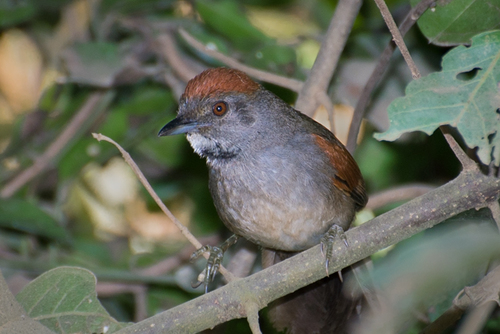 Cinereous-breasted Spinetail
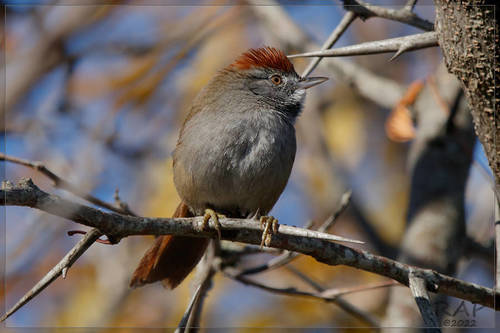 Sooty-fronted Spinetail
In short
The most reliable field mark between Cinereous-breasted Spinetail and Sooty-fronted Spinetail is the color and shape of the tail and the pattern of the throat and breast, especially in adults. Both species are similarly sized and share a generally rufous-brown and gray palette, but Cinereous-breasted has a darker brown, more rounded tail and a distinctly ash-gray (cinereous) breast, while Sooty-fronted shows a more rufous tail with pointed tips and a grayer throat with a blackish crescent. Juveniles are best separated by the underpart color and throat pattern, but beware that both can look washed-out. Habitat overlap is significant, but Sooty-fronted is more likely in southern South America and in forest edge or thorn-scrub, while Cinereous-breasted is tied to wetter, often more open habitats near water. Voice is useful if heard well: Cinereous-breasted gives a hurried, accelerating chatter, while Sooty-fronted produces slower, higher-pitched two-note phrases.
Identification tips
- Tail color and shape: Cinereous-breasted has a darker brown tail with rounded tips, while Sooty-fronted's tail is dark rufous with pointed tips and darker inner webs on the innermost feathers. This is best seen when the bird fans or flicks its tail.
- Breast and belly contrast: Cinereous-breasted shows a distinctly ash-gray (cinereous) breast sharply contrasting with a whitish belly; Sooty-fronted's breast is grayish brown, with the belly only slightly paler and the flanks/undertail browner. Look for this contrast in good light.
- Throat pattern: Adult Cinereous-breasted has a mostly whitish chin/throat with a blackish patch edged whitish on the lower throat; Sooty-fronted has a grayer throat with a blackish crescent and pale speckles. The throat crescent is usually sharper in Sooty-fronted.
- Supercilium and eye-line: Cinereous-breasted shows a faint gray supercilium and a plain gray-brown face, while Sooty-fronted has a thin brownish eye-line but lacks a strong supercilium. This is subtle and may be missed in poor light.
- Crown and nape color: Cinereous-breasted's crown and nape are chestnut-rufous, contrasting with a dark gray-brown forecrown; Sooty-fronted's hindcrown/nape is dark rufous, with a dark gray-brown forecrown but less contrast overall.
- Wing coverts and flight feathers: Both have rufous tones, but Cinereous-breasted's wing coverts are chestnut-rufous with dark brown flight feathers edged rufescent, while Sooty-fronted's coverts are dark rufous and flight feathers are tawny-rufous with dusky tips. In flight, look for the overall warmth and contrast.
- Juvenile underparts: Juvenile Cinereous-breasted is more clay-brown below with a less distinct throat patch; juvenile Sooty-fronted is ochraceous-washed but usually retains a faint blackish throat crescent. This is subtle but can help in fresh-plumaged young birds.
- Tail graduation: Both have graduated tails, but Cinereous-breasted's tail feathers are more rounded, while Sooty-fronted's are more pointed.
- Bill and leg color: Not reliably diagnostic in the field, as both have dark bills and olive to grayish legs, with some individual variation.
- Habitat context: If seen in wetter, open grassland or near water, especially in central or western Amazonia, Cinereous-breasted is more likely. In southern South America, in thorn-scrub, woodland edge, or deforested areas, Sooty-fronted is more probable.
- Vocalizations: If you hear a hurried, accelerating chatter, suspect Cinereous-breasted; if the song is a slow, high two-note phrase, Sooty-fronted is more likely. Calls are less distinctive but can help with experience.
- Geographic range: In Peru and western Amazonia, only Cinereous-breasted occurs. In Argentina, Uruguay, and southern Brazil, only Sooty-fronted is expected. In Bolivia, Brazil, and Paraguay, both can occur—use plumage and voice.
- Clinal variation: Sooty-fronted shows some regional variation, being brighter in the northeast and duller in the southwest, but this does not overlap with Cinereous-breasted's more uniform, darker tones.
- Pairing and behavior: Both species are usually seen in pairs, foraging low in dense cover. Behavior is not a strong separator.
- Pitfalls: Beware of worn or molting birds, as both can appear duller and lose contrast in the throat and breast. Juveniles of both are less distinct, so rely on subtle differences in underpart color and throat pattern.
Size
Both species are very close in size, with Cinereous-breasted Spinetail at 15–16 cm and 15–18 g, and Sooty-fronted Spinetail at 14–16 cm and 11–17 g [wikipedia]. In the hand or at close range, Cinereous-breasted may appear slightly heavier, but this is subtle and not a reliable field mark. Both have similar proportions and structure, so size alone is not diagnostic.
Plumage
- Juveniles: Both species have duller, browner crowns and ochraceous-washed underparts, but Cinereous-breasted juveniles have a less distinct throat patch and more clay-brown below, while Sooty-fronted juveniles show a brownish gray crown and ochraceous wash but retain a faint blackish crescent on the lower throat. In both, the throat pattern is less crisp than in adults, but the presence or absence of a distinct throat crescent is helpful.
- Adults: Cinereous-breasted shows a faint gray supercilium, dark gray-brown forecrown, chestnut-rufous crown and nape, dark brown back, chestnut-rufous wing coverts, and a darker brown, rounded tail. The chin and throat are mostly whitish with a blackish patch edged whitish on the lower throat, and the breast is ash-gray (cinereous), contrasting with a whitish belly. Sooty-fronted adults have a thin brownish eye-line, dark gray-brown forecrown, dark rufous hindcrown/nape, brown back with rufescent tinge, dark rufous wing coverts, tawny-rufous flight feathers with dusky tips, and a dark rufous tail with pointed tips and darker inner webs on the innermost pair. The chin is whitish, the throat grayer with a blackish crescent and pale speckles, and the breast is grayish brown, with paler belly and browner flanks/undertail.
Behaviour
Both species forage low (1–2 m) in dense vegetation, usually in pairs, gleaning arthropods from foliage and branches. Neither is particularly conspicuous, and both can be difficult to observe for long periods. Sooty-fronted may be more adaptable, sometimes extending into deforested areas and a wider range of semi-open habitats. No major behavioral differences are noted in the sources.
Habitat
Cinereous-breasted Spinetail is found in Bolivia, Brazil, Paraguay, and Peru, favoring seasonally wet grasslands, scrub, campina, and savannah, especially near water, from sea level up to 700 m. Its range is more disjunct, and it is locally common but patchy. Sooty-fronted Spinetail occurs in Argentina, Bolivia, Brazil, Paraguay, and Uruguay, with a broader, more continuous range extending farther south. It prefers gallery forest, forest edges, thorn-scrub, woodlands, and bushy savanna, and is more likely in semi-open or edge habitats, sometimes even in deforested areas. Where ranges overlap, habitat can help but is not definitive.
Voice
Cinereous-breasted Spinetail gives a hurried, loud chatter on a single pitch, accelerating at the end (e.g., 'chéw, chew-chee-chee-chee-ee-ee-ee-ee-ee-eu'), or a high, sharp 'tut-Drrrrrrruh' with a staccato, descending finish. Sooty-fronted Spinetail's song is slower, higher-pitched, and more two-noted (e.g., 'ka-kwee-éék', 'du-Twee', 'pi-whéé'), often repeated for long periods. It also gives nasal or clipped calls ('sew-kli', 'chi-cli', 'hoint'). If heard well, the Cinereous-breasted is more chattery and accelerating, while Sooty-fronted is more deliberate and two-parted.
Cinereous-breasted Spinetail · Sooty-fronted Spinetail · My Tricky Birds