

Casqued Cacique vs Yellow-tailed Oriole
Cacicus oseryi versus Icterus mesomelas
Play a quiz with Casqued Cacique and Yellow-tailed Oriole
 Casqued Cacique
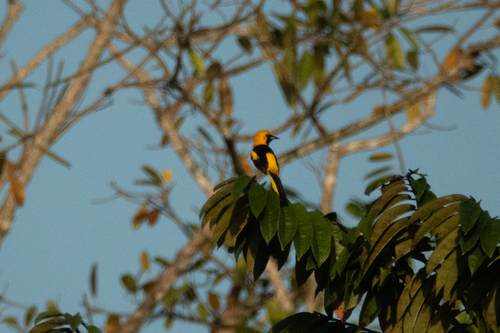 Yellow-tailed Oriole
In short
The most reliable field mark is overall body color: adult Casqued Cacique is deep chestnut with yellow highlights, while Yellow-tailed Oriole is mainly bright yellow with a black back and face. In flight or perched, the cacique’s large size, prominent casque, and rich chestnut body set it apart from the oriole’s smaller, more slender, and vividly yellow appearance. Juvenile plumages are less distinctive, but the cacique remains darker and bulkier, while young orioles are olive-backed and yellow below. Both species have yellow in the tail, but the pattern and context differ. If you see a large, chestnut bird with a casque and yellow tail edges, it’s a cacique; a smaller, mostly yellow bird with a black back and face is the oriole.
Identification tips
- Overall color: Adult Casqued Cacique is deep chestnut with yellow highlights; Yellow-tailed Oriole is bright yellow with a black back and face. This is the fastest field separation in good light.
- Size and shape: The cacique is much larger and bulkier than the oriole—nearly twice as long and several times heavier. If the bird looks crow-sized, it’s a cacique; if it’s closer to a large tanager or small oriole, it’s the oriole.
- Casque: Only Casqued Cacique has a prominent casque on the bill (larger in males, smaller in females), colored yellowish gray to dark gray. Yellow-tailed Oriole’s bill is slender and lacks any casque. This is diagnostic at close range.
- Tail pattern: Both have yellow in the tail, but in cacique, the tail is dusky olive with only the outer feathers bright yellow; in oriole, the tail is black above with yellow margins and appears almost entirely yellow from below. In flight, look for the pattern: cacique shows yellow only on the outer tail, oriole shows more extensive yellow.
- Wing pattern: Casqued Cacique has yellow edges to the flight feathers; Yellow-tailed Oriole has black wings with yellow epaulets. Juvenile orioles lack the black, showing olive instead, but still do not approach the cacique’s chestnut tones.
- Underparts: Casqued Cacique is chestnut throughout, with a grayish olive throat and yellowish olive on the upper breast and neck sides. Yellow-tailed Oriole is yellow below, with black only on the upper breast.
- Eye color: Adult cacique has a pale blue iris; juveniles have dark eyes. Oriole’s eye color is not specified but is not noted as pale blue.
- Bill color: Casqued Cacique’s bill is variable but usually dark gray above and yellow-green below with a dark tip. Oriole’s bill is not described as bicolored.
- Sexes: Both species are sexually monomorphic in plumage, but male caciques have a larger casque and are much larger than females. Orioles show little sexual dimorphism in the field.
- Juvenile confusion: Juvenile cacique is like adult but with dark eyes; juvenile oriole is olive-backed and yellow below, lacking the black of adults. Neither juvenile looks like the other species.
- Behavior: Cacique is often seen in colonies, especially in Cecropia trees along rivers; oriole is more solitary or in small groups in dense thickets.
- Habitat: If the bird is high in a Cecropia tree along a river, cacique is more likely; if in dense, shrubby growth or swampy thickets, oriole is more probable.
- Song: If you hear rich, whistled duets, it’s the oriole. Cacique’s vocalizations are not described here.
- Bill structure: Cacique’s bill is heavier and more robust, with a casque; oriole’s is slender and pointed, typical of orioles.
- Common pitfalls: Both have yellow in the tail, but the cacique is never mostly yellow or black-backed, and the oriole is never chestnut-bodied or casque-bearing. In poor light, size and casque are the best clues.
Size
Casqued Cacique is much larger and bulkier: males average 37 cm and females 29 cm, with weights of 188 g and 101 g respectively. In contrast, Yellow-tailed Oriole is much smaller, at 22–23 cm and about 40 g (up to 70 g in some sources). The cacique is robust with a heavy bill and a prominent casque, while the oriole is slender, with a more typical oriole silhouette and no casque.
Plumage
-
Juveniles: Juvenile Casqued Cacique resembles the adult but with dark eyes; overall, it is rich chestnut with yellow tail edges and yellow-edged flight feathers. Juvenile Yellow-tailed Oriole is mostly yellow below, with olive replacing the adult’s black on the back and tail, and lacks the deep chestnut tones of the cacique.
-
Adults: Adult Casqued Cacique is mostly rich chestnut with a dusky olive tail and bright yellow outer tail feathers, yellow-edged flight feathers, and a prominent casque (yellowish gray to dark gray). The throat and upper breast are grayish to yellowish olive. Adult Yellow-tailed Oriole is mainly bright yellow, with a black back, lower face, and upper breast, black wings with yellow epaulets, and a tail that is black above with yellow margins (from below, almost entirely yellow). The oriole’s bill is slender and lacks any casque.
Behaviour
Casqued Cacique is often found in colonies, especially during breeding, and is polygynous. Males may be seen guarding colonies. They are typically seen in the canopy, often in Cecropia trees. Yellow-tailed Oriole tends to forage in pairs or small groups, usually in dense thickets or vine tangles, and is less colonial. Orioles are more likely to be seen lower in the vegetation, often near water or in swampy areas.
Habitat
Both species overlap in parts of western Amazonia and river valleys, but their preferred habitats differ. Casqued Cacique is most often found in isolated Cecropia trees along small rivers, especially in Peru, and is associated with forest canopy or edge. Yellow-tailed Oriole prefers dense thickets, often with vines and Heliconias, in swampy lowlands or river corridors, and is more likely to be seen in shrubby or secondary growth than in tall forest canopy.
Voice
Yellow-tailed Oriole is noted for its melodic, rich whistles and duets, with phrases like 'chuck, chuck-yeeaow.' Casqued Cacique’s voice is not described in the provided notes, so vocalizations are only useful for identifying the oriole, which is also valued for its song in the cage-bird trade.