

Burchell's Starling vs Greater Blue-eared Starling
Lamprotornis australis versus Lamprotornis chalybaeus
Play a quiz with Burchell's Starling and Greater Blue-eared Starling
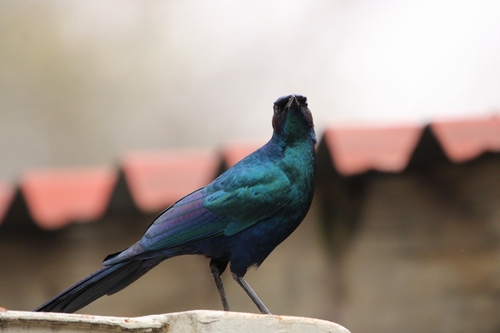 Burchell's Starling
 Greater Blue-eared Starling
In short
The most reliable way to separate Burchell's Starling from Greater Blue-eared Starling is by focusing on plumage, especially the color and extent of gloss on the underparts, and the ear patch. Greater Blue-eared Starling shows a striking blue ear patch and a purple-blue belly, while Burchell's Starling lacks these features and appears more uniformly glossy. Juvenile Greater Blue-eared Starlings are duller with blackish brown underparts, which can cause confusion with Burchell's, but the ear patch and overall gloss pattern remain useful. Both are similar in size and structure, so careful attention to plumage details is essential, especially in mixed flocks or overlapping habitats.
Identification tips
- Check for a blue ear patch: Greater Blue-eared Starling always shows a distinct blue ear patch, even in duller juveniles. Burchell's Starling lacks this feature at all ages.
- Look at the belly color: Greater Blue-eared Starling has a purple-blue belly, with the blue extending forward of the legs. Burchell's Starling is more uniformly glossy without a contrasting belly.
- Juvenile confusion: Juvenile Greater Blue-eared Starlings are duller with blackish brown underparts, but the blue ear patch and some gloss remain. If you see a dull starling with a blue ear patch, it's still Greater Blue-eared.
- Iris color: Both species have bright yellow or orange irises as adults, so this is not a useful separation mark.
- Overall gloss: Burchell's Starling appears more uniformly glossy, lacking the strong contrast between ear patch, belly, and upperparts seen in Greater Blue-eared.
- Tail and structure: Both are short-tailed and robust; tail length and structure are not helpful for separation.
- Flocking behavior: Large, noisy flocks in open woodland or around livestock are more likely to be Greater Blue-eared Starlings. Burchell's is less gregarious and more likely to be seen in pairs or small groups.
- Habitat context: In very open, well-grazed savannahs or areas with livestock, Greater Blue-eared is more likely. In denser woodland or drier, less open habitats, Burchell's is more typical.
- Range: If you are outside southern Africa, you are almost certainly seeing Greater Blue-eared Starling. In southern Africa, both species can occur, so careful plumage checks are needed.
- Mixed flocks: In mixed starling flocks, use the blue ear patch and belly color to pick out Greater Blue-eared among Burchell's and other Lamprotornis starlings.
- Flight views: No distinctive wing or flight pattern differences are described, so rely on body and head plumage even in flight.
- Seasonal movement: Greater Blue-eared may appear in new areas during migration or seasonal movements; Burchell's is more sedentary.
- Vocalizations: If you hear a nasal 'squee-ar' call, suspect Greater Blue-eared, but do not rely on voice alone unless you are very familiar with both species.
- Sex differences: Both species are sexually similar; do not use sex for identification.
- Pitfalls: Beware of dull juvenile Greater Blue-eared Starlings, which can look superficially like Burchell's, but always check for the blue ear patch and any gloss on the upperparts.
Size
Both species are very close in size, with Greater Blue-eared Starling averaging slightly heavier (85.8g) than Burchell's Starling (80.0g) [wikidata]. In the field, this difference is negligible and not a reliable separation point. Both have similar short-tailed, robust starling structure, so size and shape alone are not diagnostic.
Plumage
- Juvenile/immature birds: Juvenile Greater Blue-eared Starlings are duller overall, with blackish brown underparts, but still retain a blue ear patch and some gloss on the upperparts. Burchell's Starling juveniles are not described in detail but lack the distinctive blue ear patch and purple-blue belly.
- Adults: Greater Blue-eared Starling adults are glossy blue-green overall, with a distinct blue ear patch and a purple-blue belly. The blue of the belly is a key mark, extending forward of the legs. Burchell's Starling adults are more uniformly glossy without a contrasting blue ear patch or purple-blue belly, giving a less contrasting appearance overall. Both species have bright yellow or orange irises in adults.
- Flight views: No specific upperwing or flight pattern differences are described for these two species, so separation relies on body and head plumage even in flight.
Behaviour
Greater Blue-eared Starling is highly gregarious, often forming large flocks and mixing with other starling species. It is known to perch on livestock, feeding on insects disturbed by the animals and sometimes removing ectoparasites. Burchell's Starling is described as monogamous and presumably sedentary, with no mention of such flocking or livestock associations. In the field, Greater Blue-eared is more likely to be seen in large, noisy groups, while Burchell's may be encountered in pairs or small family groups.
Habitat
Burchell's Starling is native to dry and mesic woodlands and savannahs of southern Africa, typically in less open habitats. Greater Blue-eared Starling is common in open woodland and savannah, with a much broader range extending from West to East Africa and into northeastern South Africa and Angola. It also undertakes some seasonal migration, so may be found in a wider variety of open habitats, sometimes outside the core range of Burchell's. Overlap is possible in southern Africa, but Greater Blue-eared is generally more widespread and abundant [ebird].
Voice
Greater Blue-eared Starling has a range of musical or grating calls, with the most familiar being a nasal 'squee-ar.' There is no specific vocal description for Burchell's Starling in the provided notes, so voice is not a reliable separation point unless you are very familiar with local starling calls.
Burchell's Starling · Greater Blue-eared Starling · My Tricky Birds