

Brushland Tinamou vs Spotted Nothura
Nothoprocta cinerascens versus Nothura maculosa
Play a quiz with Brushland Tinamou and Spotted Nothura
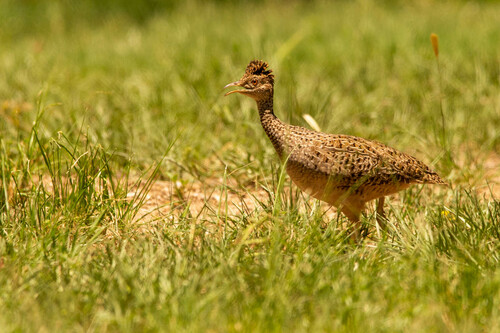 Brushland Tinamou
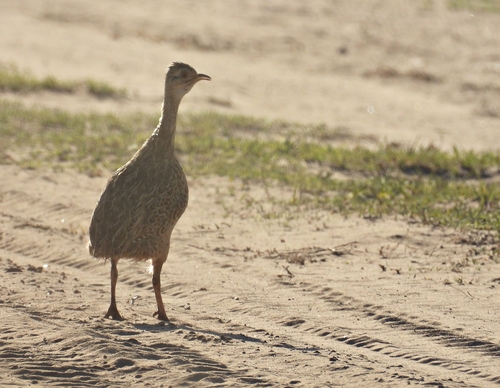 Spotted Nothura
In short
The most reliable way to separate Brushland Tinamou from Spotted Nothura in the field is by focusing on plumage details, especially the presence of barring on the primaries and flanks in Spotted Nothura, which is absent in Brushland Tinamou. Spotted Nothura also shows a distinctive white throat and more extensive streaking and barring across its body, while Brushland Tinamou is generally plainer. Habitat can help: Brushland Tinamou prefers high-altitude dry shrublands, while Spotted Nothura is found in grassy lowlands. Size is also a clue, with Brushland Tinamou being notably heavier, but this is harder to judge unless both species are seen together.
Identification tips
- Primary barring in flight: Spotted Nothura is unique among nothuras (except Chaco Nothura) in showing barring on both webs of the primaries—look for this in birds flushed or with wings spread; Brushland Tinamou lacks this feature. This mark is reliable for all ages.
- Flank barring: Spotted Nothura has clear barring on the flanks, visible when the bird is standing or walking; Brushland Tinamou's flanks are much plainer.
- Breast and underpart pattern: Spotted Nothura shows buff underparts with black and brown streaks on the breast, while Brushland Tinamou is less distinctly marked below.
- Crown and throat: Spotted Nothura has a black crown streaked with buff and a conspicuous white throat. Brushland Tinamou lacks the strong crown contrast and white throat.
- Overall contrast: Spotted Nothura is more patterned and contrasting, while Brushland Tinamou is generally plainer and more uniform.
- Leg color: Spotted Nothura has dull yellowish-grey or brown legs. While not diagnostic alone, this can support an ID if seen well.
- Size and build: Brushland Tinamou is much heavier and bulkier than Spotted Nothura, which is smaller and more delicate. Use this only if you have a good sense of scale.
- Habitat context: In dry, shrubby highlands, expect Brushland Tinamou; in open grassy lowlands, Spotted Nothura is far more likely.
- Geographic range: While ranges overlap in parts of southern South America, Spotted Nothura is more widespread in grasslands, and Brushland Tinamou is more restricted to shrubby highlands.
- Jizz in flight: If you see a bird flush, look for the patterned wings (barring) and smaller size of Spotted Nothura versus the plainer, larger Brushland Tinamou.
- Plumage variability: Spotted Nothura shows some color variation across its range due to soil differences, but the barring and streaking remain consistent.
- Sex and age: No strong sexual dimorphism or age-related confusion is noted for these marks; the primary barring and flank pattern are reliable across ages and sexes.
- Voice: No vocal differences are provided in the sources; rely on visual marks.
- Pitfalls: Beware of confusing Spotted Nothura with Chaco Nothura, which also has primary barring, but Brushland Tinamou is always plainer and heavier.
- When marks fail: If you cannot see the wings or flanks, use habitat, size, and overall contrast as supporting clues, but be cautious with distant or obscured birds.
Size
Brushland Tinamou is significantly heavier (average 526 g) than Spotted Nothura, which is a much smaller tinamou (length 24–25.5 cm, but no mass given; typically much lighter than Nothoprocta species). In the field, Brushland Tinamou will appear bulkier and more robust, while Spotted Nothura is smaller and more delicate. However, size can be hard to judge without direct comparison.
Plumage
Spotted Nothura is immediately distinguished by its intricate patterning: the upperparts are brown with buff streaks, and the underparts are buff with black and brown streaks on the breast and barring on the flanks. The crown is black streaked with buff, and the throat is white. Critically, Spotted Nothura (along with Chaco Nothura) is the only nothura with barring on both webs of the primaries—this is a key field mark in flight or when the wing is spread, and applies to all ages. Brushland Tinamou lacks this barring on the primaries, and is generally plainer overall, with less contrast and less obvious streaking or barring. The legs of Spotted Nothura are dull yellowish-grey or brown, while Brushland Tinamou's leg color is not specified, but is not noted as distinctive.
Behaviour
Both species are ground-dwelling tinamous and can be shy, often flushing at close range. There are no specific behavioral differences noted in the sources, but habitat preference may influence how and where you encounter them: Brushland Tinamou is more likely to be found in dry, shrubby areas, while Spotted Nothura prefers open grasslands.
Habitat
Brushland Tinamou is associated with high-altitude dry shrubland in subtropical and tropical regions of southern South America. In contrast, Spotted Nothura is found in grassy habitats—such as open grasslands and savannas—across eastern and southern Brazil, Paraguay, Bolivia, Uruguay, and eastern and northern Argentina. If you are in dense brush or dry shrubland, Brushland Tinamou is more likely; in open grassland, Spotted Nothura is the default.