

Brown-crested Flycatcher vs Prairie Warbler
Myiarchus tyrannulus versus Setophaga discolor
Play a quiz with Brown-crested Flycatcher and Prairie Warbler
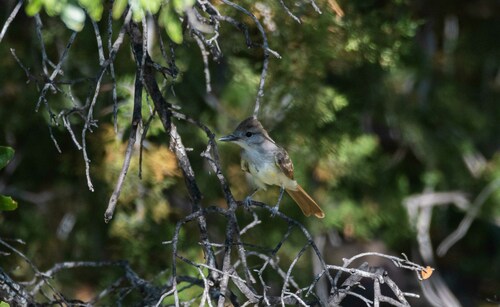 Brown-crested Flycatcher
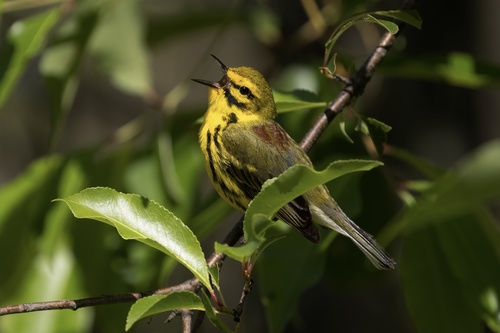 Prairie Warbler
In short
The most reliable field mark to separate Brown-crested Flycatcher from Prairie Warbler is overall structure: the flycatcher is much larger, thick-billed, and heavy-bodied, while the warbler is tiny, slender, and fine-billed. In all plumages, the flycatcher shows a strong rufous tone in the tail and wings, a bushy crest, and bold yellow underparts with a gray breast band, but lacks the Prairie Warbler’s black facial stripes and flank streaks. Prairie Warbler is much smaller, with a thin bill, bright yellow face and underparts, black eye and malar stripes, and a habit of pumping its long tail. Even immature Prairie Warblers, though duller, retain the slim, active warbler jizz and facial pattern. If seen in flight, the flycatcher’s rufous tail flashes are diagnostic, while the warbler shows white in the tail. Size and structure are decisive at any distance.
Identification tips
- Size and Structure: Brown-crested Flycatcher is much larger and bulkier than Prairie Warbler. If the bird appears sparrow-sized or smaller, it is not a flycatcher.
- Bill Shape: Flycatcher has a thick, broad-based bill; Prairie Warbler’s bill is thin, pointed, and delicate. Bill shape is visible even at moderate range.
- Tail Pattern in Flight: Brown-crested Flycatcher shows rufous flashes in the tail (except the innermost pair), visible in all ages and especially obvious in flight or when fanned. Prairie Warbler shows large white tail spots, especially when the tail is spread or flicked.
- Facial Pattern: Prairie Warbler has a bold black eye-stripe and a curved black malar stripe, forming a 'tired' or spectacled look. Brown-crested Flycatcher lacks any black facial markings, showing a plain gray face instead.
- Crest: Flycatcher often raises a bushy crest, especially when alert. Prairie Warbler’s crown is smooth and flat.
- Underparts: Both species have yellow underparts, but the flycatcher’s yellow is brightest on the belly and lower breast, with a pale gray throat and upper breast forming a subtle band. Prairie Warbler is yellow from throat to belly, with dark streaks on the flanks (especially in males and adults).
- Wingbars: Both have two wingbars, but the flycatcher’s are broader and paler (grayish or whitish), while the warbler’s are faint and narrow.
- Upperparts: Flycatcher’s back is grayish-brown to olive-gray, sometimes with a rufous tinge. Prairie Warbler is olive-green above, often with chestnut or rufous streaks in males.
- Leg Color: Both have dark legs; not a useful separator.
- Behavior: Prairie Warbler frequently pumps or wags its tail, a behavior not seen in the flycatcher. Flycatcher perches upright and sally-hunts.
- Habitat: In open woods with large trees or cacti, suspect flycatcher; in shrubby fields or young pine woods, suspect warbler.
- Sex and Age: Female and immature Prairie Warblers are duller, with fainter streaks, but still show the facial pattern and slim build. Flycatcher sexes and ages are similar in plumage, with only minor subspecific variation.
- Voice: Not diagnostic from these notes.
- Jizz: Overall impression is decisive: flycatcher is a big, upright, heavy-headed bird; warbler is tiny, slim, and active.
- Pitfalls: Do not rely on yellow underparts alone—both species have them, but the combination of size, structure, tail pattern, and face is always diagnostic.
Size
Brown-crested Flycatcher is dramatically larger and heavier than Prairie Warbler. The flycatcher ranges from 18–23 cm in length and weighs 21–54 g depending on subspecies, making it nearly three times the length and many times the mass of the Prairie Warbler, which is only 11–13 cm long and weighs about 7.5 g. The flycatcher has a thick, broad bill and a robust body, while the warbler is tiny, slender, and has a fine, pointed bill. Even at a distance or in poor light, this size difference is unmistakable.
Plumage
No matter the age, Brown-crested Flycatcher shows a combination of grayish-brown upperparts, a bushy crest, and strong rufous tones in the tail and wing edges. Its underparts are bright yellow below a pale gray breast and throat, with two pale wingbars on dark wings. The tail is dark with rufous inner webs except the innermost pair. Juvenile and adult plumages are similar, with only subtle differences in tone among subspecies. Prairie Warbler, by contrast, is bright yellow below with dark streaks on the flanks (especially in males and adults), olive-green upperparts with chestnut or rufous streaks, and two faint wingbars. The face is marked by a black eye-stripe and a curved black malar (throat) stripe, giving a distinctive 'tired' look. Females and immatures are duller, with fainter streaks, but the facial pattern and overall yellow tone remain. In flight, Prairie Warbler shows large white patches in the tail, while the flycatcher shows rufous flashes. These tail patterns are visible in all age classes.
Behaviour
Prairie Warbler is highly active, often seen pumping or wagging its tail and moving quickly through low shrubs or open woods. Brown-crested Flycatcher is more deliberate, typically perching upright on exposed branches, sallying out to catch insects, and showing a bushy crest. The flycatcher does not pump its tail. These behavioral differences are apparent even in brief views.
Habitat
Brown-crested Flycatcher favors open woodlands, edges, and areas with large trees or cacti suitable for nesting cavities, often in drier or semi-arid regions. Prairie Warbler prefers shrubby fields, young second-growth, or open pine woods, usually in areas with dense low vegetation. While some overlap can occur at migration stopovers, their preferred habitats are usually quite different.
Brown-crested Flycatcher · Prairie Warbler · My Tricky Birds