
Broad-winged Hawk vs Hawaiian Hawk
Buteo platypterus versus Buteo solitarius
Play a quiz with Broad-winged Hawk and Hawaiian Hawk
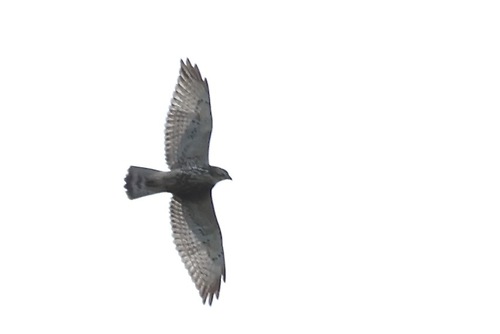 Broad-winged Hawk
 Hawaiian Hawk
In short
The most reliable field mark between Broad-winged Hawk and Hawaiian Hawk is the tail pattern: Broad-winged Hawk (all ages) shows a dark tail with distinct narrow white bands, while Hawaiian Hawk's tail is less distinctly banded. Juvenile Broad-winged Hawks have vertical streaking on the underparts, while juvenile Hawaiian Hawks show greenish legs and feet. In flight, Broad-winged Hawk has shorter, more tapered wings and a shorter tail than the bulkier, longer-winged Hawaiian Hawk. Range is also a strong clue: Broad-winged Hawk is found in North America and migrates, while Hawaiian Hawk is endemic to the Big Island of Hawaiʻi. Use a combination of tail pattern, wing shape, and local context for the most confident separation.
Identification tips
- Tail pattern (all ages): Broad-winged Hawk always shows a dark tail with several narrow, crisp white bands (at base, middle, and tip). Hawaiian Hawk's tail is less distinctly banded and often appears plainer or with less contrast.
- Juvenile underparts: Juvenile Broad-winged Hawk has vertical streaking (longitudinal barring) on the underparts, while Hawaiian Hawk juveniles lack this pattern and may show a more uniform or blotchy look.
- Leg color (juveniles): Juvenile Hawaiian Hawk has greenish legs and feet, while Broad-winged Hawk (all ages) has yellowish legs.
- Adult underparts: Adult Broad-winged Hawk has white underparts with fine horizontal barring; adult Hawaiian Hawk (light morph) has a dark head and pale underparts, but without the fine barring.
- Color morphs: Both species have dark and light morphs. Broad-winged Hawk dark morph is rare and uniformly dark brown; Hawaiian Hawk dark morph is more common and also dark brown, but check tail and leg color for confirmation.
- Wing shape in flight: Broad-winged Hawk has short, broad, and pointed wings with a unique tapered appearance. Hawaiian Hawk's wings are broader and longer, giving a bulkier impression.
- Tail length and shape: Broad-winged Hawk has a relatively short tail; Hawaiian Hawk's tail is longer in proportion to its body.
- Size: Hawaiian Hawk is larger and bulkier, especially the female, but size overlap makes this unreliable unless both are seen together.
- Range: Broad-winged Hawk is found in North America (and migrates), never in Hawaiʻi. Hawaiian Hawk is only on the Big Island; any Buteo there is Hawaiian Hawk.
- Habitat: Broad-winged Hawk prefers deciduous forests; Hawaiian Hawk is found in native ʻōhiʻa lehua forests on Hawaiʻi.
- Breeding season mark: During breeding, one Hawaiian Hawk (likely the female) may show a yellowish forecap above the bill—never seen in Broad-winged Hawk.
- Behavior: Broad-winged Hawk migrates in large flocks (kettles); Hawaiian Hawk is sedentary and territorial.
- Plumage confusion: Light morph Broad-winged Hawk can resemble light morph Hawaiian Hawk, but check for tail bands and underpart barring.
- Perched posture: Both perch upright, but Broad-winged Hawk may look more compact due to its shorter tail and wings.
- Voice: Not diagnostic with current information.
Size
Broad-winged Hawk is slightly smaller, measuring 32–44 cm (13–17 in) in length and weighing 265–560 g (9.3–19.8 oz) [wikipedia]. Hawaiian Hawk is larger, at 40–46 cm (16–18 in) long; females average 605 g (21.3 oz), males 441 g (15.6 oz) [wikipedia]. Both are medium-sized Buteos, but Hawaiian Hawk is stockier and heavier overall, especially the female. Wingspan is only given for Broad-winged Hawk (74–100 cm), but Hawaiian Hawk is likely similar or slightly larger given its body size.
Plumage
-
Juvenile/immature birds: Broad-winged Hawk juveniles have more white overall and vertical streaking (longitudinal barring) on the underparts, while Hawaiian Hawk juveniles are best recognized by their greenish legs and feet (adults have yellow legs). Both species have light and dark morphs, but Broad-winged Hawk's light morph is more likely to be confused with other Buteos due to its pale underparts and banded tail.
-
Adults: Broad-winged Hawk adults show dark brown upperparts, white underparts with horizontal barring, and a dark tail with multiple narrow white bands (at base, middle, and tip). Hawaiian Hawk adults have two color phases: dark (dark brown throughout) and light (dark head, pale underparts and underwings). The tail is less distinctly banded than Broad-winged Hawk. During breeding, one Hawaiian Hawk (likely the female) may show a yellowish forecap above the bill.
-
In flight: Broad-winged Hawk's wings are short, broad, and pointed with a unique tapered look; tail is short and distinctly banded. Hawaiian Hawk's wings are broader and longer, and the tail is less sharply marked.
Behaviour
Both are typical Buteos, often seen soaring on broad wings. Broad-winged Hawk migrates in large flocks ('kettles') during migration, while Hawaiian Hawk is sedentary and territorial on the Big Island. Courtship displays (cartwheels, dives) are noted for Broad-winged Hawk, but not specifically described for Hawaiian Hawk. Both perch in trees and hunt from a perch or in flight.
Habitat
Broad-winged Hawk breeds in deciduous forests of eastern North America and migrates to Central and South America for winter. Hawaiian Hawk is strictly endemic to the Big Island of Hawaiʻi, breeding in native ʻōhiʻa lehua forests. If you are outside Hawaiʻi, you are almost certainly seeing Broad-winged Hawk; if on the Big Island, Hawaiian Hawk is the only Buteo present.