

Bohemian Waxwing vs Japanese Waxwing
Bombycilla garrulus versus Bombycilla japonica
Play a quiz with Bohemian Waxwing and Japanese Waxwing
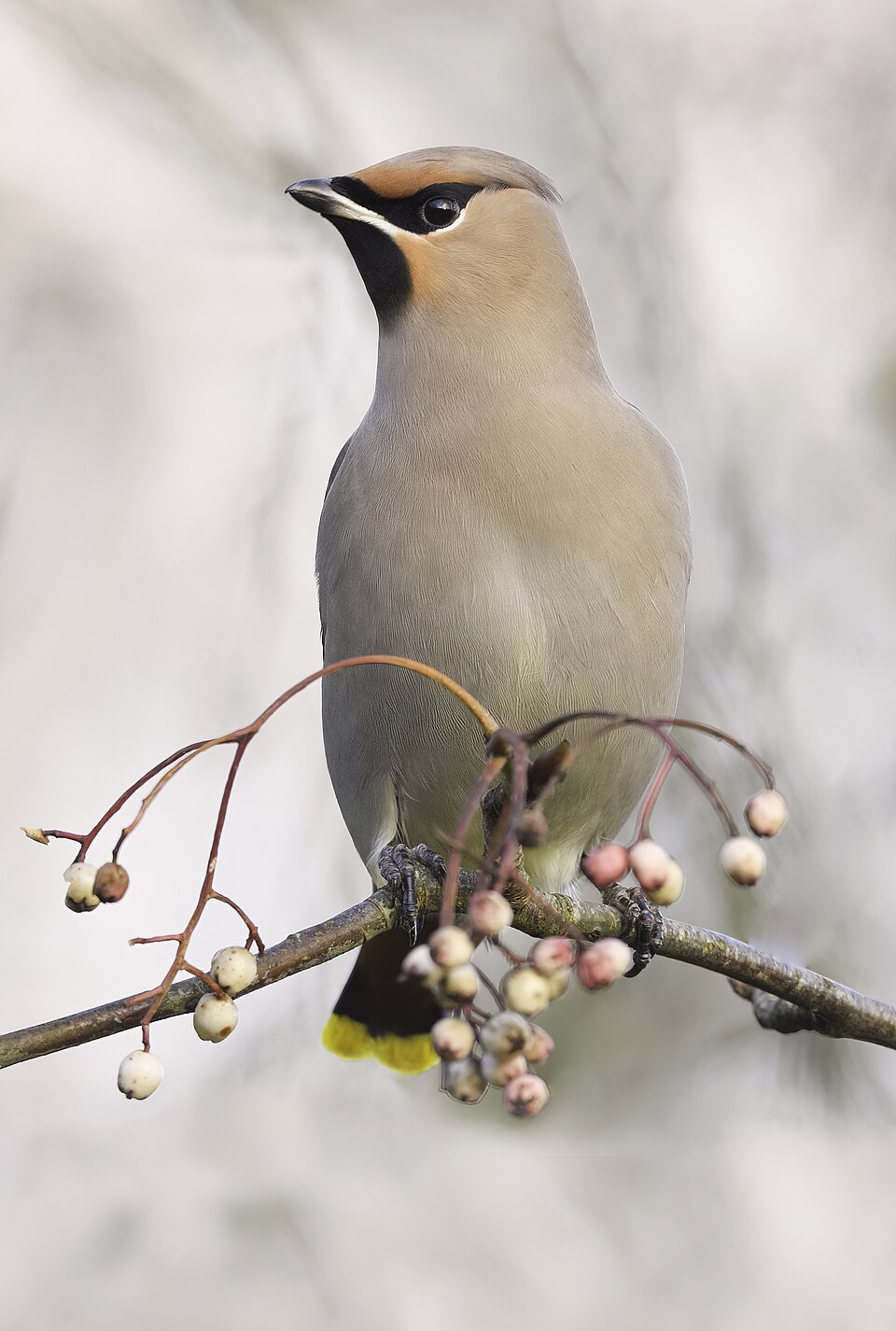 Bohemian Waxwing
 Japanese Waxwing
In short
The most reliable way to separate Bohemian and Japanese Waxwings is by tail tip color: Bohemian shows a bright yellow tail tip, while Japanese has a red tail tip with a black border. In flight or perched, Bohemian Waxwing adults display bold white and yellow wing markings and multiple red waxy tips on the secondaries (both sexes), whereas Japanese Waxwing has a more diffuse reddish-brown wing bar and red waxy tips only in males. Bohemian is slightly larger and bulkier, with buff-grey tones, while Japanese is pinkish-brown with a pale yellow belly center and rusty-red undertail. Immature and female birds are trickier, but the absence of yellow in the tail and the presence of a reddish wing bar in Japanese are key. Both species can flock together in winter, so careful attention to these details is needed.
Identification tips
- Tail tip color is the fastest check: Bohemian Waxwing always shows a broad, bright yellow tail tip (adults and immatures), while Japanese Waxwing has a red tail tip bordered with black. This is visible both perched and in flight.
- Wing pattern (adults): Bohemian Waxwing adults have a bold yellow stripe on the primaries and white 'fishhook' marks on the closed wing. Japanese Waxwing lacks these; instead, look for a diffuse reddish-brown bar across the greater coverts.
- Red waxy tips: Bohemian Waxwing (both sexes) shows multiple red waxy tips on the secondaries (6–8 in males, 5–7 in females), often teardrop-shaped. Japanese Waxwing only shows red tips in males, and these are fewer and less prominent; females usually lack them entirely.
- Belly color: Bohemian has a rich chestnut lower belly, while Japanese has a pale yellow belly center. This can be subtle but is useful on close views.
- Undertail coverts: Japanese Waxwing has rusty-red undertail coverts, contrasting with the rest of the underparts; Bohemian does not.
- Facial pattern: Both have a black mask and throat, but Bohemian's mask is broader and the throat patch is more sharply defined (especially in males). Japanese's mask is narrower and the black does not extend as far.
- Wing bar: Only Japanese Waxwing has a diffuse reddish-brown bar across the greater coverts; Bohemian lacks this feature.
- Rump color: Both have grey rumps, but this is not a strong separator.
- Juvenile/immature wing pattern: Bohemian first-winter birds lack the white 'tick mark' on the trailing edge of the primaries and have a paler (white or pale yellow) leading edge. Japanese immatures are less well described, but the absence of yellow in the tail and reddish wing bar remain clues.
- Size and structure: Bohemian is larger and bulkier, but this is only obvious in direct comparison or in mixed flocks.
- Sex differences: In Japanese Waxwing, only males have red waxy tips on the secondaries; females lack them. In Bohemian, both sexes have red tips, though females have fewer.
- Flight jizz: Both species have fast, direct flight with long wings and short tails, but Bohemian may appear slightly bulkier.
- Habitat context: In southern Japan and Taiwan in winter, Japanese Waxwing is more likely, but both species can occur together, especially in berry-rich areas.
- Mixed flocks: If you see both yellow- and red-tailed birds together, you are likely observing a mixed flock; check each bird carefully.
- Pitfalls: Immature Bohemian Waxwings can show reduced yellow and fewer red tips, making them resemble Japanese, but the yellow tail tip and lack of reddish wing bar remain reliable. Japanese females lacking red tips may be confused with Bohemian, but the tail and wing bar still separate them.
Size
Bohemian Waxwing is the larger of the two, typically starling-sized at 19–23 cm in length and weighing around 55 g (though some sources suggest slightly higher). Japanese Waxwing is smaller at 15–18 cm and 54–64 g. The difference is subtle in the field, but Bohemian appears bulkier and longer-tailed, especially in mixed flocks. Both have a pointed crest and similar proportions, so size alone is rarely diagnostic unless birds are side by side.
Plumage
Age and sex are crucial for separating these species by plumage:
-
Adults: Bohemian Waxwing adults have a buff-grey body, black face mask and throat, a broad yellow tail tip, and wings with a striking yellow stripe and white 'fishhook' marks on the primaries. Both sexes have multiple red waxy tips on the secondaries (6–8 in males, 5–7 in females). Japanese Waxwing adults are pinkish-brown with a black mask and throat, a red tail tip bordered with black, and a diffuse reddish-brown bar across the greater coverts. Only males have red waxy tips on the secondaries, and these are fewer and lack the 'teardrop' shape of Bohemian. The belly center is pale yellow, and the undertail coverts are rusty-red.
-
First-winter/immature: Bohemian first-winter birds lack the bold white 'tick mark' on the wing and have a paler (white or very pale yellow) leading edge to the primaries. The yellow tail tip is narrower, and there are fewer red wax tips (males: 4–6, females: 1–5 or none). Japanese immatures are less well described, but the absence of yellow in the tail and the presence of the reddish wing bar remain useful.
-
Juveniles: Bohemian juveniles are duller, with streaky, whiter underparts, reduced black on the throat, and a smaller mask. Japanese juveniles are not described in detail, but should lack the strong adult contrasts.
-
In flight: Bohemian shows a bold yellow tail tip and strong wing pattern; Japanese shows a red tail tip and a more muted wing with a reddish bar.
Behaviour
Both species are highly social, often forming large flocks, especially in winter, and can be found together in mixed groups. Their flight is fast and direct, reminiscent of starlings, with long wings and short tails. Bohemian Waxwing is described as clambering easily through trees and bushes but shuffling on the ground. No significant behavioral differences are noted that would reliably separate them in the field.
Habitat
Bohemian Waxwing breeds in northern forests of the Palearctic and North America, favoring coniferous or mixed woodlands. Japanese Waxwing breeds further south in dense coniferous forests of the Russian Far East and northeastern China. In winter, both species overlap extensively in East Asia, frequenting open woodlands, farmland, parks, and gardens with abundant berries. Japanese Waxwing is more numerous in southern Japan in winter, while Bohemian is more northern, but both can occur together where food is plentiful.
Voice
Japanese Waxwing gives a high-pitched trill but lacks a true song. Bohemian Waxwing's voice is not described in the provided notes, so vocalizations are not a reliable field separator based on the available information.