

Black-throated Grey Warbler vs Townsend's Warbler
Setophaga nigrescens versus Setophaga townsendi
Play a quiz with Black-throated Grey Warbler and Townsend's Warbler
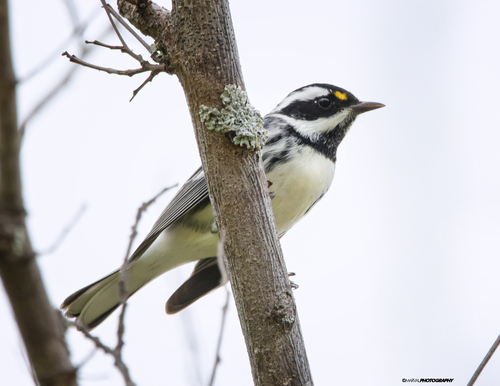 Black-throated Grey Warbler
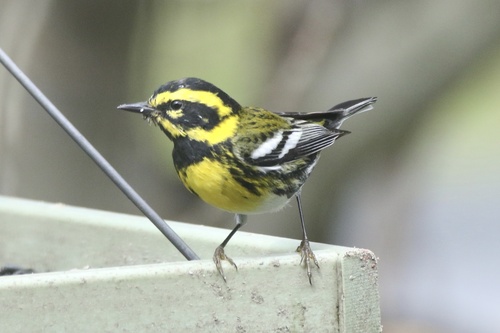 Townsend's Warbler
In short
The most reliable field mark between Black-throated Gray Warbler and Townsend's Warbler is the face pattern: Black-throated Gray shows a small yellow spot in front of the eye and bold black-and-white striping on the head, while Townsend's has a bright yellow face with a thick black cheek patch. Both males have black throats, but females and immatures differ: female Black-throated Gray has a white throat, while female Townsend's has a yellow throat. In all ages, look for the Townsend's Warbler's olive upperparts and more extensive yellow on the face and underparts, versus the Black-throated Gray's overall gray-and-white coloration. These differences are visible both in perched and foraging birds, but can be subtle in poor light or with quick views.
Identification tips
- Face pattern is key: Black-throated Gray Warbler shows a small yellow spot in front of the eye (lores) and bold black-and-white striping on the head. Townsend's Warbler has a bright yellow face with a thick black cheek patch (ear patch) that extends behind and below the eye.
- Throat color varies by sex: Male Black-throated Gray and male Townsend's both have black throats, but female Black-throated Gray has a white throat, while female Townsend's has a yellow throat. Immature Townsend's also shows a yellow throat.
- Cheek patch: Townsend's Warbler always has a strong black (male) or dark (female/immature) cheek patch, which is absent in Black-throated Gray Warbler.
- Yellow on face and underparts: Townsend's Warbler is much brighter, with yellow extending from the face onto the breast, especially in males. Black-throated Gray is more muted, with yellow limited to a small spot in front of the eye.
- Upperparts color: Black-throated Gray Warbler is gray above with black streaks, while Townsend's Warbler is olive above with black streaks.
- Flank streaking: Both have black streaks on the flanks, but in Black-throated Gray these are usually more distinct and set against white underparts; in Townsend's, the streaks are set against yellow.
- Wing bars: Both species show two white wing bars, so this is not a useful separator.
- Bill shape and size: Both have thin, pointed bills typical of warblers; bill shape is not a reliable field mark.
- Sex and age differences: Females and immatures of both species are duller, but the face pattern (yellow face and black cheek in Townsend's, yellow spot and striped face in Black-throated Gray) remains the best separator.
- Habitat context: If seen in dense, mature coniferous forest, Townsend's is more likely; in drier, open woodland or chaparral, Black-throated Gray is more expected, but there is much overlap.
- Foraging height: Townsend's often forages higher in the canopy, sometimes hovering; Black-throated Gray is more likely to be seen gleaning at mid-levels, but this is not diagnostic.
- Song: If heard well, Black-throated Gray's song is a series of buzzy notes with a high next-to-last note; Townsend's is a more complex buzzy phrase. Calls are too similar to use reliably.
- Overall impression: Townsend's Warbler appears brighter and more yellow, with a bold black cheek patch, while Black-throated Gray is a more subdued gray-and-white bird with a small yellow spot and striped face.
- Potential pitfalls: Quick or backlit views can obscure face pattern and throat color; always try for a clear look at the face and throat, and note any yellow on the underparts.
- When in doubt: Focus on the combination of face pattern (yellow spot vs. yellow face and black cheek), throat color (white vs. yellow in females), and overall brightness.
Size
Both species are small warblers and very similar in size, with Black-throated Gray Warbler averaging about 13 cm (5.1 in) in length and weighing around 8.4 g. Townsend's Warbler is also a small songbird, and no meaningful size difference is noted in the field. Wing and tail lengths overlap, so size is not a reliable separator.
Plumage
Juvenile and immature plumages are not described in detail for either species, but adult and female differences are clear. Black-throated Gray Warbler of all ages shows gray upperparts with black streaks, white underparts with black flank streaks, and a distinctive small yellow spot at the base of the bill. Males have a black crown, throat, and eye-stripe, with white above the eye and around the chin; females are paler, with a white throat and duller head pattern. Townsend's Warbler, in contrast, has a bright yellow face with a bold black cheek patch (ear patch) and two white wing bars. Males have a black cap and throat with a yellow lower breast, while females have a dark cap and yellow throat. Immatures resemble females but with a greenish cap and cheeks. Townsend's also has olive upperparts with black streaks, and the yellow on the face and breast is much more extensive than in Black-throated Gray. The overall impression is that Townsend's is a brighter, more yellow bird, while Black-throated Gray is more muted and grayish.
Behaviour
Both species are active foragers, often moving quickly through foliage and sometimes joining mixed-species flocks outside the breeding season. Townsend's Warbler is noted for foraging higher in the canopy and sometimes hovering or sallying for insects, while Black-throated Gray tends to glean from branches and leaves. These differences are subtle and not always reliable for identification.
Habitat
Both species breed in coniferous or mixed forests of western North America, but Black-throated Gray Warbler is more typical of drier, open woodlands and chaparral, while Townsend's Warbler prefers mature, dense coniferous forests, especially with large trees. In migration and winter, both can be found in a variety of wooded habitats, often overlapping, so habitat is only a minor clue.
Voice
Both species give a sharp 'tup' call, which is not reliably separable in the field. The songs are different: Black-throated Gray Warbler's song is a series of buzzy notes, with earlier notes doubled and a high next-to-last note, while Townsend's Warbler's song is a buzzy 'zee-zee-zee-bzz-zee' or 'weazy weazy weazy twea.' However, both can sound similar to the untrained ear, and song is not the best field separator unless well known.
Black-throated Grey Warbler · Townsend's Warbler · My Tricky Birds