

Black-capped Foliage-gleaner vs White-browed Foliage-gleaner
Philydor atricapillus versus Anabacerthia amaurotis
Play a quiz with Black-capped Foliage-gleaner and White-browed Foliage-gleaner
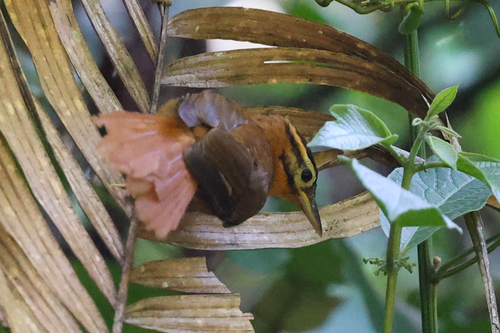 Black-capped Foliage-gleaner
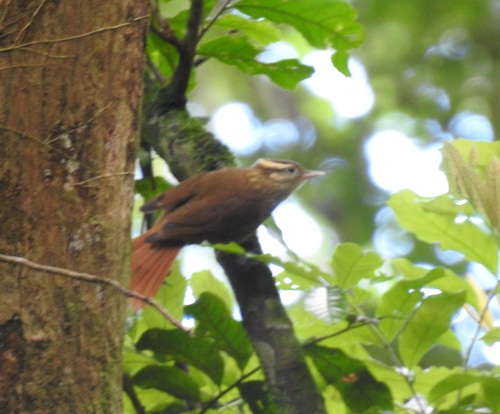 White-browed Foliage-gleaner
In short
The most reliable field mark between Black-capped and White-browed Foliage-gleaners is the dramatic facial pattern: Black-capped shows a bold, wide pale buff eyering and supercilium with a blackish-brown band behind the eye, while White-browed has a wide buff-white supercilium but a less contrasting, streaked face. Black-capped is slightly larger and richer rufous below, with a plain orange-rufous underbody, compared to the White-browed’s streaked, paler brown breast and creamy throat. In flight or perched, the Black-capped’s brighter orange-rufous tail and uppertail coverts stand out against the White-browed’s more subdued, rufescent brown tones. Both species have similar structure, but bill color and facial markings are key in binocular views.
Identification tips
- Facial pattern is the quickest separator: Black-capped shows a bold, wide pale buff eyering and supercilium (orange-rufous to rear), with a sharp blackish-brown band behind the eye and distinct pale buff ear coverts bordered by blackish-brown. White-browed’s supercilium is wide and buff-white, but the face is less sharply marked, with only a faint brown moustache and light flecking/streaking.
- Underparts coloration: Black-capped is plain, rich dark orange-rufous from throat through belly, with only slightly duller flanks. White-browed has a creamy whitish throat, a light brown breast with broad but blurry pale buff streaks, and an unstreaked light brown belly. If you see streaking on the breast, favor White-browed.
- Tail and uppertail coverts: Black-capped’s tail and uppertail coverts are bright orange-rufous, often looking more vibrant and uniform. White-browed’s tail is rufous but less bright, and the feather tips may show bare shafts, giving a slightly scruffier look.
- Crown and nape: Black-capped’s crown is dark brown with faint spots and central streaks; White-browed’s is brown, with black-edged white feathers at the center of the back and a narrow pale buff collar on the neck sides.
- Upperparts shade: Black-capped’s back is a richer rufous-brown, while White-browed’s is a more medium brown; uppertail coverts are brighter in Black-capped.
- Bill color: Black-capped has a blackish upper mandible and pale gray/greenish lower, while White-browed’s bill is pale horn with some pale gray. This is subtle but can help in good light.
- Juvenile/immature marks: If you see a bird with dark brown edges on the underparts’ feathers, it is a juvenile Black-capped. White-browed juveniles are not described but likely resemble adults.
- Breast pattern: Plain underparts (except for faint juvenile mottling) point to Black-capped; broad, blurry pale buff streaks on the breast point to White-browed.
- Throat color: Light orange-rufous throat in Black-capped vs. creamy whitish in White-browed.
- Leg color: Black-capped’s legs are paler ochre-yellow to olive-gray; White-browed’s are brownish cream to olive, but this is rarely visible in the field.
- Vocalization: If you hear a sharply descending trill of 6–8 high notes, it is Black-capped. Lack of vocal description for White-browed means silence is not diagnostic.
- Size and structure: Black-capped is slightly larger and longer, but this is not a reliable field mark unless both are together.
- Habitat: Both can occur in Atlantic Forest, but White-browed is more restricted to this biome; Black-capped may be found in a wider range, including adjacent regions.
- Wing pattern: No distinctive age-specific upperwing marks are described for either species; look to facial and underpart patterns instead.
- Context: If you are in mature, undisturbed Atlantic Forest, consider White-browed, but do not rely on habitat alone for separation.
Size
Black-capped Foliage-gleaner is marginally larger (16–17 cm, 22 g) than White-browed (15–16 cm, no mass given but slightly shorter in length). This difference is subtle in the field and not usually diagnostic unless both are seen side by side. Both are medium-sized foliage-gleaners with similar proportions.
Plumage
- Juvenile/immature marks: Black-capped juveniles are like adults but have dark brown edges on the underparts’ feathers, which may make the underparts look slightly more mottled; White-browed juveniles are not specifically described, but adults already have a streaked breast and flecked face, so immatures may appear similar to adults.
- Facial pattern: Black-capped has a very bold face: wide pale buff eyering, strong supercilium (orange-rufous to rear), blackish-brown post-ocular band, and pale buff ear coverts with blackish-brown borders. White-browed’s supercilium is buff-white and wide, but the face is less sharply marked, with a faint brown moustache and light streaking/flecking.
- Crown and nape: Black-capped’s crown is dark brown with faint spots and streaks; White-browed’s is brown with black-edged white feathers at the center of the back and a narrow pale buff collar extending onto the neck.
- Upperparts: Black-capped’s back is rich rufous-brown, rump paler but more rufous, and uppertail coverts bright orange-rufous. White-browed’s back is rich medium brown, rump slightly paler, uppertail coverts rufous but less bright.
- Tail: Black-capped’s tail is bright rufous; White-browed’s is rufous with bare shafts at the very end (may look more worn or pointed).
- Wings: Both species have rich brown wings, but Black-capped’s coverts are darker and the flight feathers have dark fuscous tips. White-browed’s wings are medium brown with darker primary coverts.
- Underparts: Black-capped is plain dark orange-rufous on breast and belly, with slightly duller flanks and bright rufous undertail coverts. White-browed has a creamy whitish throat, light brown breast with broad but blurry pale buff streaks, unstreaked light brown belly, and darker brown flanks/undertail coverts with a rufescent tinge.
- Bill, legs, eyes: Black-capped has a blackish maxilla and pale gray/greenish mandible; White-browed’s bill is pale horn with some pale gray. Leg and iris colors are similar, but Black-capped’s legs are paler ochre-yellow to olive-gray, White-browed’s are brownish cream to olive.
Behaviour
No strong behavioral differences are noted between these two species in the sources. Both are typical foliage-gleaners, foraging actively in dense foliage. No difference in flight style or foraging jizz is described.
Habitat
Both species occur in the Atlantic Forest region, but Black-capped ranges into Argentina, Brazil, and Paraguay, while White-browed is restricted to the Atlantic Forest. In areas of overlap, habitat is not a reliable separator, but White-browed may be more strictly tied to mature Atlantic Forest.
Voice
Black-capped’s song is a fast, sharply descending trill of 6–8 high notes, starting lower and ending slightly lower still. Its calls include squeaky notes, 'pit-wit', and a very high metallic 'zic'. No vocal description is provided for White-browed in the sources, so voice is only diagnostic if Black-capped’s distinctive song is heard.
Black-capped Foliage-gleaner · White-browed Foliage-gleaner · My Tricky Birds