

Barn Swallow vs Brown-throated Sunbird
Hirundo rustica versus Anthreptes malacensis
Play a quiz with Barn Swallow and Brown-throated Sunbird
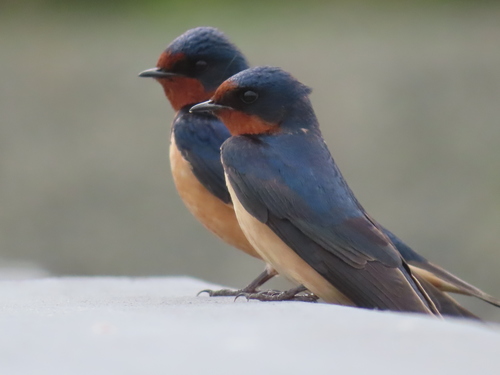 Barn Swallow
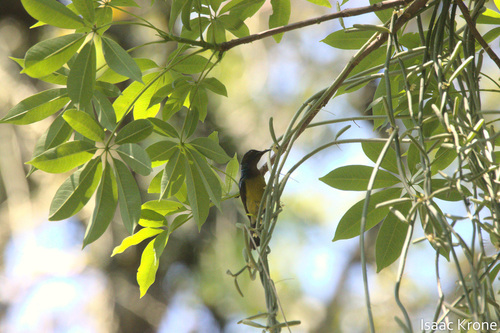 Brown-throated Sunbird
In short
The most reliable field mark is the Barn Swallow’s long, deeply forked tail with white spots and a rufous face, versus the Brown-throated Sunbird’s short, square tail and metallic green/purple upperparts. Juvenile Barn Swallows lack the long tail streamers but still show a pale rufous face and white underparts, while sunbirds never have a forked tail or rufous face. In flight, Barn Swallow shows pointed wings and a streamlined silhouette; the sunbird is more compact with a heavy bill and short wings. If you see a bird with a long, swallow-like tail and swift flight, it’s a Barn Swallow; a chunky, thick-billed, iridescent bird with yellow underparts is a Brown-throated Sunbird.
Identification tips
- Tail shape and length: Barn Swallow (adult) has a long, deeply forked tail with white spots near the tips; even juveniles have a slightly forked tail. Brown-throated Sunbird always has a short, square tail with no white spots.
- Upperwing and flight silhouette: Barn Swallow shows long, pointed wings and a streamlined, swift-flying shape. Sunbird is compact, with short, rounded wings and a heavy, decurved bill.
- Face and throat color: Barn Swallow (all ages) shows a rufous forehead, chin, and throat, separated from the underparts by a blue breast band. Sunbird never shows a rufous face; males have a metallic green/purple head, females are olive.
- Underparts: Barn Swallow has off-white (adult) or whiter (juvenile) underparts, with a clear blue breast band. Brown-throated Sunbird is always yellow below (both sexes), with no breast band.
- Bill shape: Barn Swallow has a short, broad bill suited for aerial insect catching. Brown-throated Sunbird has a long, thick, decurved bill for nectar feeding.
- Perched posture: Swallow perches upright on wires or exposed branches, often in groups. Sunbird perches singly or in pairs, often at flowers, and may briefly hover.
- Flight style: Swallow’s flight is fast, acrobatic, and sustained; sunbird’s is short, direct, and often between perches.
- Sexual dimorphism: Male Barn Swallow is glossy blue above with long tail streamers; female is duller with shorter streamers. Male Brown-throated Sunbird is iridescent green/purple above; female is olive-green above and yellow below.
- Juvenile confusion: Juvenile Barn Swallow lacks long tail streamers but still shows a pale rufous face and white underparts. Juvenile/immature sunbird is olive above, yellow below, and never has a rufous face or forked tail.
- Habitat context: Swallow is seen in open country, farmland, and near water, often on wires. Sunbird is found in gardens, forest edges, and semi-open habitats in Southeast Asia.
- Vocalization: Swallow gives sharp, varied calls, especially at colonies or when alarmed. Sunbird’s calls are softer, higher-pitched, and given from perches.
- Size impression: Swallow appears larger and more elongated due to tail and wings; sunbird is smaller, chunkier, and heavy-billed.
- Seasonal context: Swallow is migratory in many regions; sunbird is resident in Southeast Asia. Out of range, the ID is almost certain.
- Pitfalls: Juvenile swallows may appear shorter-tailed, but still show a rufous face and white underparts. Female sunbirds may look dull, but always lack the swallow’s tail and face pattern.
- Group behavior: Swallows often seen in flocks, especially in flight or on wires; sunbirds are more solitary or in pairs, usually near flowers.
Size
Barn Swallow is larger and more slender, measuring 17–19 cm in length (including tail streamers), with a wingspan of 32–34.5 cm and weighing 16–22 g [wikipedia]. Brown-throated Sunbird is much smaller and chunkier, about 14 cm long and 7.4–13.5 g [wikipedia]. The swallow’s long tail and wings exaggerate its size, while the sunbird appears compact and heavy-billed.
Plumage
- Juvenile/immature: Juvenile Barn Swallow is browner above, with a pale rufous face and white underparts, and lacks the long tail streamers of adults. The tail is still slightly forked but much shorter. Brown-throated Sunbird juveniles are not described in detail, but females and immatures are olive-green above and yellowish below, with no rufous face or forked tail.
- Adult male Barn Swallow: Steel blue upperparts, rufous forehead/throat, broad blue breast band, off-white underparts, and very long, deeply forked tail with white spots near the tips. Female similar but duller and with shorter tail streamers.
- Adult male Brown-throated Sunbird: Iridescent green and purple upperparts, chestnut on wing-coverts and scapulars, bright yellow below. Female is olive-green above and yellowish below, lacking the male’s iridescence.
- Key contrast: Only Barn Swallow has a rufous face and a blue breast band; only Barn Swallow has a forked tail with white spots. Sunbird never shows these features, instead showing metallic or olive upperparts and yellow underparts.
Behaviour
Barn Swallow is almost always seen in swift, acrobatic flight, catching insects on the wing, often over open fields or water, and perching on wires. Brown-throated Sunbird is more often seen perched, feeding on nectar or fruit, and moves in short hops or flights between flowers. Swallows rarely hover; sunbirds often do so briefly at flowers. Swallow’s flight is fast and direct with glides; sunbird’s flight is short and undulating.
Habitat
Barn Swallow is found in open country, farmland, and near water, often nesting on buildings or under eaves, and is widespread globally. Brown-throated Sunbird is restricted to Southeast Asia, found in semi-open habitats, gardens, and forest edges, and is not found in open fields or on wires. Seeing a bird in an urban garden or forest edge in Southeast Asia points to sunbird; open country or farmland anywhere else favors swallow.
Voice
Barn Swallow gives a variety of calls, including a witt or witt-witt, and a loud splee-plink when alarmed. Alarm calls include a sharp siflitt for mammals and flitt-flitt for raptors. Brown-throated Sunbird’s vocalizations are not described in detail here, but sunbirds typically give high-pitched, rapid twittering calls. In practice, Barn Swallow is more vocal in flight and at colonies, while sunbird calls are softer and given from perches.