

Bar-bellied Woodcreeper vs Red-billed Woodcreeper
Hylexetastes stresemanni versus Hylexetastes perrotii
Play a quiz with Bar-bellied Woodcreeper and Red-billed Woodcreeper
 Bar-bellied Woodcreeper
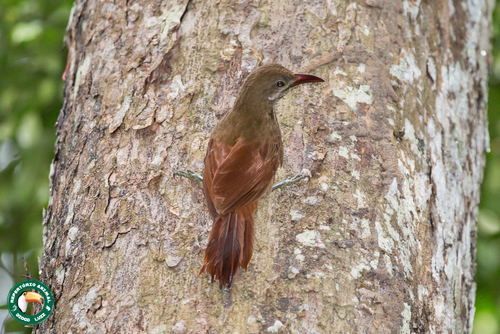 Red-billed Woodcreeper
In short
The most reliable field mark to separate Bar-bellied and Red-billed Woodcreepers is the underpart pattern: Bar-bellied shows fine blackish bars on the belly and undertail coverts (adults), while Red-billed is unbarred below, with a more uniform buffy or brown belly. Juvenile and immature birds of both species can show more streaking and barring, but Bar-bellied juveniles retain a mix of streaks and bars on the underparts, whereas Red-billed juveniles are more heavily barred and rufescent below. Structurally, both are large, heavy-bodied woodcreepers with short, massive bills, but the bill color and facial pattern are useful: Red-billed has a paler, wine-red to brownish bill and a contrasting white moustachial stripe, while Bar-bellied's bill is darker and its face is plainer. Both species overlap in size and shape, but their ranges are mostly allopatric, so location can help. Voice is only described for Red-billed, but is not a primary field mark for separation.
Identification tips
- Belly barring (adults): Bar-bellied Woodcreeper shows fine blackish bars on the olive belly and undertail coverts; Red-billed is unbarred below, with a more uniform buffy or brown belly. This is the most reliable mark in adults.
- Juvenile underparts: Juvenile Bar-bellied has a mix of streaks and bars on the throat and breast, while Red-billed juveniles are more heavily barred and rufescent below, with weak crown streaks. If you see extensive barring and a rufous wash below, suspect juvenile Red-billed.
- Facial pattern: Red-billed Woodcreeper has a distinct white moustachial stripe and whitish lores, giving a more marked face. Bar-bellied's face is plain except for paler lores, lacking a strong moustachial stripe in the nominate form (but note that H. s. insignis has a pale moustachial stripe, so this mark is less reliable in that subspecies).
- Bill color: Bar-bellied's bill is dark reddish to reddish brown; Red-billed's is paler, wine-red to brownish. Juvenile Red-billed has a dusky to blackish bill, while juvenile Bar-bellied's is more brownish.
- Throat and breast: Bar-bellied has a whitish, heavily streaked throat and an olive upper breast with pale, black-bordered streaks. Red-billed's throat is olive-brown with a paler center, and the breast is grayish brown without strong streaking.
- Upperparts: Both have brown to olive-brown heads and backs, but Bar-bellied can be more olive or rufous depending on subspecies. Red-billed's upperparts are smoky brown to olive-brown.
- Wings and tail: Both have rufous-chestnut wings and tail, with darker tips on the primaries. This is not a useful separation mark.
- Iris color: Both can show brown to reddish brown irises, but juvenile Red-billed has dark gray eyes.
- Legs and feet: Bar-bellied's are grayish green to dusky; Red-billed's are green or olive with some brown and gray. Not a strong field mark.
- Structure: Both are heavy-bodied with shortish tails and massive bills. Size is not a reliable separator, as measurements overlap.
- Range: If seen in western Amazonia (Bolivia, Peru, Ecuador, western Brazil, southern Colombia), Bar-bellied is expected. In the Guianas, Venezuela, or northern Brazil north of the Amazon, Red-billed is the likely species.
- Habitat: Both favor mature humid forest, but Red-billed is more sensitive to disturbance and rarely found in savanna (in Suriname only).
- Behavior: Red-billed is known to follow army ant swarms and can be seen lower in the forest when doing so. Bar-bellied's foraging behavior is less well described but is not known to differ markedly.
- Vocalization: Only Red-billed's song and calls are described, but unless you know Bar-bellied's voice, this is not a safe separator.
- Pitfalls: Subspecies of Bar-bellied (H. s. insignis) can show a pale moustachial stripe, resembling Red-billed's facial pattern. Always check underpart barring and range to confirm ID.
Size
Both species are among the largest woodcreepers, with considerable overlap in length and mass. Bar-bellied Woodcreeper is 28–30 cm long, males weighing 114–125 g and females about 100 g. Red-billed Woodcreeper is 25–30 cm long, with males 112–137.5 g and females 110–145 g. In practice, size alone is not diagnostic, as both are heavy-bodied with shortish tails and massive bills. Bar-bellied may average slightly longer, but this is not reliable in the field.
Plumage
- Juvenile/immature birds: Both species show more streaking and barring below than adults, but Bar-bellied juveniles have a mix of streaks and bars on the throat and breast, a more rufous back, and a brownish bill. Red-billed juveniles have weak crown streaks, are more heavily barred and rufescent below, and have a dusky to blackish bill and dark gray eyes.
- Adults: Bar-bellied Woodcreeper adults have brown to olive-brown upperparts, a plain face with only paler lores, and a whitish, heavily streaked throat. The upper breast is olive with pale, black-bordered streaks, the lower breast is plain olive, and the belly/undertail coverts are olive with thin blackish bars (the 'bar-bellied' mark). Red-billed adults have smoky brown to olive-brown upperparts, but with a distinct white moustachial stripe and whitish lores, an olive-brown throat with a paler center, grayish-brown breast, buffy brown belly, and undertail coverts brown with a rufescent cast—no barring below. Both have rufous-chestnut wings and tail, but Bar-bellied's are slightly darker-tipped. Bill color differs: Bar-bellied's is dark reddish to reddish brown, Red-billed's is wine-red to brownish.
Behaviour
Both species forage by climbing trunks and branches, often joining mixed-species flocks. Red-billed Woodcreeper is noted for following army ant swarms and foraging singly or in pairs, sometimes lower in the forest when attending ants. No unique behavioral differences are described for Bar-bellied. Both are typically seen in the interior of mature forests.
Habitat
Bar-bellied Woodcreeper occurs in western Amazonia (Bolivia, Brazil, Colombia, Ecuador, Peru) and is associated with humid lowland forests. Red-billed Woodcreeper is found in the northeastern Amazon Basin (Brazil north of the Amazon, French Guiana, Guyana, Suriname, Venezuela), favoring humid terra firme forest, but also gallery forest, várzea, and occasionally savanna (in Suriname). Both prefer primary forest interiors, but Red-billed is more sensitive to habitat modification and is generally rarer and more localized.
Voice
Only Red-billed Woodcreeper's vocalizations are described: a loud, ringing series of 2–6 whistles, sometimes disyllabic, and a variety of calls including 'screee-wip' and 'nyip, nyeek.' Bar-bellied's voice is not described in the sources provided, so vocalization is not a reliable field mark for separation.
Bar-bellied Woodcreeper · Red-billed Woodcreeper · My Tricky Birds