

Banded Bay Cuckoo vs Ashy-throated Warbler
Cacomantis sonneratii versus Phylloscopus maculipennis
Play a quiz with Banded Bay Cuckoo and Ashy-throated Warbler
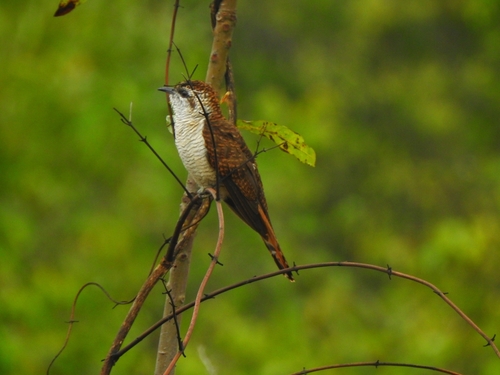 Banded Bay Cuckoo
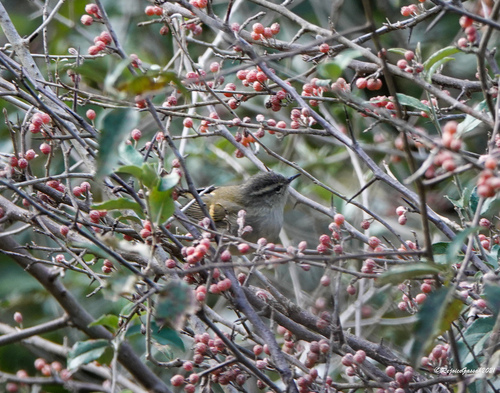 Ashy-throated Warbler
In short
The most reliable way to separate Banded Bay Cuckoo from Ashy-throated Warbler is by structure and overall coloration: the cuckoo is a much larger, long-tailed bird with a boldly barred rufous upperparts and a strong whitish supercilium, while the warbler is a tiny, greenish leaf warbler with a plain face and no barring. Juvenile cuckoos may show white-fringed upperparts, but even then, their size and long, graduated tail are unmistakable. In flight or perched, the cuckoo’s long, slightly curved bill and striking tail pattern (black subterminal band, white tips) contrast sharply with the warbler’s short bill and plain, rounded tail. If you hear a high-pitched, four-note whistle, it’s the cuckoo; the warbler’s vocalizations are much softer and less distinctive.
Identification tips
- Size and structure are the fastest checks: Banded Bay Cuckoo is much larger and bulkier, with a long, graduated tail and a noticeably long, slightly curved bill. Ashy-throated Warbler is tiny, with a short, fine bill and short, rounded tail. This difference is obvious even at a distance.
- Tail pattern: Cuckoo’s tail is long, with a dark brown center, a black subterminal band, and white tips—visible both perched and in flight. Warbler’s tail is plain and short, lacking any barring or color contrast.
- Supercilium and face: Banded Bay Cuckoo has a strong whitish supercilium above a dark eye-line, giving a striking "eyebrowed" look. Ashy-throated Warbler has a much weaker or absent supercilium and a plain face.
- Upperparts color and barring: Cuckoo is bright rufous or bay above, with broad dark barring. Warbler is greenish above, with no barring or rufous tones.
- Underparts: Cuckoo’s underparts are whitish with fine striations; warbler’s are plain pale, lacking striations.
- Bill color: Adult cuckoo has a black bill with a greenish-grey base to the lower mandible; juveniles have a paler lower mandible. Warbler’s bill is uniformly pale and much shorter.
- Juvenile marks: Young cuckoo shows white fringes to upper body feathers and a pale lower mandible, but remains much larger and more patterned than any warbler. No juvenile warbler can approach this appearance.
- Behavior: Cuckoo often perches openly and sings from exposed branches; warbler is almost always moving, flitting through leaves and rarely perching in the open.
- Flight style: Cuckoo’s flight is strong and direct; warbler’s is weak and fluttery.
- Voice: If you hear a loud, high-pitched four-note whistle, it is the cuckoo. Warbler’s song is much softer and less distinctive.
- Habitat context: Both can be in wooded hills, but cuckoo is more likely in well-wooded forests during monsoon, while warbler is a highland species, often in mixed flocks.
- Sexes and ages: Both species are sexually monomorphic, so sex does not help, but juvenile cuckoo is still much larger and more patterned than any warbler.
- Common pitfalls: The only real confusion arises if you see a small rufous bird briefly; but the cuckoo’s size, tail, and bold face pattern are always diagnostic. Warbler never shows barring, rufous, or a strong supercilium.
- Do not rely on host association: Both are insectivorous and can be seen foraging in similar ways, but the cuckoo’s size and behavior are distinctive.
- If in doubt: Focus on tail length and pattern, bill shape, and the presence or absence of barring and supercilium—these never overlap between these two species.
Size
Banded Bay Cuckoo is dramatically larger than Ashy-throated Warbler: the cuckoo measures about 22 cm in length (about the size of a small thrush), while the warbler is a tiny bird with a body mass of only 5.1 g ([wikidata]). The cuckoo’s long tail and larger bulk are obvious even at a distance or in flight. The warbler, by contrast, is a classic small leaf warbler, much more delicate and compact.
Plumage
- Juvenile/immature Banded Bay Cuckoo shows white fringes to the upper body feathers and a pale lower mandible, but retains the overall rufous and dark barring, supercilium, and long tail. No age of Ashy-throated Warbler shows any barring, rufous tones, or supercilium as bold as the cuckoo’s.
- Adult Banded Bay Cuckoo is bright rufous or bay above, heavily barred with dark brown, with a strong whitish supercilium and a dark eye-line. The tail is graduated, with a dark brown center, a black subterminal band, and white tips. Underparts are whitish with fine striations. Sexes are alike.
- Ashy-throated Warbler is greenish above, with a plain or subtly marked face, lacking any strong supercilium, barring, or rufous coloration. The underparts are pale, but not striated, and the tail is short and plain.
- At all ages and seasons, the cuckoo’s bold pattern and structure are diagnostic against the plain, small warbler.
Behaviour
Banded Bay Cuckoo often perches openly on exposed branches, especially when singing, and may sally out for insects or glean from foliage. Its movements are deliberate, befitting its larger size. Ashy-throated Warbler is much more active and restless, typically flitting through foliage, gleaning insects in classic warbler fashion, and rarely perching in the open for long. The cuckoo’s flight is more direct and powerful, while the warbler’s is fluttery and weak.
Habitat
Both species can occur in wooded areas, but context helps: Banded Bay Cuckoo favors well-wooded forests, mainly in lower hills, and is often found during the monsoon in India. Ashy-throated Warbler is a bird of the Himalayas and adjacent regions, typically in montane forests. If you are in dense hill forest during the monsoon and see a boldly marked, rufous, long-tailed bird, cuckoo is likely; a tiny, greenish, active bird in the same habitat is more likely the warbler.
Voice
Banded Bay Cuckoo’s call is a distinctive, high-pitched four-note whistle, described as "wee-ti wee-tee" or "smoke-yer-pepper," with each note falling in pitch ([wikipedia]). This is loud and carries well. Ashy-throated Warbler’s vocalizations are much softer, typical of leaf warblers, and lack the cuckoo’s distinctive pattern and volume.