

Motmot

Band-rumped Storm-Petrel vs Matsudaira's Storm-Petrel

Hydrobates castro versus Hydrobates matsudairae

Play a quiz with Band-rumped Storm-Petrel and Matsudaira's Storm-Petrel
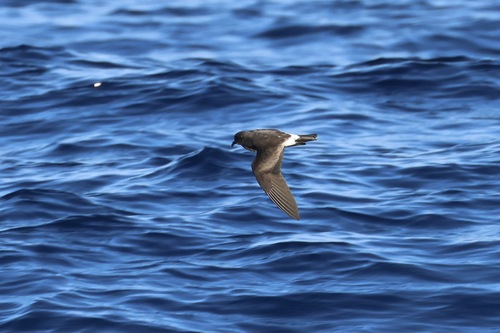
Band-rumped Storm-Petrel (Hydrobates castro) Band-rumped Storm-Petrel
Matsudaira's Storm-Petrel (Hydrobates matsudairae) Matsudaira's Storm-Petrel

Media

Loading…

In short

The most reliable field mark to separate Band-rumped Storm-Petrel from Matsudaira's Storm-Petrel is the presence of an extensive white rump on Band-rumped, versus the all-dark appearance of Matsudaira's, which lacks a white rump and instead shows blackish alula feathers and white bases to the primaries. Matsudaira's also stands out with a longer, deeply forked tail and a notably hooked bill, while Band-rumped has a shorter, less deeply forked tail and a more typical storm-petrel bill. In flight, Band-rumped tends to look more 'shearwater-like,' while Matsudaira's shows a long, forked tail and distinctive wing pattern. These marks are visible in all plumages, but especially important for immatures and birds seen in flight.

Identification tips

  1. White rump (Band-rumped) vs. all-dark (Matsudaira's): Band-rumped Storm-Petrel always shows a broad, clean white rump patch, visible in all ages and especially obvious in flight. Matsudaira's is entirely dark with no white rump at any age.
  2. Upperwing pattern: Matsudaira's has blackish alula feathers and white bases to the primaries, creating a subtle pale panel on the upperwing, best seen in good light. Band-rumped lacks this contrast and appears more uniformly dark above, aside from the white rump.
  3. Tail shape: Matsudaira's Storm-Petrel has a long, deeply forked tail, giving a more 'swallow-like' or 'tern-like' silhouette. Band-rumped's tail is shorter and less deeply forked, appearing more squared-off or only slightly notched.
  4. Bill shape: Matsudaira's has a noticeably long bill with a pronounced hook at the tip, which can be seen at close range or in good photos. Band-rumped's bill is shorter and less strongly hooked, typical for storm-petrels.
  5. Flight style: Band-rumped tends to fly with a steady, direct, 'shearwater-like' action, while Matsudaira's may look more buoyant or elongated due to its long tail, though detailed differences are subtle at sea.
  6. Overall color impression: Band-rumped is brownish-black with a white rump; Matsudaira's is more uniformly blackish, especially on the upperparts and tail.
  7. No age-specific confusion: Both species retain their key field marks (white rump vs. all-dark) throughout all plumages; there are no noted juvenile or immature-specific differences in upperwing or rump pattern.
  8. Geographic context: If seen in the Atlantic, Band-rumped is vastly more likely; Matsudaira's is restricted to the NW Pacific and Indian Ocean. Out-of-range records are extremely rare for both.
  9. Breeding context: Band-rumped is strictly nocturnal at colonies; Matsudaira's breeding behavior is not detailed but is limited to remote islands.
  10. On-water appearance: Both species sit low on the water, but Matsudaira's longer tail may project further behind when at rest.
  11. No vocalization cues: There are no field-identifiable vocal differences noted for these two species.
  12. No seasonal or sex-based confusion: Neither species is sexually dimorphic or shows seasonal changes that would affect these key field marks.
  13. Pitfalls: In poor light or distant views, the white rump of Band-rumped may be missed, and Matsudaira's subtle wing panel may not be visible. Always look for the combination of rump color and tail shape.
  14. Bill and tail combination: The combination of a long, hooked bill and deeply forked tail is unique to Matsudaira's among these two; Band-rumped lacks both features.
  15. Do not confuse with Leach's Storm-Petrel: Both species can be confused with Leach's, but Leach's has a more deeply forked tail than Band-rumped and a different rump shape; Matsudaira's is even more deeply forked and lacks the white rump entirely.

Size

Band-rumped Storm-Petrel is 19–21 cm in length with a 43–46 cm wingspan and weighs 44–49 g [wikipedia]. Matsudaira's Storm-Petrel is similar in overall size, but the notes do not provide precise measurements for direct comparison. Structurally, Matsudaira's appears longer-tailed and more elongated due to its deeply forked tail and long bill, which can make it look slightly larger or more attenuated in flight, even if body size is similar.

Plumage

For all ages, Band-rumped Storm-Petrel shows a prominent white rump contrasting with otherwise brownish-black plumage. This white rump is broad and wraps onto the sides, visible in flight and often from above or behind. Matsudaira's Storm-Petrel, in contrast, is entirely dark with no white rump. Instead, it has blackish alula feathers and white bases to the primaries, which may create a subtle pale panel on the upperwing, especially in good light. The tail of Matsudaira's is long and deeply forked, accentuating the dark, elegant look. These differences are consistent across ages; there are no notes indicating age-specific variation in upperwing or rump pattern for either species.

Behaviour

Band-rumped Storm-Petrel typically exhibits a more 'shearwater-like' flight, with steady, direct movements and less erratic fluttering. Matsudaira's Storm-Petrel, with its long, deeply forked tail, may appear more buoyant or tern-like, but the notes do not provide a detailed comparison of flight style beyond these general impressions. On land, both are rarely seen except near breeding colonies, where Band-rumped is strictly nocturnal to avoid predation.

Habitat

Band-rumped Storm-Petrel breeds on islands in the warmer Atlantic and Pacific, including the Azores, Madeira, Canary Islands, Saint Helena, and parts of the Pacific (Japan, Hawaii, Galápagos). Matsudaira's Storm-Petrel breeds only in the Volcano Islands (NW Pacific) and winters in the Indian Ocean. Thus, Band-rumped is more likely in the Atlantic or eastern Pacific, while Matsudaira's is a NW Pacific/Indian Ocean specialty. Overlap is extremely unlikely except as rare vagrants.

Submit a better description

Use the same sections as the comparison. Your text is published immediately.

The most reliable field mark to separate Band-rumped Storm-Petrel from Matsudaira's Storm-Petrel is the presence of an extensive white rump on Band-rumped, versus the all-dark appearance of Matsudaira's, which lacks a white rump and instead shows blackish alula feathers and white bases to the primaries. Matsudaira's also stands out with a longer, deeply forked tail and a notably hooked bill, while Band-rumped has a shorter, less deeply forked tail and a more typical storm-petrel bill. In flight, Band-rumped tends to look more 'shearwater-like,' while Matsudaira's shows a long, forked tail and distinctive wing pattern. These marks are visible in all plumages, but especially important for immatures and birds seen in flight.

  1. White rump (Band-rumped) vs. all-dark (Matsudaira's): Band-rumped Storm-Petrel always shows a broad, clean white rump patch, visible in all ages and especially obvious in flight. Matsudaira's is entirely dark with no white rump at any age.
  2. Upperwing pattern: Matsudaira's has blackish alula feathers and white bases to the primaries, creating a subtle pale panel on the upperwing, best seen in good light. Band-rumped lacks this contrast and appears more uniformly dark above, aside from the white rump.
  3. Tail shape: Matsudaira's Storm-Petrel has a long, deeply forked tail, giving a more 'swallow-like' or 'tern-like' silhouette. Band-rumped's tail is shorter and less deeply forked, appearing more squared-off or only slightly notched.
  4. Bill shape: Matsudaira's has a noticeably long bill with a pronounced hook at the tip, which can be seen at close range or in good photos. Band-rumped's bill is shorter and less strongly hooked, typical for storm-petrels.
  5. Flight style: Band-rumped tends to fly with a steady, direct, 'shearwater-like' action, while Matsudaira's may look more buoyant or elongated due to its long tail, though detailed differences are subtle at sea.
  6. Overall color impression: Band-rumped is brownish-black with a white rump; Matsudaira's is more uniformly blackish, especially on the upperparts and tail.
  7. No age-specific confusion: Both species retain their key field marks (white rump vs. all-dark) throughout all plumages; there are no noted juvenile or immature-specific differences in upperwing or rump pattern.
  8. Geographic context: If seen in the Atlantic, Band-rumped is vastly more likely; Matsudaira's is restricted to the NW Pacific and Indian Ocean. Out-of-range records are extremely rare for both.
  9. Breeding context: Band-rumped is strictly nocturnal at colonies; Matsudaira's breeding behavior is not detailed but is limited to remote islands.
  10. On-water appearance: Both species sit low on the water, but Matsudaira's longer tail may project further behind when at rest.
  11. No vocalization cues: There are no field-identifiable vocal differences noted for these two species.
  12. No seasonal or sex-based confusion: Neither species is sexually dimorphic or shows seasonal changes that would affect these key field marks.
  13. Pitfalls: In poor light or distant views, the white rump of Band-rumped may be missed, and Matsudaira's subtle wing panel may not be visible. Always look for the combination of rump color and tail shape.
  14. Bill and tail combination: The combination of a long, hooked bill and deeply forked tail is unique to Matsudaira's among these two; Band-rumped lacks both features.
  15. Do not confuse with Leach's Storm-Petrel: Both species can be confused with Leach's, but Leach's has a more deeply forked tail than Band-rumped and a different rump shape; Matsudaira's is even more deeply forked and lacks the white rump entirely.

Band-rumped Storm-Petrel is 19–21 cm in length with a 43–46 cm wingspan and weighs 44–49 g [wikipedia]. Matsudaira's Storm-Petrel is similar in overall size, but the notes do not provide precise measurements for direct comparison. Structurally, Matsudaira's appears longer-tailed and more elongated due to its deeply forked tail and long bill, which can make it look slightly larger or more attenuated in flight, even if body size is similar.

For all ages, Band-rumped Storm-Petrel shows a prominent white rump contrasting with otherwise brownish-black plumage. This white rump is broad and wraps onto the sides, visible in flight and often from above or behind. Matsudaira's Storm-Petrel, in contrast, is entirely dark with no white rump. Instead, it has blackish alula feathers and white bases to the primaries, which may create a subtle pale panel on the upperwing, especially in good light. The tail of Matsudaira's is long and deeply forked, accentuating the dark, elegant look. These differences are consistent across ages; there are no notes indicating age-specific variation in upperwing or rump pattern for either species.

Band-rumped Storm-Petrel typically exhibits a more 'shearwater-like' flight, with steady, direct movements and less erratic fluttering. Matsudaira's Storm-Petrel, with its long, deeply forked tail, may appear more buoyant or tern-like, but the notes do not provide a detailed comparison of flight style beyond these general impressions. On land, both are rarely seen except near breeding colonies, where Band-rumped is strictly nocturnal to avoid predation.

Band-rumped Storm-Petrel breeds on islands in the warmer Atlantic and Pacific, including the Azores, Madeira, Canary Islands, Saint Helena, and parts of the Pacific (Japan, Hawaii, Galápagos). Matsudaira's Storm-Petrel breeds only in the Volcano Islands (NW Pacific) and winters in the Indian Ocean. Thus, Band-rumped is more likely in the Atlantic or eastern Pacific, while Matsudaira's is a NW Pacific/Indian Ocean specialty. Overlap is extremely unlikely except as rare vagrants.

Discard your changes?

You have unsaved edits. If you leave now, those changes will be lost.

Band-rumped Storm-Petrel · Matsudaira's Storm-Petrel · My Tricky Birds