

Asian Palm Swift vs Blue-throated Barbet
Cypsiurus balasiensis versus Psilopogon asiaticus
Play a quiz with Asian Palm Swift and Blue-throated Barbet
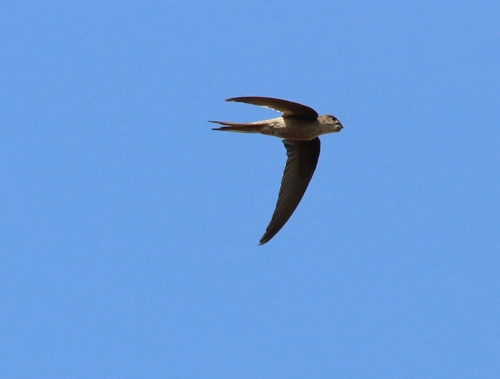 Asian Palm Swift
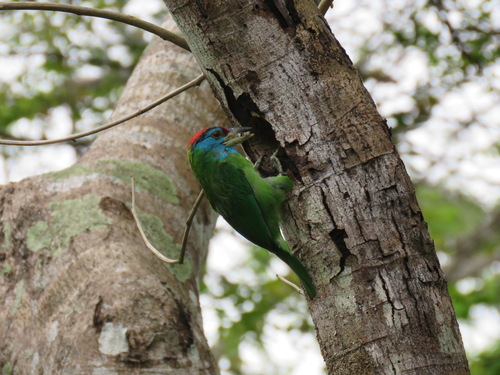 Blue-throated Barbet
In short
The most reliable way to separate Asian Palm Swift from Blue-throated Barbet is by overall structure and behavior: Asian Palm Swift is a tiny, slender, crescent-winged aerialist with a long, deeply forked tail, always seen in flight or clinging to vertical surfaces, while Blue-throated Barbet is a chunky, short-tailed, green bird that perches upright in trees and rarely flies for long. Swifts are uniformly pale brown and never show the bright green, blue, and red head pattern of the barbet. If you see a bird with a stocky body, large head, and colorful face perched in a fruiting tree, it is the barbet; a slim, boomerang-winged bird scything through the air is the swift. Juvenile swifts have shorter tails but still lack any green or facial color. Calls are also distinctive: the swift gives a shrill scream, while the barbet produces repetitive, loud, frog-like notes.
Identification tips
- Flight vs. Perched Posture: Asian Palm Swift is almost always seen in flight or clinging vertically to surfaces; it never perches upright on branches. Blue-throated Barbet is typically perched upright in trees, rarely seen in sustained flight.
- Overall Structure: Swifts are slim, long-winged, and long-tailed with a deeply forked tail (shorter in juveniles); barbets are chunky, short-tailed, and big-headed.
- Wing Shape in Flight: Swifts show long, narrow, crescent-shaped wings; barbets have short, rounded wings and undulating flight.
- Tail Shape: Swifts have a long, deeply forked tail (less so in juveniles), usually held closed; barbets have a short, squared tail.
- Plumage Color: Swifts are plain pale brown with no facial or body color; barbets are bright green with a red and blue head (duller in juveniles but still patterned).
- Head Pattern: Barbets show a red forehead, black crown stripe, blue face and chin, and red neck patches; swifts have no head pattern at any age.
- Bill Shape: Swifts have a tiny, flat bill adapted for aerial insect-catching; barbets have a large, stout, conical bill suited for fruit and insects.
- Legs and Feet: Swifts have very short legs, used only for clinging; barbets have strong feet for perching and climbing.
- Voice: Swifts emit a shrill scream in flight; barbets call loudly and repetitively from perches with frog-like notes.
- Habitat: Swifts are common in open areas, especially near palms; barbets are found in forested areas with fruiting trees, rarely in palm plantations.
- Feeding Behavior: Swifts feed on insects caught in flight, often low over fields; barbets eat fruit and some insects, usually while perched.
- Juvenile Confusion: Young swifts have shorter tails but remain plain brown; juvenile barbets are duller but still green with a patterned head.
- Size: Swifts are much smaller and lighter (9.2 g, 13 cm) than barbets (79–103 g, 19–22 cm); even at a distance, the size difference is striking.
- Nesting: Swifts glue nests under palm leaves; barbets excavate holes in tree trunks or branches.
- Contextual Clues: A bird seen flying rapidly, never perching, in open country is almost certainly a swift; a bird sitting quietly in a fruiting tree, calling loudly, is a barbet.
Size
Asian Palm Swift is dramatically smaller and lighter: about 9.2 g in mass and 13 cm in length, with a very slender build. Blue-throated Barbet is much larger and heavier (19–22 cm long, 79–103 g), with a stocky, robust body and a large head. Even at a distance, the barbet appears bulkier and more compact, while the swift looks needle-thin and elongated.
Plumage
Juvenile and adult Asian Palm Swifts are mainly pale brown all over, with no strong pattern except a long, deeply forked tail (shorter in juveniles). Their wings are long, narrow, and swept back, giving a crescent or boomerang shape in flight. There is no contrast or color on the face or underparts. In contrast, Blue-throated Barbet of all ages is bright green with a short tail and a strikingly colorful head: adults show a bright red forehead and rear crown, black crown stripe, pale blue face, chin, and upper neck, and red patches at the base of the blue. Juveniles are similar but duller, with muted reds and blues and dusky or blue-black crown stripes. The barbet's underparts are lighter yellow-green, and the underside of the tail may have a bluish cast. No age or season of the swift ever shows green, blue, or red plumage.
Behaviour
Asian Palm Swifts spend nearly their entire lives in the air, feeding, drinking, and even mating on the wing; they only cling vertically to palm leaves or similar surfaces and never perch upright on branches. Their flight is fast, agile, and highly maneuverable, often low over open areas or near palms. Blue-throated Barbets are arboreal and sedentary, usually seen perched upright in trees, especially at fruiting trees. Their flight is noisy and undulating, with bursts of wingbeats and glides, but they spend most of their time sitting, feeding, or calling from a perch. Barbets excavate nest holes in trees, while swifts glue nests under palm leaves.
Habitat
Asian Palm Swift is strongly associated with open country and cultivation, especially near oil palms, and is often seen flying low over open areas or plantations. Blue-throated Barbet inhabits lowland and montane forests (200–2,000 m), favoring areas with fruiting trees, including evergreen and deciduous forests, secondary growth, and sometimes urban parks with suitable trees. Barbets are uncommon in oil plantations, where swifts thrive. Thus, a bird seen in open, palm-rich habitat is likely a swift; one in dense, fruiting forest or canopy is likely a barbet.
Voice
Asian Palm Swift gives a loud, shrill scream, typical of swifts and heard while in flight. Blue-throated Barbet is very vocal, with loud, repetitive, frog-like calls described as 'took-a-rook', 'pu-ku-ruk', or 'kut-ru-uk', repeated rapidly (90–105 times per minute) throughout the day. The barbet's call is often the best clue to its presence, as its green plumage is well-camouflaged in foliage.