

Asian Emerald Dove vs Little Green-Pigeon
Chalcophaps indica versus Treron olax
Play a quiz with Asian Emerald Dove and Little Green-Pigeon
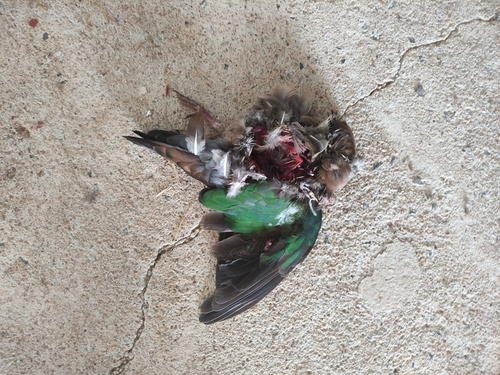 Asian Emerald Dove
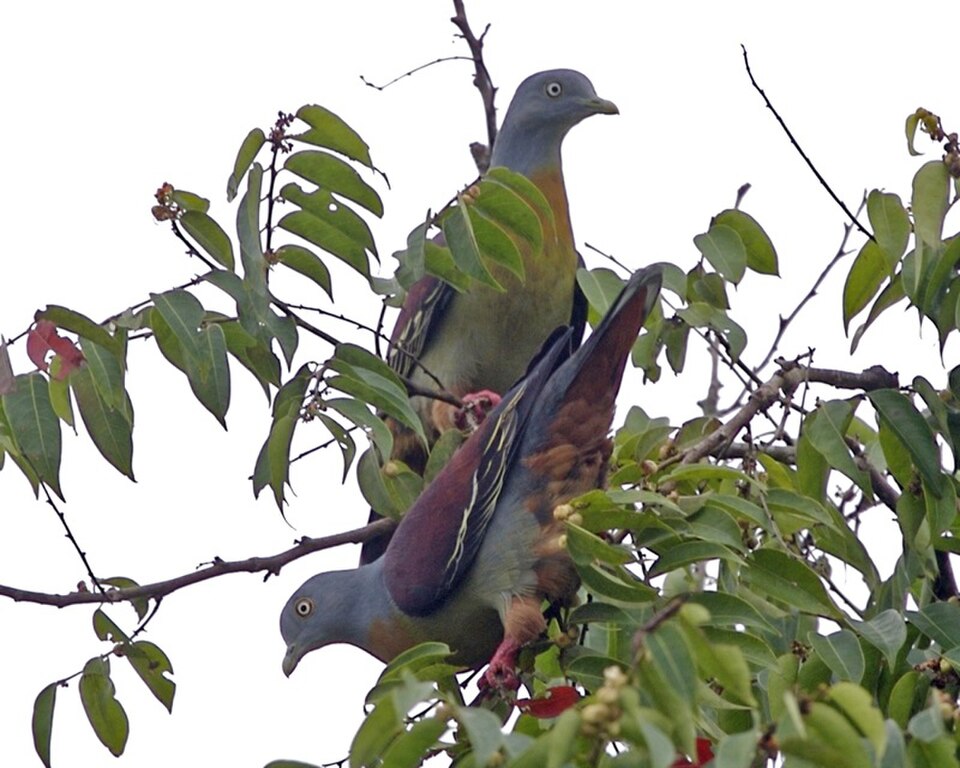 Little Green-Pigeon
In short
The most reliable field mark between Asian Emerald Dove and Little Green-Pigeon is the presence of bright emerald green upperwings and back in the Emerald Dove, contrasted with the more uniformly olive-green upperparts of the Little Green-Pigeon. In flight, the Emerald Dove shows bold black and white bars on the lower back and blackish flight feathers, while the Little Green-Pigeon lacks these contrasting patterns. Structure also differs: Emerald Dove is stockier with a bright red bill and rufous legs, while Little Green-Pigeon is slimmer and lacks the red bill. Sexually dimorphic plumage in Little Green-Pigeon (males with orange neck patch and maroon mantle) is never matched by Emerald Dove. Immature Emerald Doves have brown scalloping, which is not seen in Little Green-Pigeon. Both species can be found in dense forests, but their ranges only overlap in parts of Southeast Asia.
Identification tips
- Upperwing and Back in Flight (All Ages): Look for the Emerald Dove's bright emerald green back and wings, with blackish flight feathers and bold black and white bars on the lower back—these are visible in flight and never shown by Little Green-Pigeon.
- Juvenile Scalloping (Emerald Dove): Immature Emerald Doves have brown scalloping on body and wing plumage, a feature not present in Little Green-Pigeon of any age.
- Size and Structure: Emerald Dove is stockier and slightly larger (23–27 cm) than the slimmer, smaller Little Green-Pigeon (21–22 cm). This is subtle but useful with experience.
- Bill Color: Emerald Dove has a bright red bill, visible at close range or in good light; Little Green-Pigeon does not.
- Leg Color: Emerald Dove's legs and feet are rufous; this is not a mark for Little Green-Pigeon.
- Male Plumage (Little Green-Pigeon): Male Little Green-Pigeon has a distinctive orange neck patch blending into yellow underparts and a maroon mantle—never matched by Emerald Dove.
- Female Plumage: Female Emerald Dove is browner with a grey mark on the shoulder and lacks the white shoulder patch of the male. Female Little Green-Pigeon is olive-green above and yellow below, lacking maroon or orange.
- Crown Color (Emerald Dove Male): Male Emerald Dove has a grey crown, which is not seen in Little Green-Pigeon.
- Shoulder Patch: Male Emerald Dove shows a white patch on the edge of the shoulders; absent in Little Green-Pigeon.
- Ground vs Tree Foraging: Emerald Dove is often seen walking on the ground, while Little Green-Pigeon is almost always in trees.
- Flight Style: Emerald Dove flies low and directly through forest, sometimes weaving; Little Green-Pigeon is more likely to move from tree to tree.
- Vocalization: If you hear a soft, rising coo or 'hoo-hoo-hoon,' it is Emerald Dove; Little Green-Pigeon is not described as vocal in these notes.
- Habitat Context: If seen in mangroves or on farmland, Emerald Dove is more likely; Little Green-Pigeon is more strictly a forest canopy bird.
- Sexual Dimorphism: Only Little Green-Pigeon shows strong male-female differences in color (maroon and orange in males); Emerald Dove's sexes are more subtly different.
- Approachability: Emerald Dove is often tame and approachable, sometimes walking away from disturbance rather than flushing; Little Green-Pigeon is more likely to flush from the canopy.
Size
Asian Emerald Dove is slightly larger and stockier, measuring 23–27 cm in length, while Little Green-Pigeon is smaller at 21–22 cm. This difference is subtle but can be noticeable with direct comparison or experience. The Emerald Dove also appears more robust and compact, whereas the Little Green-Pigeon is slimmer and more delicate in build. Bill color is a useful structural cue: Emerald Dove has a bright red bill, while Little Green-Pigeon does not.
Plumage
- Juvenile/Immature: Immature Emerald Doves resemble females but have distinctive brown scalloping on their body and wing plumage. Little Green-Pigeon immatures are not described as having such scalloping; their upperparts remain more uniformly olive.
- Adult Male: Emerald Dove males have a grey crown and a white patch on the shoulder, with bright emerald green back and wings. Little Green-Pigeon males have an orange neck patch blending into a yellow underside and a maroon mantle, which are absent in Emerald Dove.
- Adult Female: Female Emerald Doves lack the white shoulder patch and have a browner, slightly greyer head. Female Little Green-Pigeons are olive-green above and yellow below, lacking the maroon and orange of the male.
- In Flight: Emerald Dove shows blackish flight feathers and tail, with broad black and white bars on the lower back—these are visible in flight and diagnostic. Little Green-Pigeon does not show such contrasting wing or back patterns in flight, appearing more uniform.
- Bill and Legs: Emerald Dove has a bright red bill and rufous legs; Little Green-Pigeon lacks these colors.
Behaviour
Emerald Dove is often seen walking on the ground searching for fallen fruit and is generally tame and approachable, frequently walking away when disturbed rather than flying immediately. Its flight is fast, direct, and low, weaving through dense forest patches. Little Green-Pigeon, like other Treron species, is more arboreal, typically foraging in trees for fruit and less likely to be seen walking on the ground. Both species are frugivorous, but their foraging behavior differs, with Emerald Dove more terrestrial.
Habitat
Both species inhabit dense, moist lowland forests, but Emerald Dove is more widespread, ranging from the Indian subcontinent through Southeast Asia, including mangroves and even farms. Little Green-Pigeon is more restricted to Brunei, Indonesia, Malaysia, Singapore, and Thailand. Where ranges overlap, both may occur in similar forest habitats, but Emerald Dove is more likely to be encountered on or near the ground, while Little Green-Pigeon is more strictly arboreal.
Voice
Emerald Dove gives a low, soft, moaning coo of about six to seven notes, starting quietly and rising, as well as a nasal 'hoo-hoo-hoon.' No distinctive vocalization is described for Little Green-Pigeon in these notes, so voice is not a reliable separator unless the Emerald Dove's call is heard.