

Ashy Drongo vs Hair-crested Drongo
Dicrurus leucophaeus versus Dicrurus hottentottus
Play a quiz with Ashy Drongo and Hair-crested Drongo
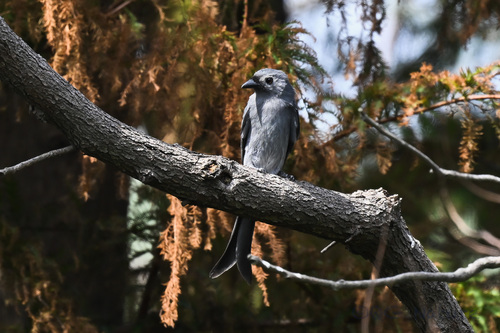 Ashy Drongo
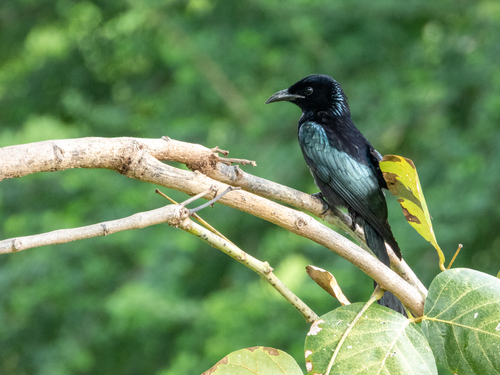 Hair-crested Drongo
In short
The most reliable way to separate Ashy Drongo from Hair-crested Drongo is by overall color and structure: Ashy Drongo is a slimmer, mainly dark grey bird (sometimes with white facial markings), while Hair-crested Drongo is much heavier-bodied and typically glossier black. Ashy Drongo’s tail is long, deeply forked, and less splayed than Hair-crested, and it sits very upright when perched. Juvenile Ashy Drongos are dull brownish-grey, never glossy, while Hair-crested Drongo is consistently blackish. If you see a drongo with a white eye-patch or pale face, it is an Ashy Drongo. In flight, Ashy Drongo looks more slender and lacks the heavy, crested look of Hair-crested.
Identification tips
- Overall color: Ashy Drongo is dark grey (sometimes very dark, but never truly black), while Hair-crested Drongo is glossy black. This is the most consistent field mark for adults.
- Facial markings: If you see a white patch around the eye or on the face, it is Ashy Drongo (not all Ashy Drongos have this, but Hair-crested Drongo never does).
- Tail shape: Ashy Drongo’s tail is long, deeply forked, and less splayed than Hair-crested Drongo. Hair-crested’s tail is also long and forked but appears heavier and more splayed.
- Structure: Ashy Drongo is slimmer and more delicate, with a lighter build and shorter legs. Hair-crested Drongo is much bulkier and heavier-bodied.
- Perched posture: Ashy Drongo sits very upright and often perches high and prominently; Hair-crested Drongo is heavier and may not appear as upright.
- Juvenile plumage: Young Ashy Drongos are dull brownish-grey, never blackish or glossy. If you see a brownish immature drongo, it is Ashy Drongo. Hair-crested Drongo immatures are not described as brownish.
- Gloss: Ashy Drongo lacks the blue-black gloss of Hair-crested Drongo. If the bird looks glossy or spangled, it is not Ashy Drongo.
- Iris color: Ashy Drongo has a crimson iris (at least in the Indian longicaudatus group), while iris color for Hair-crested Drongo is not described; use with caution.
- White rictal spot: Ashy Drongo lacks a white rictal spot; not described for Hair-crested Drongo, so not strongly diagnostic.
- Flight silhouette: Ashy Drongo appears more slender and less crested in flight, with a longer, narrower tail. Hair-crested Drongo looks heavier and may show a more crested outline.
- Voice: If you hear a nasal, twangy 'drangh gip' or mimicry of other birds, it is likely Ashy Drongo. Hair-crested Drongo’s voice is not described here.
- Habitat: In hill forests, especially in winter or migration, Ashy Drongo is more likely. Hair-crested Drongo’s habitat is not specified, so use this only as supporting evidence.
- Group size: Ashy Drongo is usually seen singly or in small groups, sometimes in small flocks on migration. Hair-crested Drongo’s social habits are not described, so this is only weakly diagnostic.
- Size impression: If the bird appears very robust and heavy, suspect Hair-crested Drongo; if slim and delicate, suspect Ashy Drongo.
- Beware subspecies variation: Some Ashy Drongos (e.g., longicaudatus) are very dark and can look almost black, but always check for slimmer build, lack of gloss, and possible white facial markings.
Size
Ashy Drongo is significantly lighter (38g) than Hair-crested Drongo (77g) [wikidata], making the latter nearly twice as heavy. This size difference is often evident in the field: Hair-crested Drongo appears bulkier and more robust, while Ashy Drongo is noticeably slimmer and more delicate overall. Tail length is long in both, but Ashy Drongo’s is proportionally longer and less splayed.
Plumage
- Juvenile/immature birds: Ashy Drongo immatures are dull brownish-grey, lacking any gloss, while Hair-crested Drongo immatures are not described as brownish and are generally blackish from an early age. No distinctive upperwing pattern is noted for either species in the sources.
- Adults: Ashy Drongo is mainly dark grey (shade varies by subspecies), sometimes with white patches around the eye or face (notably in some SE Asian forms). Its tail is long, deeply forked, and less splayed than Hair-crested. Hair-crested Drongo is glossy black overall, with a heavier, more robust appearance and a distinctive 'hair-crested' look (not described in detail in the sources, but implied by the name and contrast with Ashy Drongo). Ashy Drongo lacks the blue-black gloss of Hair-crested and never appears truly black.
- Facial markings: Only Ashy Drongo shows white on the face or around the eye in some subspecies; Hair-crested Drongo never does.
Behaviour
Ashy Drongo tends to perch very upright and prominently, often high in trees, and forages by sallying out for insects or gleaning from trunks. It is usually seen singly, in pairs, or small groups, and migratory populations may form small flocks. Hair-crested Drongo’s behavior is not detailed in the sources, but it is generally more robust and may appear heavier in flight and at rest.
Habitat
Ashy Drongo favors tall forests and is especially fond of hill forests in winter. It is more likely to be found in upland or forested habitats, especially during migration. Hair-crested Drongo’s habitat is not described in the provided notes, so habitat is only weakly diagnostic unless you are in a known Ashy Drongo wintering area.
Voice
Ashy Drongo’s call is described as a nasal, twangy 'drangh gip' or 'gip-gip-drangh.' It is also a skilled mimic, sometimes imitating the whistling notes of other birds such as the common iora. No vocal details are given for Hair-crested Drongo in the sources, so voice is only helpful if you hear the distinctive Ashy Drongo call or mimicry.