

Amethyst-throated Sunangel vs Tourmaline Sunangel
Heliangelus amethysticollis versus Heliangelus exortis
Play a quiz with Amethyst-throated Sunangel and Tourmaline Sunangel
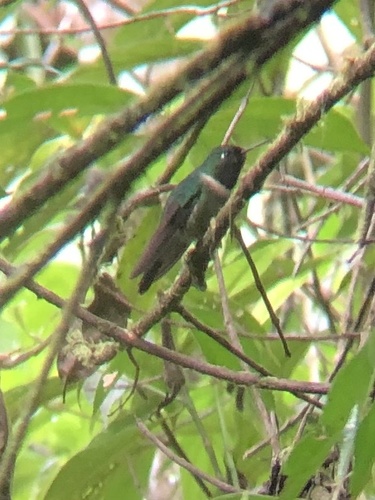 Amethyst-throated Sunangel
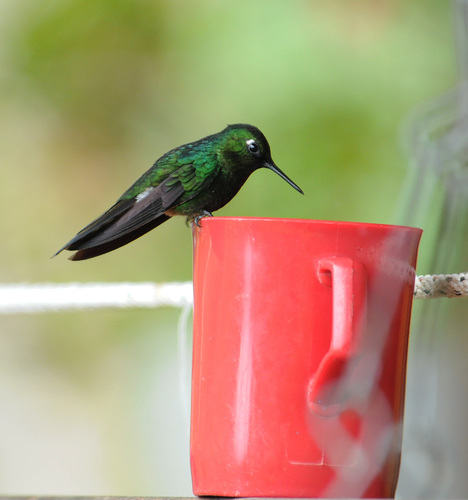 Tourmaline Sunangel
In short
To separate Amethyst-throated Sunangel from Tourmaline Sunangel, focus first on the throat and breast pattern: adult male Amethyst-throated shows a rosy amethyst gorget bordered by a narrow black and then a broad cinnamon band, while Tourmaline males have a glittering rosy pink gorget with a green border below and a dark purple-blue chin. Females and immatures are trickier, but Amethyst-throated females have a rusty throat with black flecks, while Tourmaline females show a whitish throat with green or dusky speckles. Both species have similar structure and size, but subtle differences in frontlet color and underpart pattern can help. Geographic range is also a strong clue: Amethyst-throated is found south of Ecuador, while Tourmaline is limited to Colombia and Ecuador.
Identification tips
- Adult male gorget and breast pattern: Amethyst-throated shows a rosy amethyst gorget with a narrow black border and a broad cinnamon band below; Tourmaline has a glittering rosy pink gorget with a green border and a dark purple-blue chin. This is the most reliable mark for adult males.
- Frontlet color: Both species have a green frontlet above the bill in adult males, but Tourmaline females lack this feature entirely. Some Amethyst-throated subspecies have turquoise or paler frontlets, which may help in certain regions.
- Female/immature throat: Female Amethyst-throated has a rusty throat with black flecks; Tourmaline female has a whitish throat with green/dusky speckles and sometimes a few rosy feathers. Juvenile Tourmaline males have a white chin, unlike Amethyst-throated.
- Underparts: Amethyst-throated typically shows a buff or buffy grayish belly with green discs, sometimes paler or grayer in subspecies; Tourmaline has dusky gray underparts with round green spots.
- Tail pattern: Both have bronze-green central tail feathers and blue-black or blackish outers, not reliably separating, but check for subtle differences if seen well.
- Bill: Both have straight, blackish bills of similar length; bill shape is not a separator.
- Size and structure: Both are compact, short-billed hummingbirds, 10–11 cm long; size is not useful for separation.
- Juvenile/immature confusion: Immature Amethyst-throated resembles the female (rusty throat, black flecks); juvenile Tourmaline males have a white chin, which is unique among the two.
- Subspecies variation: Amethyst-throated shows regional variation in gorget and belly color (e.g., reddish purple gorget, whitish or buffy belly in some forms); Tourmaline is more consistent but always check for the green border below the gorget in males.
- Geographic range: In Colombia, expect Tourmaline; in Bolivia or Peru, only Amethyst-throated. In Ecuador, both are possible, so rely on plumage.
- Habitat: Both prefer humid Andean forest edges and interiors, so habitat is not a strong separator except by country.
- Behavior: Both defend nectar-rich territories and hawk insects from perches; behavior is not diagnostic.
- Perched vs. flight views: Most field marks (gorget, frontlet, throat, belly) are best seen on perched birds; flight views may show underpart color and tail pattern but are less reliable for separation.
- Sexing pitfalls: Females and immatures are much harder to separate than adult males; focus on throat color and pattern, and use range as a backup.
- When in doubt: If you cannot see the gorget or throat well, and are in Ecuador, note all possible features and consider location and elevation to help narrow the ID.
Size
Both species are very close in size, with Amethyst-throated Sunangel measuring about 10 cm and weighing 3.8–7.7 g, and Tourmaline Sunangel at 10–11 cm and 3.5–8.5 g (males) or 4–5.2 g (females). In the field, size is not a reliable separator between these two, as overlap is nearly complete and both have a compact, short-billed hummingbird structure.
Plumage
For adult males, the gorget and breast pattern are most diagnostic: Amethyst-throated males have a rosy amethyst gorget with a narrow black border and a broad cinnamon band below, while Tourmaline males show a glittering rosy pink gorget with a green border and a dark purple-blue chin. The frontlet above the bill is bright green in Amethyst-throated (sometimes turquoise-green or paler in subspecies), and glittering green in Tourmaline, but Tourmaline females lack this frontlet entirely. Female Amethyst-throated have a rusty throat with black flecks, while Tourmaline females have a whitish throat with green to dusky speckles and sometimes a few rosy feathers. Juvenile Tourmaline males have a white chin, while Amethyst-throated immatures resemble the female. Both species have bronze-green central tail feathers and blue-black or blackish outer tail feathers, and green-spotted underparts, but Amethyst-throated often shows a buff or buffy grayish belly with green discs, while Tourmaline underparts are dusky gray with round green spots.
Behaviour
Both species feed on nectar and insects, defending territories rich in flowers. Amethyst-throated is noted for feeding at heights up to 6 m and staying close to cover at forest edge or interior, often hawking insects from a perch. There is no behavioral difference noted that is reliably diagnostic in the field between these two.
Habitat
Amethyst-throated Sunangel ranges from Bolivia through Peru to Ecuador, while Tourmaline Sunangel is restricted to Colombia and Ecuador. Both inhabit humid Andean forests and edges, but if seen in Colombia, it is almost certainly Tourmaline; in Bolivia or Peru, it is Amethyst-throated. In Ecuador, both may occur, so careful attention to plumage is needed.
Amethyst-throated Sunangel · Tourmaline Sunangel · My Tricky Birds