

Amazon Kingfisher vs Green Kingfisher
Chloroceryle amazona versus Chloroceryle americana
Play a quiz with Amazon Kingfisher and Green Kingfisher
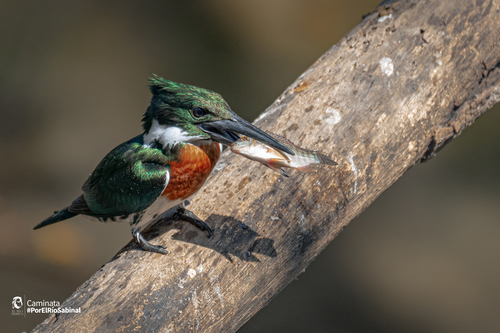 Amazon Kingfisher
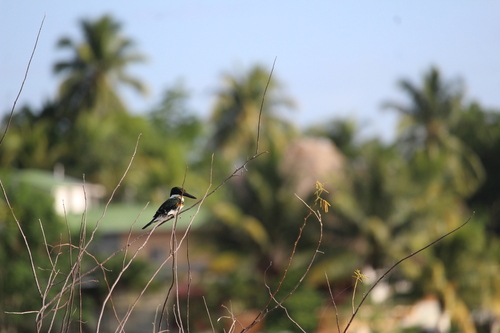 Green Kingfisher
In short
The most reliable field mark between Amazon Kingfisher and Green Kingfisher is size: Amazon is much larger and bulkier, with a heavier bill and a shaggy crest, while Green is noticeably smaller, slimmer, and lacks a crest. Juvenile Amazon Kingfishers show buff spots on the upperwing coverts and a large yellow patch at the bill base, which is absent in Green Kingfisher juveniles. In adults, both sexes of Amazon have extensive dark green upperparts and a white collar, but males have a rich rufous breast (females have green across the breast), while Green Kingfisher males have a rufous breast and females a green-speckled band. In flight, Green Kingfisher shows more white in the tail and prominent white spotting on the wings, especially on the flight feathers, which is less obvious in Amazon. Both species overlap in range and habitat, but Amazon prefers larger, more open waterways.
Identification tips
- Size is the first check: Amazon Kingfisher is much larger and heavier than Green Kingfisher. If the bird looks small and delicate, it's almost certainly Green.
- Crested vs. smooth crown: Amazon has a shaggy crest, often obvious when perched or alert, while Green Kingfisher lacks a crest and has a smooth head profile.
- Bill size and shape: Amazon's bill is longer, deeper, and heavier, especially obvious in profile. Green's bill is proportionately smaller and finer.
- Juvenile marks: Juvenile Amazon Kingfishers show buff spots on the upperwing coverts and a large yellow patch at the bill base. Green Kingfisher juveniles have small buff spots on the crown and wing coverts but lack the yellow bill patch.
- Adult male breast color: Both males have rufous on the breast, but Amazon's is richer and covers more area, with dark green sides. Green's rufous is more limited, with white underparts and green-spotted flanks.
- Adult female breast pattern: Female Amazon has green extending across the breast, nearly meeting in the middle; female Green has a white throat and breast with a band of green speckles (not solid green) across the breast and upper belly.
- White spotting in wings and tail: Green Kingfisher shows two or more rows of white spots on the flight feathers and much white in the tail, especially visible in flight. Amazon lacks these extensive white marks.
- Tail pattern in flight: Green Kingfisher's tail shows much white on the outer feathers; Amazon's tail is mostly green with little white.
- Perch height and behavior: Amazon Kingfisher often perches higher and more openly, while Green Kingfisher prefers low, close-to-water perches and is more active, often flicking its tail.
- Habitat context: On large, open rivers or lakes, expect Amazon; on small streams, ditches, or brushy water, expect Green. Both can overlap, but context helps.
- Voice: Amazon's calls are loud, harsh, and frog-like; Green's are less well described but generally softer and less harsh. Use with caution unless experienced.
- Sexing pitfalls: Female Amazon can be confused with female Green due to lack of rufous, but the solid green breast band (Amazon) vs. green-speckled band (Green) is key.
- Subtle differences in green shade: Amazon's upperparts are dark bronzy green; Green's are variable but generally paler and more spotted.
- Bill base color in juveniles: Only juvenile Amazon shows a large yellow patch at the base of the bill; Green never shows this.
- Direct comparison: If both species are present, the size, structure, and wing/tail pattern differences are unmistakable. Alone, rely on size, crest, and wing/tail spotting.
Size
Amazon Kingfisher is significantly larger (about 30 cm long, 98–140 g) than Green Kingfisher (about 20 cm, 32–40 g). The size gap is obvious in the field, with Amazon appearing almost twice as heavy and much bulkier. Amazon's bill is also proportionately longer and heavier, and its overall structure is more robust, while Green Kingfisher is petite and delicate by comparison. If seen together, the difference is striking, but even alone, Amazon's size is closer to a Belted Kingfisher, while Green is much smaller than any other North American kingfisher.
Plumage
-
Juveniles: Juvenile Amazon Kingfishers have buff spots on the upperwing coverts and a large yellow patch at the base of the bill—these are not present in Green Kingfisher juveniles. Juvenile Green Kingfishers resemble adult females but are duller, with small buff spots on the crown and wing coverts.
-
Adults: Both species have green upperparts and a white collar, but Amazon Kingfisher's green is darker and more bronzy, and it has a shaggy crest. Adult male Amazon has a rich rufous breast with dark green sides and a white belly with green streaks; adult female Amazon lacks the rufous, with green extending across the breast. Green Kingfisher males also have a rufous breast, but their underparts are otherwise white with green spots on the flanks; females have a green-speckled band across the breast and a buffy throat and breast.
-
Flight/wing pattern: Green Kingfisher shows two or more rows of white spots on the flight feathers and much white in the tail, especially visible in flight. Amazon Kingfisher does not show such extensive white in the wings or tail.
-
Bill: Both have black bills with some pale at the base, but Amazon's is heavier and longer, with a yellowish base to the mandible in juveniles.
Behaviour
Both species hunt by diving from a perch, but Amazon Kingfisher often uses higher, more prominent perches and may occasionally hover before diving. Green Kingfisher tends to use lower perches closer to the water and is more likely to be seen flicking its tail or making short flights along the water's edge. Amazon's larger size means it often appears more deliberate and less active than the smaller, more restless Green Kingfisher.
Habitat
Both species are found along rivers, streams, lakes, and lagoons in the Neotropics, often overlapping in range. However, Amazon Kingfisher prefers larger rivers and more open water, often with wooded banks, and is less likely in dense forest or small streams. Green Kingfisher is more flexible, using smaller streams, ponds, and even ditches, and is more likely to be found in tighter, brushy or forested waterways. In areas of overlap, Amazon is usually on broader water, Green on narrower or more vegetated channels.
Voice
Amazon Kingfisher gives loud, harsh, repeated 'tek' or 'klek' notes, sometimes a staccato 'chrit' or frog-like calls, and an accelerating series of clear 'see see see...su su su su' notes. Green Kingfisher's vocalizations are not detailed here, but both species can give sharp, rattling calls typical of kingfishers. In practice, Amazon's calls are louder and harsher, but voice alone is not always diagnostic without experience.