

ハイガシラアホウドリ 対 ニュージーランドアホウドリ
Thalassarche chrysostoma 対 Thalassarche bulleri
ハイガシラアホウドリとニュージーランドアホウドリのクイズ
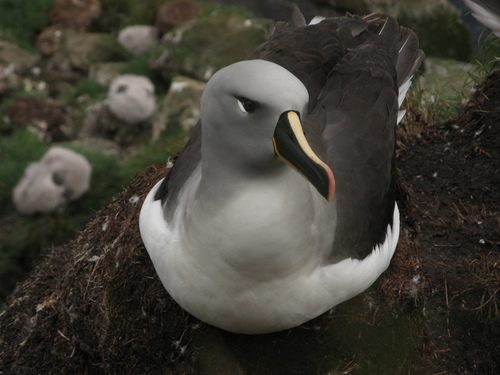 ハイガシラアホウドリ
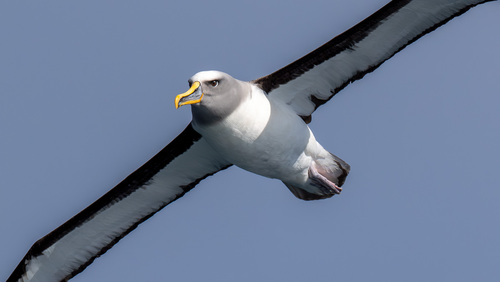 ニュージーランドアホウドリ
要点
The most reliable field mark between Grey-headed and Buller's Albatross is the extent and pattern of black on the underwing: Grey-headed (especially juveniles) shows a much darker underwing overall, with heavy black on both leading and trailing edges, while Buller's has a crisp, broad black leading edge and tip but much more white overall. Adults of both species have grey heads, but Grey-headed's is darker and more extensive, covering the throat and upper neck, whereas Buller's is paler with a silvery forehead and a distinctive dark eye patch. Bill color is also helpful: Grey-headed has a mostly black bill with bright yellow ridges and a pinkish tip, while Buller's bill is black with yellow only on the upper ridge and tip. Juveniles of both species are darker, but Grey-headed juveniles are especially dusky-headed and have a black bill. These differences are best seen in good light and at close range, but the underwing pattern is often visible in flight at a distance.
識別のコツ
- Underwing pattern in flight (all ages): Grey-headed Albatross, especially juveniles, shows a much darker underwing overall, with heavy black on both leading and trailing edges; Buller's has a broad, sharply defined black leading edge and tip, but the rest of the underwing is white. This is often visible even at a distance.
- Juvenile head and bill: Juvenile Grey-headed has a black bill and a very dark head and nape, with an indistinct eye crescent; juvenile Buller's has a brown bill and a dark head, but usually shows a more defined white crescent behind/below the eye.
- Adult head color: Adult Grey-headed has a uniform, ashy-grey head, throat, and upper neck, contrasting with the white underparts and rump; Buller's adult has a paler, silvery-grey forehead, a grey head and throat, a black patch around the eye, and a white crescent behind and below the eye.
- Bill color (adults): Grey-headed's bill is black with bright yellow ridges and a pinkish tip; Buller's is black with yellow only on the upper ridge and tip. The yellow on Grey-headed is more extensive and brighter.
- Upperwing and back: Grey-headed's upperwing, mantle, and tail are almost black; Buller's are dark grey, not black, and the contrast with the white rump is less stark.
- Size and structure: Grey-headed is slightly larger and bulkier, with a longer wingspan, but this is subtle unless both species are together.
- Eye crescent: Both species have a white crescent behind the eye, but it is more sharply defined in Buller's, especially in adults.
- Rump and underparts: Both have white rumps and underparts, but the contrast is stronger in Grey-headed due to the darker upperparts.
- Habitat and range: If seen near New Zealand or in the South Pacific (especially north of 50°S), Buller's is more likely; in colder, southern waters or near subantarctic islands, Grey-headed is more likely, but range overlap is possible.
- Perched views: On land, look for the extent of grey on the head and neck (more extensive and darker in Grey-headed), and bill color details.
- Flight jizz: Grey-headed may appear more robust and powerful in flight, but this is subtle.
- Juvenile confusion: Both juveniles are darker than adults, but Grey-headed's all-dark underwing and black bill are distinctive.
- Eye patch: Buller's has a distinctive black patch around the eye, lacking in Grey-headed.
- Trailing edge of underwing: Grey-headed often shows more black along the trailing edge of the underwing, especially in immatures; Buller's has a cleaner white trailing edge.
- When in doubt: Focus on underwing pattern and bill color, as these are the most consistently reliable marks across ages and conditions.
大きさ
Grey-headed Albatross is slightly larger, averaging 81 cm in length and a wingspan of 2.2 m, with a mean mass of 3.65 kg. Buller's Albatross is smaller at about 79 cm in length; no wingspan or mass is given in the notes, but it is described as a 'small mollymawk.' In the field, this size difference is subtle and may not be obvious unless the birds are side by side, but Grey-headed typically appears bulkier and longer-winged.
羽色
Juvenile and immature birds are the most likely to be confused. Juvenile Grey-headed Albatross has a very dark head and nape, an indistinct eye crescent, and a nearly all-dark underwing. Its bill is black. Juvenile Buller's is also darker-headed than the adult, but the bill is brown rather than black, and the underwing retains a broad, sharply defined black leading edge and tip, with more white elsewhere. In adults, Grey-headed's head, throat, and upper neck are ashy-grey, contrasting sharply with the white underparts and rump, and the upperwing is almost black. Buller's adult has a paler, silvery-grey forehead, a grey head and throat, a black patch around the eye, and a white crescent behind and below the eye. Its upperwing and back are dark grey, not black, and the underwing is white with a bold black leading edge and tip, but less black elsewhere compared to Grey-headed. Bill color is a strong adult mark: Grey-headed's is black with bright yellow ridges and a pink-orange tip, while Buller's is black with yellow only on the upper ridge and tip.
行動
Both species are classic mollymawks, gliding low over the sea with stiff wings and banking turns. Grey-headed may appear slightly more powerful and robust in flight due to its larger size and longer wings. Both species nest in colonies on remote islands and spend much of their lives at sea. There are no strongly diagnostic behavioral differences in the field.
生息環境
Grey-headed Albatross breeds on subantarctic islands scattered across the Southern Ocean and forages further south than any other mollymawk, often within or south of the Antarctic Polar Frontal Zone. Buller's Albatross is endemic to New Zealand, breeding on islands near New Zealand and foraging mostly between 40°S and 50°S, including the Tasman Sea and South Pacific. While both can disperse widely, Buller's is much more likely near New Zealand and the South Pacific, while Grey-headed is more likely in colder, higher-latitude waters. However, vagrants of either species can occur outside these core ranges.