

キムネミドリカザリドリ 対 Tricoloured Brushfinch
Pipreola aureopectus 対 Atlapetes tricolor
キムネミドリカザリドリとTricoloured Brushfinchのクイズ
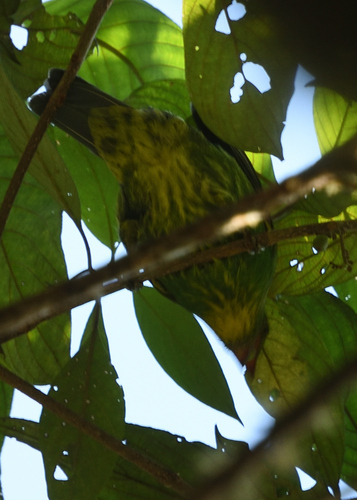 キムネミドリカザリドリ
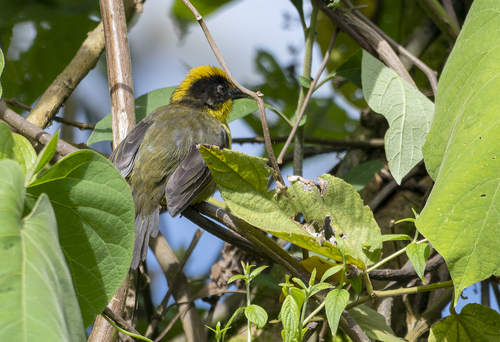 Tricoloured Brushfinch
要点
The most reliable field mark is the striking difference in head and underpart coloration: adult male Golden-breasted Fruiteaters show a grass-green head and upperparts with a bright yellow throat and breast, while Tricoloured Brushfinches have a yellow or ochre crown and nape, a black face, and yellow underparts with a strong olive wash. Females and immatures of the fruiteater are streaked below, never showing the brushfinch’s clean yellow underparts. Juvenile brushfinches are brownish above with a rufous crown, unlike any fruiteater. Both are similar in size, but the fruiteater is slightly heavier and bulkier. Habitat and range are also helpful: Fruiteater is found in Colombia and Venezuela, while the brushfinch is endemic to Peru.
識別のコツ
- Juvenile plumage: Juvenile Tricoloured Brushfinch is dark brown above and lighter brown below with a rufous crown—never matched by any fruiteater. If you see a brownish bird with a rufous crown, it is a brushfinch.
- Adult male underparts: Male Golden-breasted Fruiteater has a bright yellow throat and breast, blending to green on the sides and flanks. Brushfinch has yellow underparts with a strong olive wash, especially on the sides and undertail.
- Head pattern: Adult brushfinch has a yellow to ochre crown and nape with a black face, while fruiteater males and females have a grass-green head with dusky lores and chin (males). No fruiteater shows the brushfinch’s black face or yellow crown.
- Female/immature underparts: Female fruiteater is green below with yellow streaks, never showing the brushfinch’s clean yellow underparts. Both sexes of brushfinch are unstreaked below.
- Upperparts: Fruiteater is grass-green above and on the tail; brushfinch is dark olive to olive-citrine on the back, with a blackish tail and dusky gray wings edged olive.
- Wing pattern: Fruiteater has small white tips on the tertials (adults); brushfinch wings are dusky gray with olive edges, no white tips.
- Bill color and shape: Fruiteater has an orange or orange-red bill, slightly hooked; brushfinch has a black, conical, sparrow-like bill.
- Iris color: Fruiteater’s iris is orange-yellow; brushfinch’s is deep reddish brown.
- Leg color: Fruiteater has greenish gray legs and feet; brushfinch has grayish or dusky black legs and feet.
- Sexual dimorphism: Fruiteater shows strong sexual dimorphism (males and females look different below); brushfinch sexes look alike.
- Behavior: Fruiteater is more often seen in pairs, foraging quietly in mid-levels or canopy; brushfinch is more active, often on or near the ground.
- Range: Fruiteater is found in Colombia and Venezuela; brushfinch is endemic to Peru. If you are outside the range, reconsider your ID.
- Habitat: Fruiteater prefers interior humid montane forest; brushfinch is more often at forest edge or in secondary growth.
- Size and shape: Fruiteater is slightly heavier and bulkier; brushfinch is more slender and sparrow-like.
- Mixed flocks: Fruiteater often joins mixed-species flocks in the canopy; brushfinch is less likely to do so and stays lower.
大きさ
Both species are similar in length (16–18 cm), but the Golden-breasted Fruiteater is somewhat heavier (46–50 g for three individuals) compared to the Tricoloured Brushfinch (about 37 g). The fruiteater may appear slightly bulkier, especially in the body, while the brushfinch is more slender and sparrow-like in build. Bill structure also differs: the fruiteater has a more robust, slightly hooked bill typical of cotingas, whereas the brushfinch has a conical, sparrow-like bill.
羽色
- Juveniles: Juvenile Tricoloured Brushfinches are dark brown above and lighter brown below, with a dark rufous crown—completely unlike any age of Golden-breasted Fruiteater, which does not show this brown or rufous coloration at any stage.
- Adult males: Golden-breasted Fruiteater males have a grass-green head and upperparts, a bright yellow throat and central breast, and a lemon-yellow lower breast blending to green flanks. They also have small white tips on the tertials. In contrast, adult Tricoloured Brushfinches have a yellow to ochre crown and nape, a black face, dark olive back, blackish tail, and yellow underparts with a strong olive wash, especially on the sides and vent.
- Adult females: Female fruiteaters resemble males above but are green with yellow streaks below, lacking the brushfinch’s clean yellow underparts. Both sexes of brushfinch look alike and never show streaked underparts.
- Iris and bill: Fruiteaters have an orange-yellow iris and orange or orange-red bill; brushfinches have a deep reddish brown iris and black bill.
行動
Golden-breasted Fruiteater typically forages in pairs, mainly in the mid-levels of forest, and often joins mixed-species flocks. They are more likely to be seen perched quietly, feeding on fruit. Tricoloured Brushfinch, as a sparrow relative, is more terrestrial or found in low vegetation, often seen foraging on or near the ground and moving singly or in pairs. Their movements are more active and sparrow-like compared to the fruiteater’s slower, more deliberate behavior.
生息環境
Golden-breasted Fruiteater is found in humid montane forests of Colombia and Venezuela, usually in the mid-levels of the canopy. Tricoloured Brushfinch is restricted to Peru and inhabits montane forests and forest edges, often at higher elevations. If you are outside the range of one species, this can be a decisive clue. Fruiteater prefers interior forest, while brushfinch is more likely at edges or in secondary growth.