

モリキクイタダキモドキ 対 Amazonian Elaenia
Myiopagis gaimardii 対 Myiopagis cinerea
モリキクイタダキモドキとAmazonian Elaeniaのクイズ
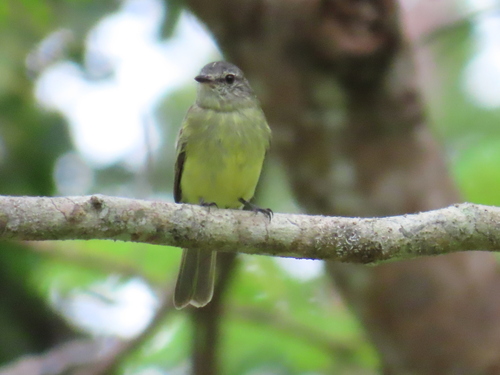 モリキクイタダキモドキ
 Amazonian Elaenia
要点
The most reliable field mark between Forest Elaenia and Amazonian Elaenia is the color and pattern of the upperparts and underparts, especially in perched birds: Forest Elaenia shows olive-green upperparts and greenish-yellow underparts, while Amazonian Elaenia (male) is blue-gray above with pale gray underparts and a white belly. Females of Amazonian Elaenia, however, can be quite similar to Forest Elaenia, with olive-green upperparts and yellowish underparts, so close attention to details like wing bar color and facial markings is essential. Both species have a partially concealed crown stripe, but the color and visibility differ. Subtle differences in bill color and wing bar brightness can help, but beware of overlap in dull light or with worn birds. Immature and female Amazonian Elaenia are the most likely to be confused with Forest Elaenia, so focus on the combination of upperpart color, underpart tone, and wing bar contrast.
識別のコツ
- Upperpart color (adults): Forest Elaenia is olive-green above; male Amazonian Elaenia is blue-gray above, while females are olive-green, making them more similar to Forest Elaenia.
- Underpart color: Forest Elaenia is greenish-yellow on the breast, yellow on the belly; male Amazonian Elaenia is pale gray on the underparts with a white belly. Female Amazonian Elaenia has greenish-yellow underparts and yellow belly, closely matching Forest Elaenia.
- Wing bars: Forest Elaenia always shows two yellow wing bars; Amazonian Elaenia males have two white wing bars, while females have yellowish wing bars. In poor light, white and yellow can be hard to distinguish, but in good light, this is a key mark.
- Wing edging: Forest Elaenia has yellow feather edging on the brown wings; Amazonian Elaenia males have white edges on the black wings, females have yellowish edges.
- Crown stripe: Both species have a partially concealed crown stripe. Forest Elaenia's is white or pale yellow; male Amazonian Elaenia's is white, female's is yellow. The stripe is often hidden, so do not rely on this alone.
- Facial markings: Forest Elaenia has a weak whitish supercilium and a white eyering, giving a more open-faced look. Amazonian Elaenia males have a thin grayish white loral spot and a grizzled lower face, but the supercilium is less distinct. Female Amazonian Elaenia may show a less contrasting face.
- Bill shape and color: Forest Elaenia has a long, narrow bill, black above and pink-based below; Amazonian Elaenia has a short, blackish bill. This is subtle but can help at close range.
- Tail: Amazonian Elaenia has a gray tail with white tips; tail color is not distinctive in Forest Elaenia but is not described as white-tipped.
- Iris and legs: Both have dark irises and dark legs, not useful for separation.
- Sex differences: Only Amazonian Elaenia shows strong sexual dimorphism in plumage; Forest Elaenia sexes are alike. If a pair shows obvious blue-gray and olive-green birds together, Amazonian Elaenia is likely.
- Perched vs. in flight: No distinctive flight or juvenile wing patterns are described for either species, so focus on perched views.
- Voice: A sharp 'pitch-weep' call indicates Forest Elaenia; lack of this call does not confirm Amazonian Elaenia.
- Habitat: Forest Elaenia is more likely at mangrove edges and on Trinidad; Amazonian Elaenia is absent from Trinidad and the southern cone of South America.
- Range: If in Trinidad, Forest Elaenia is the default; if in southern Amazonia, check for Amazonian Elaenia.
- Pitfalls: Female and immature Amazonian Elaenia are the most likely to be confused with Forest Elaenia; always check wing bar color and underpart tone in good light.
大きさ
Both species are very similar in size, with Forest Elaenia averaging about 12.7 cm in length and 12 g in mass, and Amazonian Elaenia at 12–13 cm and about 11 g. In the field, size is not a reliable separator. The Trinidad subspecies of Forest Elaenia is slightly larger, but this is only relevant on that island.
羽色
-
Juvenile/immature wing pattern: No distinctive juvenile or first-winter upperwing marks are described for either species, so age-specific flight marks are not diagnostic here.
-
Adults (male Amazonian Elaenia): Forest Elaenia has olive-green upperparts and greenish-yellow underparts, with brown wings edged yellow and two yellow wing bars. The head shows a blackish crown with a partly concealed white or pale yellow central stripe, a weak whitish supercilium, and white eyering. Amazonian Elaenia males have blue-gray upperparts, a dark gray crown with a partially concealed white stripe, a thin grayish white loral spot continuing around the eye, and a grizzled whitish lower face. Their wings are black with white edges on the inner flight feathers and white-tipped coverts forming two white wing bars. Underparts are pale gray with a white belly.
-
Adult females (Amazonian Elaenia): Females are much more similar to Forest Elaenia, with bright olive-green upperparts, yellowish wing bars and edges, and greenish-yellow underparts with a yellow belly. The crown stripe in females is yellow, not white. This makes them quite close to Forest Elaenia in overall color, but Forest Elaenia's wing bars and edges are always yellow, and its supercilium and eyering are more distinct.
-
Bill color: Forest Elaenia has a long, narrow bill, black above and pink-based below; Amazonian Elaenia's bill is short and blackish.
-
Tail: Amazonian Elaenia has a gray tail with white tips, while tail color is not specifically described for Forest Elaenia but is not noted as distinctive.
行動
Both species are typically seen alone or in pairs, often perched inconspicuously in the mid to upper canopy, or sallying for insects. Forest Elaenia is noted for catching insects and spiders high in the foliage and also eating berries. No unique behavioral differences are described that reliably separate these two species in the field.
生息環境
Forest Elaenia is found in forests and at the edges of mangrove swamps, ranging from Panama through northern South America to Bolivia and Brazil, and on Trinidad. Amazonian Elaenia is widespread in the Amazon Basin and adjacent areas, present in almost all mainland South American countries except the southern cone. Both species overlap in lowland forest habitats, so habitat alone is not a reliable separator except at the extreme edges of their ranges or in mangrove edges (more typical for Forest Elaenia).
声
Forest Elaenia has a sharp 'pitch-weep' call. No vocal description is provided for Amazonian Elaenia, so voice is not a reliable separator unless Forest Elaenia's distinctive call is heard.