

ズアオバンケン 対 ハジロムクドリ
Centropus monachus 対 Neocichla gutturalis
ズアオバンケンとハジロムクドリのクイズ
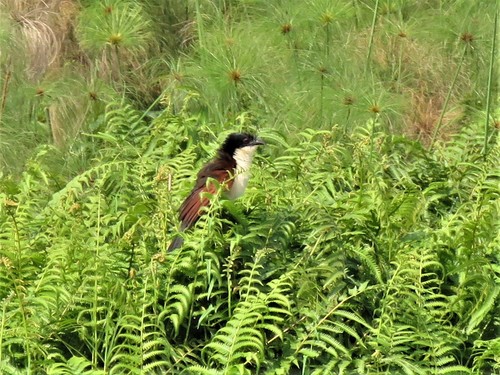 ズアオバンケン
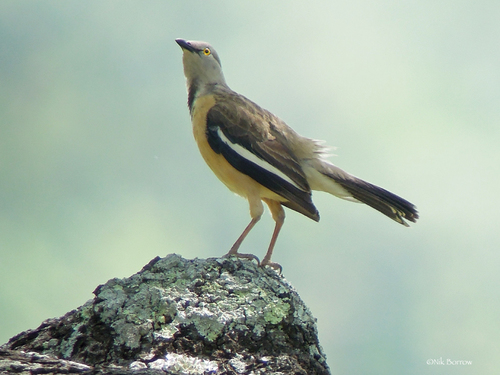 ハジロムクドリ
要点
The most reliable field mark to separate Blue-headed Coucal from Babbling Starling is overall size and structure: the coucal is much larger and bulkier, with a long tail and heavy bill, while the starling is a small, compact songbird. Juvenile Blue-headed Coucals show heavy barring and streaking on the wings and head, quite unlike the clean, banded wing and yellow chest of the starling. Adult coucals have a striking contrast of glossy blackish-blue head and back, chestnut wings, and pale underparts, while babbling starlings are pale-headed with a yellow chest and a distinctive black wedge on the breast. If you see a bird with a bright yellow eye and a white wing band, it's the starling; a dark red eye and no wing band points to coucal.
識別のコツ
- Size and structure: Blue-headed Coucal is over twice the length of Babbling Starling and much bulkier, with a long tail and heavy bill. If the bird looks crow-sized, it's a coucal; if it's thrush-sized or smaller, it's a starling.
- Bill shape: Coucal has a thick, strong, slightly decurved bill, while the starling's bill is finer and straight, typical of starlings.
- Tail: Coucal's tail is long and broad, often held down or fanned; starling's tail is shorter and more squared.
- Adult head and back: Coucal adults have a glossy blue-black head and back; starling has a pale, off-white head and light brown upperparts.
- Wings (perched): Coucal's wings are deep chestnut with no white band; starling's wings are dark greyish-brown with a clear white band visible on the folded wing.
- Juvenile wing pattern: Juvenile coucals show heavy barring on the wings and back, and streaked rufous-buff on the head; juvenile starlings lack this barring and have a clean, pale head and wing band.
- Underparts: Coucal has white or pale buff underparts; starling has a yellow chest with a distinctive black wedge in the center.
- Eye color: Coucal has dark red eyes; starling has bright yellow eyes, which are striking at close range.
- Leg color: Coucal's legs and feet are greyish-black; starling's leg color is not described, but is not a primary field mark.
- Vocalizations: Starling gives slurred, squealing, raspy calls; coucal's calls are deeper and more bubbling (not described here, but generally true for coucals).
- Behavior: Coucal is skulking, slow-moving, and often hidden in wet vegetation; starling is active, social, and perches openly.
- Habitat: Coucal is in swamps, riverbanks, and wet areas; starling is in drier woodland and savanna.
- Sexes: Both species are sexually monomorphic (sexes look alike), so do not use sex for identification.
- Flight: Coucal rarely flies far and appears heavy in flight; starling has a more buoyant, direct flight.
- Pitfalls: Immature coucals can look dull and streaky, but the size, structure, and barring remain distinctive. Starling's white wing band and yellow chest are unique in this pair.
大きさ
Blue-headed Coucal is a much larger bird, measuring 45–52 cm in length, compared to the Babbling Starling's 17 cm. The coucal is also heavier and more robust, with a long tail and a thick, strong bill, while the starling is light (64–72 g), compact, and has a typical starling shape with a shorter tail and finer bill. This size difference is obvious even at a distance and is a key separation point in the field.
羽色
- Juvenile/immature birds: Juvenile Blue-headed Coucals have duller black areas (not glossy), the head is streaked rufous-buff, and the wings are dark chestnut heavily barred with dark brown; the back and tail are barred with buff, and the throat and breast are spotted with black. In contrast, juvenile Babbling Starlings (not specifically described, but likely similar to adults) would show the same pale head, yellow chest, black breast wedge, and white wing band as adults, without heavy barring or streaking.
- Adults: Adult Blue-headed Coucals have a glossy blue-black head, neck, and back, deep chestnut wings, black tail with green/bronze gloss, and white or pale buff underparts. Babbling Starlings have an off-white head, yellow chest with a black wedge, light brown upperparts fading to dark greyish-brown wings (with a white wing band), and a dark brown tail. The eye color is also distinctive: dark red in coucal, bright yellow in starling.
行動
Blue-headed Coucal is typically sluggish, moving through dense wet vegetation or perching low, often remaining hidden or skulking. It rarely flies far and often clambers through reeds or bushes. Babbling Starling is more active and conspicuous, often seen in small groups, perching openly, and moving about in trees or on the ground. Their flight is more direct and starling-like, with short bursts between perches.
生息環境
Blue-headed Coucal is found in wet habitats: swamps, riverbanks, forest edges, and generally moist areas in tropical central Africa. Babbling Starling prefers drier, more open habitats in southern-central Africa (Angola, Malawi, Tanzania, Zambia), often in woodland or savanna, and is not associated with swamps or dense wet areas. Thus, habitat context can help, but there is some overlap at forest edges.
声
Babbling Starling is noted for its slurred, squealing, or raspy scolding calls, which are typical of starlings and quite vocal. Blue-headed Coucal is not described here for voice, but coucals generally have deep, bubbling or booming calls, quite unlike the starling's raspy sounds. If you hear a harsh, squealing call, think starling.