

Rhipidure des Samoa vs Rhipidure à collier
Rhipidura nebulosa contre Rhipidura fuliginosa
Faire un quiz avec Rhipidure des Samoa et Rhipidure à collier
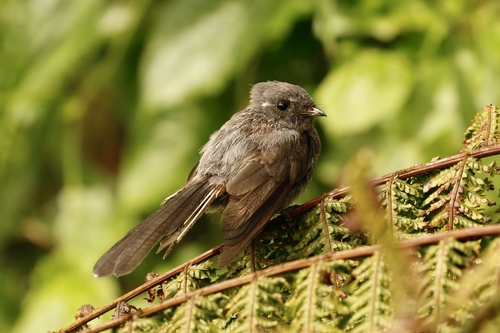 Rhipidure des Samoa
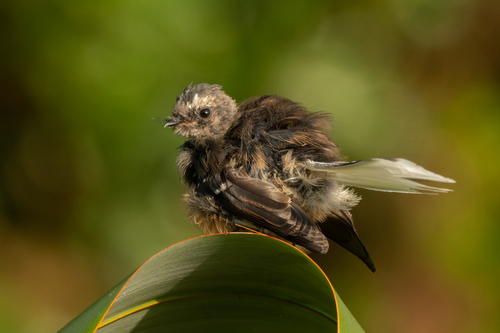 Rhipidure à collier
En bref
The most reliable way to separate Samoan Fantail from New Zealand Fantail is by focusing on the underparts and tail pattern: Samoan Fantail has a mostly dark grey-brown plumage with a white undertail and black tail, while New Zealand Fantail shows yellowish or orange underparts, a dark chest band, and white-edged or white outer tail feathers (except in the rare black morph). Both species fan their tails, but the New Zealand Fantail’s tail pattern is more contrasting, especially in flight. Juveniles of both are browner, but the New Zealand Fantail juvenile still shows some pale tail edges. Both species have a white spot behind the eye, but only New Zealand Fantail has a clear dark chest band and paler belly. Habitat and range are also strong clues: Samoan Fantail is strictly Samoan, while New Zealand Fantail is only found in New Zealand. Size is similar, but not a useful field mark.
Conseils d’identification
- Tail pattern in flight or when fanned (all ages): New Zealand Fantail always shows white edges or white outer tail feathers contrasting with dark central feathers; Samoan Fantail’s tail is black with a white undertail, lacking the bold white outer tail feathers.
- Underparts color (adults): New Zealand Fantail has yellowish or orange underparts with a strong dark chest band; Samoan Fantail is dark grey-brown below, lacking any orange or yellow wash and without a chest band.
- Throat and chest: New Zealand Fantail has a white throat sharply set off by a dark chest band; Samoan Fantail has a pale (white or smoky) throat but no chest band.
- White spot behind the eye: Both species have this, so it is not diagnostic on its own.
- Juvenile plumage: Juvenile New Zealand Fantail is browner but still shows pale or white in the outer tail; juvenile Samoan Fantail is browner overall but lacks white tail edges.
- Black morph (New Zealand Fantail): Rare and only in parts of New Zealand; all dark except white spot behind the eye, can be confused with Samoan Fantail but is extremely rare and local.
- Tail shape and behavior: Both species fan their tails, but New Zealand Fantail’s tail pattern is more striking when spread.
- Habitat and range: Samoan Fantail is only in Samoa (Upolu and Savaiʻi); New Zealand Fantail is only in New Zealand. If you are outside these islands, you are not seeing the other species.
- Size: Not a useful separator; both are small fantails with similar proportions.
- Bill and structure: No diagnostic differences noted in the available sources.
- Voice: New Zealand Fantail gives a metallic 'cheek' or chattering call; Samoan Fantail gives a low chirp and may imitate other birds. Use with caution unless familiar with local calls.
- Behavior: Both are restless and active, but New Zealand Fantail is especially confiding around people.
- Context: If seen in gardens or urban parks in New Zealand, it is New Zealand Fantail; in Samoa, especially in rainforest or plantations, it is Samoan Fantail.
- Sex and season: No significant sexual dimorphism or seasonal plumage differences noted for either species.
- Common pitfalls: Do not rely on the white spot behind the eye alone; focus on tail pattern and underparts color, especially in good light or when the tail is fanned.
Taille
Both species are small fantails with long, fanned tails. The New Zealand Fantail has a documented average mass of 7.2 g [wikidata], while the Samoan Fantail’s mass is not specified, but they are in the same genus and appear similar in size. In the field, size alone is not a reliable separator.
Plumage
Juvenile and immature birds of both species are browner than adults, but the New Zealand Fantail juvenile still shows pale edges or white in the outer tail feathers, which is absent in Samoan Fantail. Adult Samoan Fantail is mostly dark grey-brown above and below, with a white undertail, black tail, and a pale (white or smoky) throat. It has a white spot behind the eye. New Zealand Fantail adults are mid-to-dark grey or grey-brown above, but distinctly yellowish or orange below, with a white throat, a strong dark band across the chest, and white markings over the eye. The tail is strikingly patterned: outer tail feathers are white-edged or fully white, contrasting with dark central feathers, especially when fanned. The rare black morph of New Zealand Fantail is all dark except for the white spot behind the eye, potentially confusing with Samoan Fantail, but is extremely rare and geographically limited. Both species fan their tails, but the New Zealand Fantail’s tail pattern is more contrasting and obvious in flight or when perched with tail spread.
Comportement
Both species are highly active, flitting from perch to perch and frequently fanning their tails. New Zealand Fantail is noted for being especially confiding, often approaching people in gardens and forests, and is almost never still. Samoan Fantail is also active and adaptable, but there is no specific mention of it approaching humans as closely. Both species catch insects on the wing and show typical fantail restlessness.
Habitat
Samoan Fantail is endemic to Samoa, found only on Upolu and Savaiʻi islands, and prefers primary and secondary rainforest but also occurs in plantations and gardens. New Zealand Fantail is the only fantail in New Zealand, found in a wide range of habitats including forests, gardens, and urban parks. Range is a strong separator: if you are not on Samoa, you are not seeing Samoan Fantail; if not in New Zealand, you are not seeing New Zealand Fantail.
Voix
Samoan Fantail gives a low chirp and is sometimes noted to imitate other bird species. New Zealand Fantail has an almost metallic 'cheek' call, often repeated in a chattering series. Vocalizations are not the most reliable separator unless you are familiar with the local calls, but New Zealand Fantail’s call is more metallic and chattery.
Rhipidure des Samoa · Rhipidure à collier · Mes oiseaux difficiles