

Rotkehlnymphe vs Purpurstirn-Saphirkolibri
Lampornis amethystinus gegen Basilinna leucotis
Ein Quiz mit Rotkehlnymphe und Purpurstirn-Saphirkolibri spielen
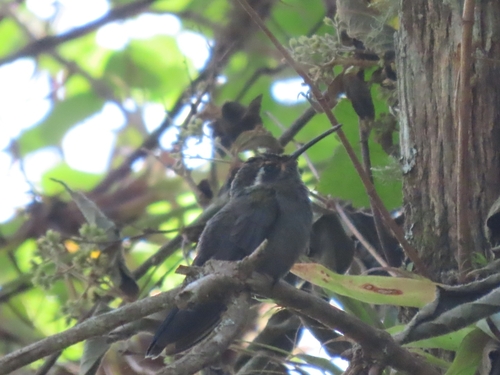 Rotkehlnymphe
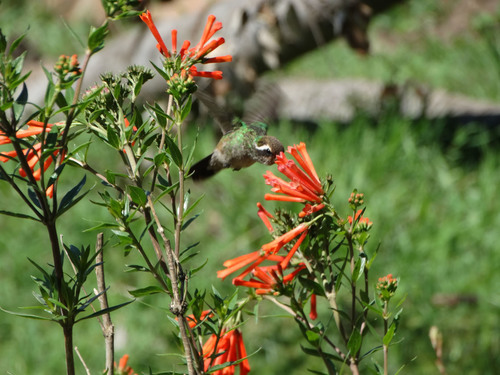 Purpurstirn-Saphirkolibri
Kurz gesagt
The most reliable field mark to separate Amethyst-throated Mountain-gem from White-eared Hummingbird is the color and extent of the throat patch (gorget) in adult males: the Mountain-gem shows a brilliant rosy pink to violet gorget (varying by subspecies), while the White-eared Hummingbird has a violet-blue chin and upper throat with metallic emerald green lower throat. Both species have a bold white post-ocular stripe, but the White-eared Hummingbird's is broader and more striking, especially in males. Bill color is also a key difference: male White-eared Hummingbirds have a mostly red bill with a black tip, while Mountain-gems have a straight black bill in both sexes. Juveniles and females of both species can be confusing, but the Mountain-gem female and young show a cinnamon or pale throat, not the green-spotted or plain grayish underparts of the White-eared. Size and structure are subtly different, with the Mountain-gem being noticeably larger and heavier, and having a broader, slightly forked tail.
Bestimmungstipps
- Throat color in adult males: Look for a brilliant rosy pink, violet, or blue gorget in Amethyst-throated Mountain-gem (color varies by subspecies), versus a violet-blue chin and emerald green lower throat in White-eared Hummingbird. This is the most reliable mark in good light.
- White post-ocular stripe: Both species have a white stripe behind the eye, but it is broader and more striking in White-eared Hummingbird, especially in males. In Mountain-gem, it is present but less bold.
- Bill color: Male White-eared Hummingbirds have a mostly red bill with a black tip, while both sexes of Mountain-gem have a straight black bill. Female White-eareds have a mostly blackish bill with some red or orange at the base; check carefully in good light.
- Size and structure: Mountain-gem is larger and bulkier, with a broader, slightly forked tail. White-eared is smaller, lighter, and appears more delicate, with a more graduated tail.
- Crown and face: Male White-eared Hummingbirds have a metallic violet or bluish violet forehead and a mostly black face, while Mountain-gem males have a dark green crown and dark auriculars. Female White-eareds have a dusky brown crown, contrasting with the green crown of Mountain-gem females.
- Upperparts and rump: Mountain-gem males have a bronze rump and blackish uppertail coverts; White-eareds have bright metallic green to bronze green upperparts with bronzy rump and covert feathers edged rusty.
- Underparts (females/immatures): Female Mountain-gems have a cinnamon throat and dusky gray underparts; White-eared females have pale brownish gray to grayish white underparts with metallic green spots and lack the cinnamon tones.
- Tail pattern: Mountain-gem's tail is black with gray tips on outer feathers and slightly forked; White-eared's tail is more graduated, with central feathers bronze green and outer feathers bronzy black with green tips. This can be subtle unless the tail is fanned.
- Juvenile males: Young Mountain-gem males may show a few pink throat feathers; White-eared juveniles are not well described but likely lack any pink or cinnamon in the throat.
- Habitat context: In montane evergreen or pine-oak forest interiors, Mountain-gem is more likely; in edges, clearings, or gardens, especially at lower elevations, White-eared is favored.
- Behavior: White-eared Hummingbird is more aggressive and territorial at feeders or flower patches, often chasing other hummingbirds. Mountain-gem is less territorial except during display.
- Display: If observed displaying, Mountain-gem males perform aerial loops and dives, usually in the morning or evening.
- Vocalizations: If you hear a quiet, complex chatter with a two-syllable intro, it may indicate Mountain-gem. White-eared's vocalizations are not distinctive for field separation.
- Subspecies variation: Be aware that Mountain-gem subspecies (especially L. a. margaritae) can have gorgets that are violet to royal blue, potentially overlapping with White-eared's throat color, but the overall size, bill color, and face pattern will still separate them.
- Pitfalls: In poor light, the throat colors may appear dull or similar; rely on bill color, size, and the boldness of the white post-ocular stripe as backup marks. Juveniles and females are most easily confused—look for cinnamon tones in Mountain-gem, green spotting in White-eared.
Größe
Amethyst-throated Mountain-gem is distinctly larger, measuring 11.5–12.5 cm in length and weighing 5–7.8 g (males) or 5–5.8 g (females) [wikipedia]. In contrast, White-eared Hummingbird is smaller at 9–10 cm and lighter at 3.6 g (males) and 3.2 g (females) [wikipedia]. This size difference is usually apparent in direct comparison or with experience, especially in areas where both occur. The Mountain-gem also appears bulkier and more robust, while the White-eared is daintier and more agile.
Gefieder
- Juveniles/immatures: Juvenile Amethyst-throated Mountain-gems resemble females, with dusky gray underparts and a cinnamon throat (males may show a few pink throat feathers). Juvenile White-eared Hummingbirds are not described in detail, but likely resemble adult females, with pale brownish gray to grayish white underparts and metallic green spots, lacking the cinnamon tones of Mountain-gem.
- Adult males: Amethyst-throated Mountain-gem males have a dark green crown and back, bronze rump, blackish uppertail coverts, and a brilliant rosy pink (or violet/blue in some subspecies) gorget. The breast and belly are dusky gray, undertail coverts pale buff. White-eared Hummingbird males have a metallic violet or bluish violet forehead, black face, broad white post-ocular stripe, bright metallic green to bronze green upperparts, and a violet-blue chin/upper throat with metallic emerald green lower throat. Their underparts are bronze to bronze green with a dull grayish white center.
- Adult females: Female Mountain-gems are similar to males but with a cinnamon throat and duller overall color. Female White-eared Hummingbirds have a dusky brown crown, lack the brilliant throat, and show pale brownish gray to grayish white underparts with metallic bronze green spots. Both have a white post-ocular stripe, but it is broader and more obvious in White-eared.
- Tail: Mountain-gem has a broad, slightly forked tail, black with gray tips on outer feathers. White-eared Hummingbird's tail is more graduated, with central feathers bronze green and outer feathers bronzy black with green tips.
Verhalten
Both species feed on nectar and small insects, but White-eared Hummingbird is notably territorial, defending feeding areas even against larger hummingbirds. Amethyst-throated Mountain-gem is usually not territorial, though males may defend a territory during display. White-eared Hummingbird often forages at lower to mid-levels and is more likely to be seen making quick, secretive feeding forays into other birds' territories. Mountain-gem displays include aerial loops and dives, usually in the morning and evening.
Lebensraum
Amethyst-throated Mountain-gem is restricted to montane evergreen and pine-oak forests in Mexico and northern Central America, typically at elevations from 900 to 3,000 m. White-eared Hummingbird has a broader range, from the southwestern U.S. to Nicaragua, and is found in a wider variety of wooded habitats, including edges, clearings, and gardens, often at similar elevations but sometimes lower. Overlap is possible in Mexico, but White-eared is more likely in disturbed or edge habitats.
Stimme
Amethyst-throated Mountain-gem's song is a quiet, complex chatter with a two-syllable introductory phrase and up to nine complex phrases; both sexes sing. Calls include persistent buzzing, short rapid clicks (territorial), and shrill whistles (display). White-eared Hummingbird's vocalizations are not detailed in the notes, so are not reliably diagnostic for separation.
Rotkehlnymphe · Purpurstirn-Saphirkolibri · Meine schwierigen Vögel