

Yellow-headed Blackbird vs Eastern Meadowlark
Xanthocephalus xanthocephalus versus Sturnella magna
Play a quiz with Yellow-headed Blackbird and Eastern Meadowlark
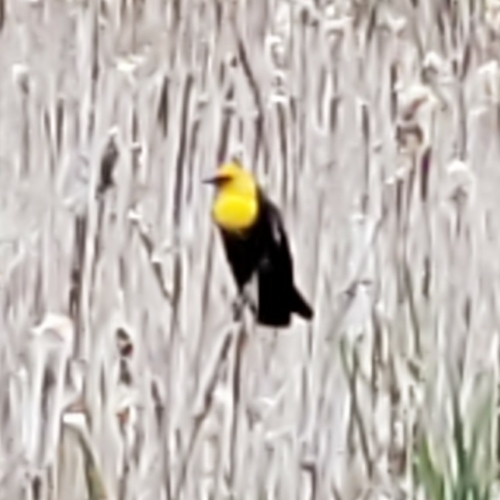 Yellow-headed Blackbird
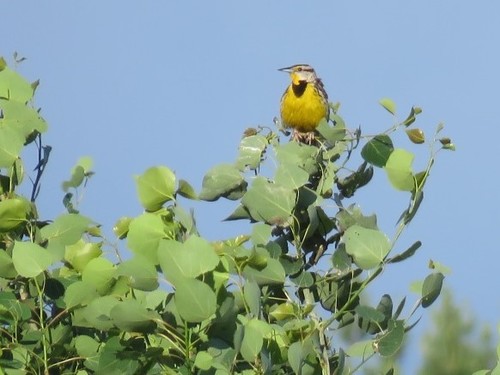 Eastern Meadowlark
In short
The most reliable field mark to separate Yellow-headed Blackbird from Eastern Meadowlark is the head and breast color: adult male Yellow-headed Blackbirds have a striking yellow head and breast, while Eastern Meadowlarks show a yellow throat and belly with a bold black 'V' on the breast and a streaked brown head. In flight, adult male Yellow-headed Blackbirds show a white wing patch, sometimes visible only when the bird is flying or spreading its wings, while Eastern Meadowlarks have white outer tail feathers and lack any white in the wings. Females and immatures of both species are duller and browner, but the Yellow-headed Blackbird's structure and bill shape remain distinctive. Both species can be found in open country, but Yellow-headed Blackbirds are tied to marshes, while Eastern Meadowlarks favor grasslands and fields. Voice is also a strong clue: Yellow-headed Blackbirds have harsh, grating calls, while Eastern Meadowlarks give clear, whistled songs.
Identification tips
- Head and breast color (adult males): Yellow-headed Blackbird males have a bright yellow head and breast; Eastern Meadowlark males have a yellow throat and belly but a brown, streaked head and a bold black 'V' on the breast.
- White wing patch (Yellow-headed Blackbird): Adult and some immature Yellow-headed Blackbirds show a white wing patch, visible in flight or when wings are spread; Eastern Meadowlark never shows white in the wings.
- White outer tail feathers (Eastern Meadowlark): In flight, Eastern Meadowlark shows white outer tail feathers, especially when fanning the tail; Yellow-headed Blackbird lacks this feature.
- Bill shape: Yellow-headed Blackbird has a pointed, conical bill; Eastern Meadowlark's bill is longer, straighter, and more dagger-like, suited for probing.
- Plumage in immatures/females: Immature and female Yellow-headed Blackbirds are brown with dull yellow on the throat and breast, sometimes with a faint white wing patch; Eastern Meadowlark immatures/females are brown above with bold head stripes, yellow underparts, and a black 'V' on the breast.
- Back and head pattern: Eastern Meadowlark has a heavily streaked brown back and a head with bold pale and dark stripes; Yellow-headed Blackbird is more uniform brown (females/immatures) or black (adult males) with little head striping.
- Flank pattern: Eastern Meadowlark shows white flanks with black streaks; Yellow-headed Blackbird lacks this flank streaking.
- Song: Yellow-headed Blackbird gives harsh, grating, rusty-hinge-like songs and calls; Eastern Meadowlark sings clear, whistled, melodic notes.
- Habitat: Yellow-headed Blackbird is almost always in marshes with emergent vegetation; Eastern Meadowlark is in grasslands, fields, and pastures, rarely in marshes.
- Perching behavior: Yellow-headed Blackbird often perches on reeds or cattails; Eastern Meadowlark prefers fenceposts, low shrubs, or the ground.
- Flocking: Outside breeding season, Yellow-headed Blackbirds may be in large, mixed blackbird flocks; Eastern Meadowlarks flock with their own species.
- Seasonal context: If seen in a marsh during breeding season, especially in the western or central US, Yellow-headed Blackbird is likely; in an open field or pasture, especially in the east, expect Eastern Meadowlark.
- Size and bulk: Eastern Meadowlark is often heavier and bulkier, especially females, but this is subtle and overlaps; use with caution.
- Sex differences: Female and immature Yellow-headed Blackbirds can be confused with meadowlarks, but look for the dull yellow on throat/breast and possible white wing patch in flight.
- When in doubt: Listen for the song or call, and note habitat and behavior—these often clinch the identification when plumage is ambiguous.
Size
Yellow-headed Blackbird is a medium-sized blackbird, measuring 21–26 cm in length with a wingspan of 42–44 cm and a typical body mass around 69.5 g [wikidata]. Eastern Meadowlark is similar or slightly larger, at 19–28 cm in length and a wingspan of 35–40 cm, but with a heavier body mass range (76–150 g) [wikipedia]. Both are robust birds, but the meadowlark is often bulkier and heavier, especially in females. Bill shape is also a clue: Yellow-headed Blackbird has a more pointed, conical bill, while Eastern Meadowlark's bill is long and straight, adapted for probing.
Plumage
- Immature/Nonbreeding birds: Both species can appear brownish and dull, but immature Yellow-headed Blackbirds (both sexes) are brown with dull yellow on the head and breast, and immature males may show some white in the wing, especially in flight. Eastern Meadowlark immatures and nonbreeding adults retain the yellow underparts with a black 'V', but their upperparts and flanks are more yellow-brown and heavily streaked, and the head is boldly striped.
- Adult males: Yellow-headed Blackbird males are black with a bright yellow head and breast and a white wing patch (best seen in flight). Eastern Meadowlark males have a yellow throat and belly, a black 'V' on the breast, white flanks with black streaks, and a brown, streaked back and crown.
- Adult females: Female Yellow-headed Blackbirds are brown with a dull yellow throat and breast, lacking the male's bright contrast, but still bulkier and with a stouter bill than meadowlarks. Female Eastern Meadowlarks are similar to males but duller and smaller, with the same pattern of yellow underparts and black 'V'.
- Flight: Yellow-headed Blackbird shows a white wing patch in flight (adults and some immatures), while Eastern Meadowlark shows white outer tail feathers but no wing patch.
Behaviour
Yellow-headed Blackbirds are often seen perched prominently on reeds or cattails in marshes, especially males during the breeding season, and can form large, noisy flocks outside the breeding season. Eastern Meadowlarks are more likely to be found walking or foraging on the ground in grasslands or perched on fenceposts and low vegetation. Both species may be seen in flocks in winter, but Yellow-headed Blackbirds are more likely to mix with other blackbirds, while Eastern Meadowlarks tend to flock with their own kind.
Habitat
Yellow-headed Blackbird is strongly associated with marshes and wetlands, especially those with dense stands of cattails, bulrushes, or reeds, and nests over open water. Eastern Meadowlark prefers open grasslands, pastures, hayfields, and agricultural areas with tall grass, and rarely occurs in marshes. If the bird is in a wetland with emergent vegetation, Yellow-headed Blackbird is far more likely; in dry grassland or farmland, expect Eastern Meadowlark.
Voice
Yellow-headed Blackbird's song is a harsh, grating series of notes, often compared to a rusty hinge, with males giving both 'accent' and higher-pitched 'buzz' songs. Calls are also harsh and grating. Eastern Meadowlark, by contrast, sings a series of clear, pure, whistled notes, often described as sweet or melancholy, and much simpler than the western meadowlark's song. Voice is often the easiest way to separate them if the bird is singing.
Yellow-headed Blackbird · Eastern Meadowlark · My Tricky Birds