

Yellow-crowned Tyrannulet vs Yellow-bellied Elaenia
Tyrannulus elatus versus Elaenia flavogaster
Play a quiz with Yellow-crowned Tyrannulet and Yellow-bellied Elaenia
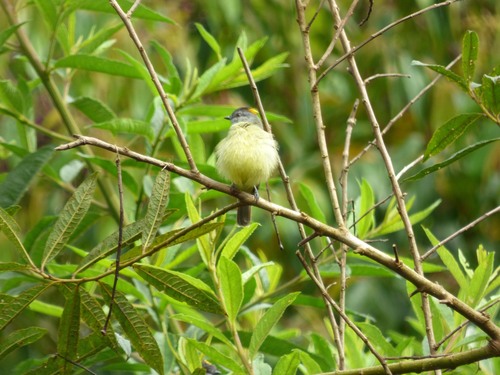 Yellow-crowned Tyrannulet
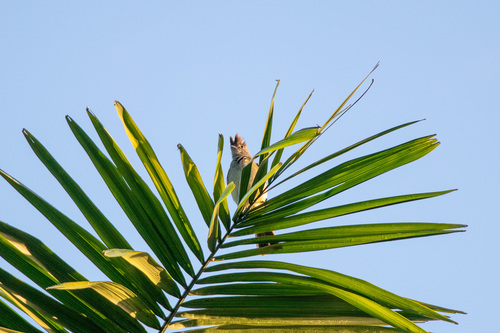 Yellow-bellied Elaenia
In short
The most reliable field mark to separate Yellow-crowned Tyrannulet from Yellow-bellied Elaenia is overall size and structure: the tyrannulet is much smaller, more compact, and has a proportionally shorter bill and tail. In plumage, look for the tyrannulet’s distinctive yellow or orange-yellow crown stripe, which is usually visible, versus the elaenia’s bushy crest with a concealed white stripe. Both have wingbars, but the tyrannulet’s are whiter and more contrasting. If you see the bird in flight or perched, the overall jizz—tiny, active, and short-billed versus larger, crested, and heavier—will often clinch the ID. Beware that both can show yellow underparts and olive upperparts, so focus on head pattern and size.
Identification tips
- Size is the fastest check: If the bird looks tiny and delicate, it is almost certainly Yellow-crowned Tyrannulet. If it looks medium-sized and chunky for a flycatcher, suspect Yellow-bellied Elaenia. This works at all ages and in all seasons.
- Bill shape and size: Tyrannulet has a short, rounded, black bill; elaenia’s bill is longer, broader at the base, and often shows a paler base to the mandible. Bill shape is especially useful when the birds are perched in profile.
- Head pattern: Look for the tyrannulet’s bright yellow or orange-yellow crown stripe on a dark crown (especially obvious in males, but present in both sexes). Elaenia’s white crest stripe is usually hidden unless the crest is raised; its crown is brownish olive and the overall head is bushier.
- Supercilium and eyering: Tyrannulet has a grayish supercilium and thin dark eye-line, giving a sharper facial pattern. Elaenia has a faint whitish eyering and paler lores, but the face is less sharply marked.
- Crest: Elaenia often raises its bushy crest, giving a peaked or tousled look. Tyrannulet’s crown is smooth and flat, never bushy.
- Wingbars: Both species have two pale wingbars, but the tyrannulet’s are usually brighter and more contrasting (white to yellowish white), while elaenia’s are duller yellowish white and less distinct.
- Underparts: Both have yellowish bellies, but tyrannulet’s is paler and more uniform, with an olive wash on the breast. Elaenia’s underparts are more variable, with a pale gray throat, olive gray breast, and yellow to whitish belly.
- Upperparts: Tyrannulet’s back is bright olive-green, while elaenia’s is brownish olive (sometimes browner or grayer depending on subspecies).
- Tail: Tyrannulet’s tail is short and compact; elaenia’s is longer and more proportional to its larger body.
- Jizz in flight: Tyrannulet is quick, agile, and often flits in the canopy; elaenia is bulkier, slower, and perches more upright, often in more open areas.
- Habitat context: In very open, arid, or urban areas, elaenia is much more likely. Tyrannulet is more typical of forest edges and humid woodland.
- Sex/age confusion: Tyrannulet females are slightly paler, but still show the yellow crown stripe. Elaenia sexes and ages are similar, so don’t rely on sex differences.
- Voice (not described in sources): If you hear a distinctive call, check a local guide, but don’t rely on voice for this pair unless you know them well.
- Beware of overlap: Both can occur at forest edge and in semi-open woodland, so always double-check size and head pattern.
- Seasonal plumage: No significant seasonal changes described; these marks are reliable year-round.
Size
Yellow-crowned Tyrannulet is dramatically smaller: 10–11 cm long and about 7 g, compared to Yellow-bellied Elaenia’s 15–17 cm and 24 g ([wikidata]). The tyrannulet appears tiny, with a short, stubby bill and compact proportions, while the elaenia is medium-sized, noticeably bulkier, and has a larger, bushier head and crest. Even at a distance or in poor light, the size gap is striking and often diagnostic.
Plumage
- Juvenile/immature upperwing pattern: No specific juvenile or immature wing pattern differences are described for either species in the sources, so focus on adult and general plumage.
- Head pattern: Yellow-crowned Tyrannulet shows a bright yellow to orange-yellow crown stripe on a dark crown (slate-gray to blackish in males, paler in females), with a grayish supercilium and thin dark eye-line. Yellow-bellied Elaenia has a bushy crest with a partially hidden white stripe, brownish olive crown, and a faint whitish eyering; the white crest stripe is often not visible unless the crest is raised.
- Upperparts: Tyrannulet’s back is bright olive-green, while elaenia is brownish olive (browner or grayer in some subspecies).
- Wingbars: Both have two pale wingbars, but tyrannulet’s are white to yellowish white and often brighter and more sharply defined; elaenia’s are yellowish white, often less contrasting against duskier wings.
- Underparts: Both have yellowish bellies, but tyrannulet’s is pale to medium yellow with an olive wash on the breast, while elaenia’s is yellow to pale yellow or whitish, with an olive gray breast and pale gray throat.
- Tail: Both have dusky olive tails, but the tyrannulet’s is shorter and more compact relative to body size.
- Sex/age variation: Tyrannulet females are slightly paler overall, especially on the crown and upperparts; elaenia sexes are alike.
Behaviour
Yellow-crowned Tyrannulet is very active, often flitting about in the canopy or mid-levels, and tends to perch more horizontally. It is quick and agile, matching its tiny size. Yellow-bellied Elaenia is more deliberate, often raising its bushy crest, and perches more upright. The elaenia is more likely to be seen in open or semi-open areas, sometimes sallying for insects from exposed perches. Their foraging style reflects their size: tyrannulet is quick and mouse-like, elaenia is bolder and more obvious.
Habitat
Yellow-crowned Tyrannulet prefers forest edges, open woodlands, and second growth, but is more restricted to humid and semi-humid lowland forests in Central and South America (excluding southernmost countries). Yellow-bellied Elaenia is much more of a generalist, found in a wide range of lightly wooded habitats from arid scrub to savanna, gardens, and parks, and shuns dense forest interiors. If you’re in a very open or urban area, elaenia is more likely; in forest edge or canopy, both are possible.
Yellow-crowned Tyrannulet · Yellow-bellied Elaenia · My Tricky Birds