

Yellow-browed Warbler vs Hume's Warbler
Phylloscopus inornatus versus Phylloscopus humei
Play a quiz with Yellow-browed Warbler and Hume's Warbler
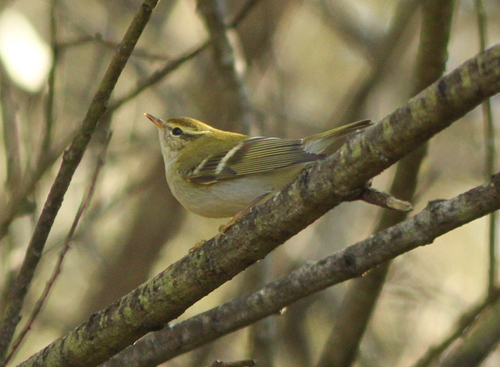 Yellow-browed Warbler
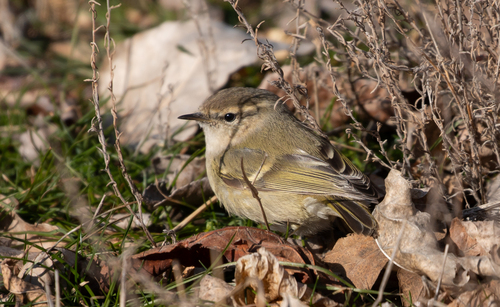 Hume's Warbler
In short
The most reliable field mark to separate Yellow-browed Warbler from Hume's Warbler is the number and clarity of the wing bars: Yellow-browed Warbler consistently shows two distinct pale wing bars, while Hume's Warbler usually has only one strong wing bar and at most a faint trace of a second. Hume's also appears duller overall, with darker legs and a dark lower mandible, compared to the brighter, more yellowish Yellow-browed. Both species are small, active leaf warblers with similar structure and habits, but their calls are notably different if heard well. Pay special attention to the upperwing pattern in all ages, as this is the most practical field mark in the overlap zone.
Identification tips
- Wing bars (all ages, perched or in flight): Yellow-browed Warbler always shows two clear pale wing bars (greater and median coverts); Hume's Warbler has only one strong wing bar and at most a faint second bar. This is the single most reliable field mark in all plumages.
- Overall brightness: Yellow-browed Warbler is noticeably brighter and more greenish above, with a cleaner, whiter belly. Hume's Warbler appears duller and more greyish or olive, with less contrast.
- Leg and bill color: Hume's Warbler has distinctly dark legs and a dark lower mandible, while Yellow-browed's legs and lower mandible are paler. This is best seen in good light and close views.
- Supercilium: Both have a long pale supercilium, but Yellow-browed's is usually more striking due to the overall brighter plumage. Not a primary separator on its own.
- Tertial edges: Both show yellowish edges to the tertials, but this is not a separator between the two.
- Crown stripe: Some Yellow-browed Warblers show a faint pale central crown stripe, but many do not; Hume's may show a crown stripe as well, so this is not a reliable field mark.
- Call: Yellow-browed's call is a loud, piercing, often disyllabic 'tseeweest'; Hume's is a more subdued, chirping 'chwee'. Learning the calls is very helpful, but beware of individual variation and poor listening conditions.
- Song: Yellow-browed sings a high-pitched medley of whistles; Hume's song is more buzzing and high-pitched. Song is rarely heard on migration or in winter.
- Habitat: Both use similar habitats in migration and winter; habitat is not a reliable separator except in breeding season (not relevant for most European records).
- Behavior: Both species are highly active, arboreal, and restless; behavior does not help separate them.
- Size and structure: Both are tiny, short-tailed, and similar in shape; size is not a useful field mark.
- Pitfalls: Worn or poorly lit birds may appear duller or lose contrast in wing bars, making separation harder. Always try to see the wing bars clearly.
- Seasonal context: In western Europe, Yellow-browed is much more likely in autumn and winter; Hume's is a rare vagrant. However, do not rely on rarity alone for identification.
- Sex and age: No sexual dimorphism; age differences are mainly in the clarity of wing bars, but the two-bar vs. one-bar pattern holds for all ages.
- When in doubt: Prioritize clear views of the upperwing and leg color, and try to obtain a recording of the call if possible.
Size
Both species are among the smallest Old World warblers and are very close in size, with Yellow-browed Warbler measuring 9.5–11 cm in length and weighing 4–9 g. Hume's Warbler is similarly small, and size is not a reliable separator in the field. Both are distinctly smaller than a chiffchaff but slightly larger than Pallas's Leaf Warbler. Structural proportions (bill, tail, wing) are not highlighted as diagnostic in the available sources.
Plumage
The key plumage distinction, visible in all ages and especially critical for immatures and birds in flight, is the wing bar pattern. Yellow-browed Warbler shows two prominent pale wing bars: a long, clear bar on the greater coverts and a shorter but still obvious bar on the median coverts. Hume's Warbler, by contrast, has only one strong wing bar (greater coverts) and at most a faint, often barely visible vestige of a second (median coverts). Hume's also appears generally duller and less green above, with less contrast between upperparts and underparts. Both species have yellow-margined tertials and a long pale supercilium, but Hume's is less bright overall. The legs and lower mandible of Hume's are distinctly darker than the paler tones of Yellow-browed. Some Yellow-browed may show a faint central crown stripe, but this is variable and not a primary separator.
Behaviour
Both species are highly active, arboreal, and rarely still, often feeding in the outer branches of trees and constantly moving. Their behavior and jizz are very similar, and both can be difficult to observe well due to their restlessness. Neither species is particularly shy, but their small size and canopy habits make them challenging to follow in binoculars. No behavioral differences are highlighted as diagnostic.
Habitat
Yellow-browed Warbler breeds across the east Palearctic in lowland and montane forests, wintering mainly in tropical South and Southeast Asia, but also regularly in western Europe. Hume's Warbler breeds in the mountains of inner Asia and winters mainly in India. In the overlap zone (western Sayan Mountains), both may occur together, but habitat is not a reliable separator in migration or winter. Both species use similar woodland and forest-edge habitats during migration and winter.
Voice
Vocalizations are a strong separator if heard well. Yellow-browed Warbler gives a piercing, often disyllabic 'tseeweest' call that is loud for its size and has a high-pitched, whistled song. Hume's Warbler has a more buzzing, high-pitched song and a more chirping, disyllabic 'chwee' call. The calls are distinct to experienced ears, but confusion is possible if only brief or poor-quality calls are heard.