

Yellow Bishop vs Yellow-mantled Widowbird
Euplectes capensis versus Euplectes macroura
Play a quiz with Yellow Bishop and Yellow-mantled Widowbird
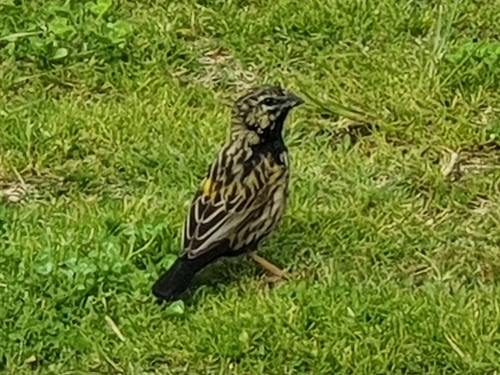 Yellow Bishop
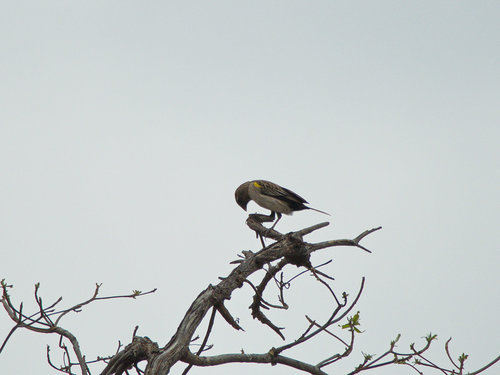 Yellow-mantled Widowbird
In short
The most reliable field mark for separating Yellow Bishop from Yellow-mantled Widowbird is the tail: breeding male Yellow-mantled Widowbirds show a much longer tail, while Yellow Bishops have a relatively short tail in all plumages. Both species' breeding males are mostly black with bright yellow shoulder and rump patches, but the Yellow Bishop's yellow extends lower onto the back and rump, while the Yellow-mantled Widowbird's yellow is concentrated on the mantle and shoulders. Non-breeding and female plumages are extremely similar and notoriously difficult to separate, but Yellow Bishops retain yellow on the rump, which is absent in female/immature Yellow-mantled Widowbirds. Structure, especially bill size and body bulk, can also help: Yellow Bishop is heavier and stockier. Juveniles and females are a major pitfall, as both are streaky brown with yellow shoulder patches, but careful attention to rump color and overall shape may help.
Identification tips
- Tail length is the best single field mark in breeding males: Yellow-mantled Widowbird males have a dramatically long tail in breeding season, while Yellow Bishop's tail is always short and square. This is most obvious in flight or when perched with the tail spread.
- Yellow on the rump vs. mantle: Yellow Bishop males (and non-breeding males) show bright yellow on the lower back and rump, visible both perched and in flight. Yellow-mantled Widowbird males have yellow on the mantle and shoulders, but the rump is black. This is subtle but diagnostic if seen well.
- Shoulder patches in both: Both species show bright yellow shoulder patches in all male plumages, and even in females/immatures, so this mark alone is not sufficient for separation.
- Female and juvenile separation is difficult: Both are streaky brown with yellow shoulder patches, but only Yellow Bishop females/immatures show yellow on the rump. In Yellow-mantled Widowbird, the rump is plain brown or blackish, lacking yellow. This is the main clue for non-breeding birds.
- Bill size and shape: Yellow Bishop has a thicker, more conical bill, often appearing heavy-headed. Bill size can vary between races, but is generally larger than in Yellow-mantled Widowbird.
- Body structure: Yellow Bishop is stockier and heavier-bodied, while Yellow-mantled Widowbird is more slender. This is subtle but can help in direct comparison.
- Crest: Yellow Bishop males have a short crest, which is lacking in Yellow-mantled Widowbird.
- Plumage seasonality: In non-breeding season, both species become streaky brown, but Yellow Bishop males retain yellow on the rump and shoulders, while Yellow-mantled Widowbird males retain yellow only on the shoulders.
- Bill color in non-breeding plumage: Yellow Bishop's bill becomes pale in non-breeding plumage, which may help separate from Yellow-mantled Widowbird if seen well.
- Group behavior: Yellow Bishop is often solitary or in pairs during breeding, but joins mixed Euplectes flocks in non-breeding season. Yellow-mantled Widowbird males may display in groups (leks) with long tails.
- Habitat preference: Yellow Bishop prefers moister, more vegetated habitats (fynbos, bracken valleys), while Yellow-mantled Widowbird is more typical of open grassland and savanna, though overlap can occur.
- Pitfall: Females and juveniles of both species are very similar and can be nearly impossible to separate without a good view of the rump or direct comparison. When in doubt, note the habitat and flock composition.
- Flight views: In flight, look for the yellow rump (Yellow Bishop) versus long tail (Yellow-mantled Widowbird male) as the quickest separation.
- Mixed flocks: In non-breeding season, both may occur together in mixed Euplectes flocks, making identification especially challenging for non-males.
- No reliable vocal differences noted: Voice is not described as a useful field mark in the available notes.
Size
Yellow Bishop is considerably heavier and bulkier (average 33.95g) than Yellow-mantled Widowbird (average 22g) [wikidata]. In the field, Yellow Bishop appears stockier with a thicker conical bill and a shorter tail, while Yellow-mantled Widowbird is more slender and, in breeding males, has a much longer tail. This size difference is most obvious when the two species are seen side by side, but can be subtle at a distance or in poor light.
Plumage
- Juveniles and females: Both species are streaky brown with yellow shoulder patches, but Yellow Bishop females/immatures retain yellow on the rump and lower back, while Yellow-mantled Widowbird females/immatures do not. Both lack the black and yellow contrast of breeding males.
- Breeding males: Both are mostly black with bright yellow shoulder patches. Yellow Bishop males have yellow extending onto the lower back and rump, and a short crest; Yellow-mantled Widowbird males have yellow on the mantle and shoulders, but the rump is black. The tail is dramatically longer in breeding male Yellow-mantled Widowbird, while Yellow Bishop's tail remains short.
- Non-breeding males: Both become streaky brown, but Yellow Bishop males retain yellow on the rump and shoulders, while Yellow-mantled Widowbird males retain yellow on the shoulders only. Bill color also changes: Yellow Bishop's bill becomes pale in non-breeding plumage, while Yellow-mantled Widowbird's bill color is not specified but is likely less contrasting.
Behaviour
Yellow Bishop is typically solitary or in pairs during the breeding season, but forms mixed-species flocks with other Euplectes in the non-breeding season. Yellow-mantled Widowbird's social behavior is less detailed in the notes, but as a widowbird, males are often seen displaying with long tails in leks or open areas during breeding. Both feed mainly on seeds and some insects.
Habitat
Yellow Bishop prefers less arid, vegetated areas such as fynbos, moist grassland, and bracken-covered valleys, often at a range of altitudes from sea level to highlands. Yellow-mantled Widowbird's habitat is not detailed here, but it is generally found in open grassland and savanna, sometimes overlapping with Yellow Bishop but often in slightly drier or more open settings. Both can occur in mixed flocks outside the breeding season.