

Yellow-bellied Flycatcher vs Alder Flycatcher
Empidonax flaviventris versus Empidonax alnorum
Play a quiz with Yellow-bellied Flycatcher and Alder Flycatcher
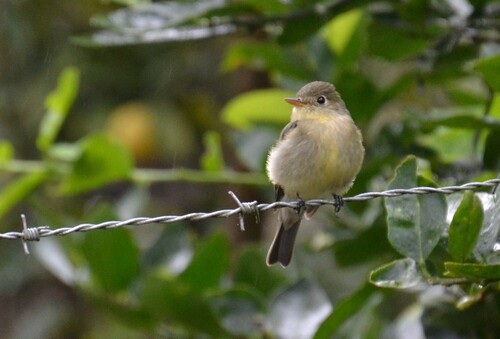 Yellow-bellied Flycatcher
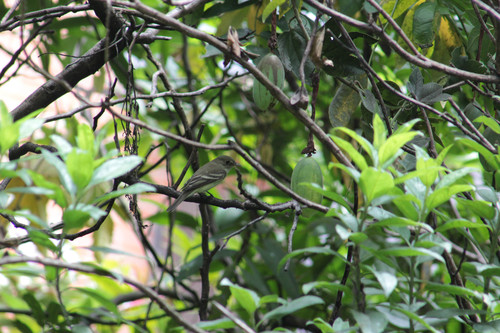 Alder Flycatcher
In short
The most reliable field mark between Yellow-bellied and Alder Flycatchers is the overall yellowish tone of the underparts and throat in Yellow-bellied, versus the whiter throat and duller, olive-tinged underparts of Alder. Juvenile Alder Flycatchers show buffy or yellowish-brown wingbars, while Yellow-bellied juveniles are more yellow below and have stronger yellow tones overall. Both species are classic 'Empids'—difficult to separate visually, especially in fall or away from breeding grounds, but careful attention to underpart color, throat contrast, and wingbar tone can help. Structure and voice are also useful, but beware of overlap and individual variation.
Identification tips
- Juvenile plumage: In fresh juveniles, look for brownish upperparts and buffy/yellow-brown wingbars on Alder, versus greener upperparts and brighter yellow underparts and wingbars on Yellow-bellied. This is most useful in late summer and early fall.
- Underpart color: Yellow-bellied shows a strong yellow wash on the underparts, especially the throat; Alder is duller, with a whiter throat and less yellow below. This holds for most ages and seasons, but can be subtle in worn or faded birds.
- Throat contrast: Alder Flycatcher has a white throat sharply set off from a darker breast band, while Yellow-bellied's throat is yellowish and blends more into the chest.
- Eye ring: Both have eye rings, but Yellow-bellied's is often more yellowish and can appear bolder; Alder's is thin and white. This is variable and not always reliable.
- Wingbars: Both species have two pale wingbars, but Yellow-bellied's are often brighter white or yellowish, contrasting strongly with black wings, while Alder's are white in adults and buffy in juveniles.
- Secondary edging: On close views or photos, Yellow-bellied shows more extensive buffy edging on the secondaries than Alder. This is subtle and best assessed in-hand or with excellent photos.
- Bill color: Both have a dark upper mandible and a paler lower mandible, but Yellow-bellied's lower mandible is more orange-pink, while Alder's is pinkish or yellow-orange. This is a minor mark and can be hard to judge.
- Tail length: Yellow-bellied has a relatively short tail compared to other Empidonax, but Alder is also short-tailed; this is not a strong separator between these two.
- Behavior: Watch for frequent upward tail flicking in Alder, which is less common in Yellow-bellied. This is not diagnostic but can support an ID.
- Habitat: In breeding season, Yellow-bellied prefers coniferous or mixed woods, especially bogs; Alder is found in wet thickets with alder or birch. In migration, both can occur in a wider range of habitats.
- Vocalizations: Song is the most reliable separator: Yellow-bellied gives a rough, descending 'tse-berk'; Alder gives a clear 'fee-bee-o'. Calls differ but are less distinctive. Use voice only when confident of the singer.
- Primary projection/wing formula: Not described in detail here, but ratio of primary lengths can separate these species in the hand or with excellent photos.
- Confusion risk: Both species are extremely similar and can overlap in all marks, especially in fall or away from breeding grounds. Use a combination of marks and, when possible, voice for best accuracy.
- Do not rely on size: Size differences are minimal and not reliable in the field.
- Avoid confusion with other Empidonax: Both can be confused with Least, Willow, and other Empids; always consider the full suite of marks and context.
Size
Both species are very similar in size, but Alder Flycatcher averages slightly larger, with a length of 13–17 cm and weight of 12–14 g, compared to Yellow-bellied's 13–15 cm and 8.5–17 g. In the field, this difference is subtle and rarely diagnostic unless birds are side by side. Wingspan is slightly greater in Alder (21–24 cm vs. 18–20 cm), but this is not easily judged in the field. Both have a compact, short-tailed look typical of Empidonax.
Plumage
Juvenile Alder Flycatchers have brownish upperparts, yellow underparts, and notably buff or yellowish-brown wingbars, while juvenile Yellow-bellied Flycatchers are greener above and more distinctly yellow below, with brighter yellowish or white wingbars. In adults, Yellow-bellied shows greenish upperparts and a strong yellow wash on the underparts, especially the throat, with a dusky chest. Alder adults are duller olive-green above, with a whiter throat and a darker breast band, and their underparts are less yellow overall. Both have eye rings, but Yellow-bellied's is often more yellowish, while Alder's is thin and white. Both have dark upper mandibles and paler lower mandibles, but Yellow-bellied's lower mandible is more orange-pink, while Alder's is pinkish or yellow-orange. The extent of buffy edging on the secondaries is a subtle but reliable mark in hand or on close photos: Yellow-bellied shows more extensive buffy edging.
Behaviour
Both species forage by sallying from low or mid-level perches to catch insects, sometimes hovering briefly. Alder Flycatcher is noted for frequent upward tail flicking, which can be a behavioral clue, while Yellow-bellied is less likely to show this. Both may eat berries or seeds occasionally. Perched posture and foraging style are otherwise very similar.
Habitat
Yellow-bellied Flycatcher prefers low or mid-level perches in mixed woods, especially in northern bogs and spruce forests during breeding. Alder Flycatcher breeds in wet thickets, especially those with alder, birch, or maple, often in shrubby, open, or edge habitats. While both can overlap in migration, Yellow-bellied is more associated with coniferous or mixed woods, and Alder with wet, shrubby thickets.
Voice
Vocalizations are often the best way to separate these species. Yellow-bellied's song is a rough, descending 'tse-berk', while Alder's is a distinct 'fee-bee-o', often accompanied by head-throwing and tail-shaking. Alder also gives a sharp 'pit' call and a variety of other calls ('zwee-oo', 'wee-oo', 'kitter'), while Yellow-bellied's call is less described here. Voice is most reliable on territory; beware of confusion with Least Flycatcher and Willow Flycatcher.
Yellow-bellied Flycatcher · Alder Flycatcher · My Tricky Birds