

Wilson's Storm-Petrel vs Leach's Storm-Petrel
Oceanites oceanicus versus Hydrobates leucorhous
Play a quiz with Wilson's Storm-Petrel and Leach's Storm-Petrel
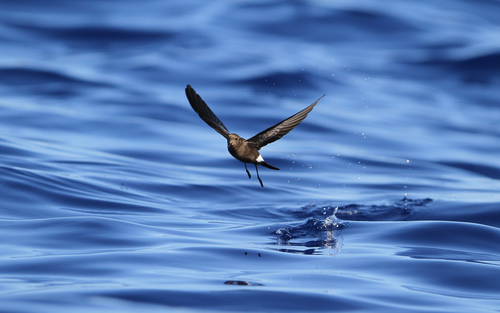 Wilson's Storm-Petrel
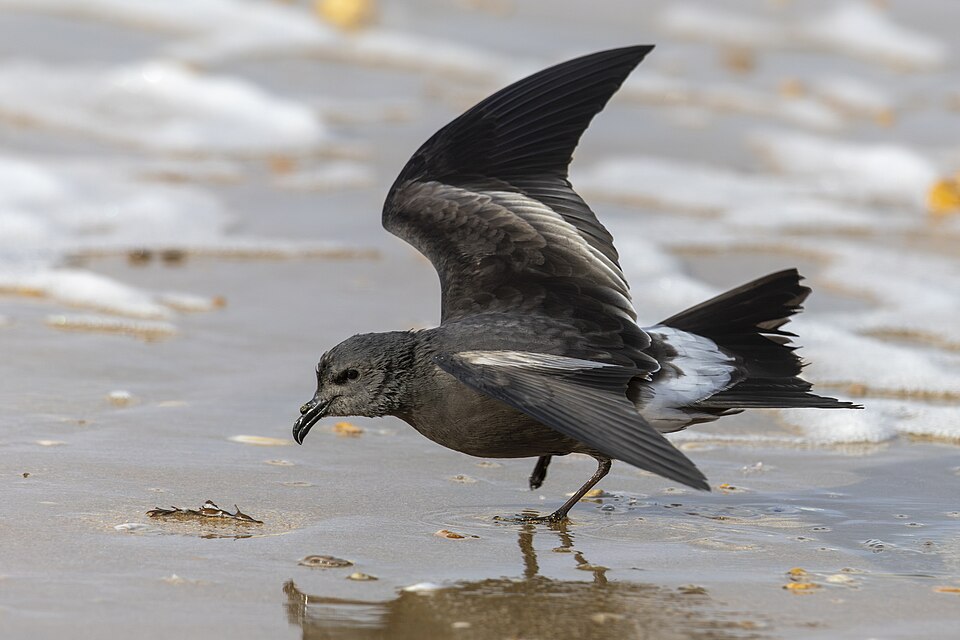 Leach's Storm-Petrel
In short
The most reliable field mark to separate Wilson's Storm-Petrel from Leach's Storm-Petrel is the tail shape and rump pattern in flight: Wilson's has a square-ended tail and a clean white rump, while Leach's shows a noticeably forked tail and usually a white rump with a dark central line. For all ages, Wilson's also shows a diffuse pale band on the upperwing coverts, whereas Leach's has a paler bar on the secondary coverts but lacks the same diffuse panel. Wilson's is slightly smaller and more compact, with feet that project beyond the tail in flight, which Leach's does not show. Both species are dark overall with white rumps, but subtle differences in flight style and structure are key for confident identification.
Identification tips
- Tail shape: In flight, Wilson's Storm-Petrel has a square-ended tail, while Leach's Storm-Petrel shows a distinctly forked tail. This is the most reliable field mark at all ages and seasons.
- Rump pattern: Wilson's always has a clean, unbroken white rump and flanks. Leach's typically shows a white rump with a dark central line or smudge, especially in Atlantic birds. Beware of dark-rumped Leach's in the Pacific, which can lack the white rump entirely.
- Upperwing pattern: Wilson's shows a diffuse pale band along the upperwing coverts (all ages), while Leach's has a paler grey-brown bar on the secondary coverts. The difference is subtle but visible in good light.
- Feet projection: In Wilson's, the legs and feet extend just beyond the tail in flight, creating a tiny projection. Leach's does not show this feature; the feet are not visible beyond the tail.
- Flight style: Wilson's has a more direct, gliding, and fluttering flight, often with wings held high and frequent 'pattering' on the water. Leach's is more bounding and erratic, with more frequent glides and less hovering.
- Size and shape: Wilson's is slightly smaller and more compact; Leach's is longer-winged and more slender. This is subtle and best used in direct comparison.
- Face: Leach's may show a slightly paler face, but this is not always obvious.
- Webbing color: Wilson's pre-breeding birds have yellow webbing with black spots between the toes, but this is rarely visible except at very close range.
- Plumage pitfalls: Both are dark with white rumps, but beware of dark-rumped Leach's on the Pacific coast, which can appear all-dark and lack the white rump. In such cases, rely on tail shape and flight style.
- Habitat and context: Wilson's is more likely in large flocks and is globally abundant; Leach's is more localized and less likely to be seen in large numbers away from breeding sites.
- Ship-following: Wilson's is more likely to follow ships and fishing boats, sometimes in large flocks. Leach's is less gregarious in this context.
- Vocalizations: Not useful for separation at sea; both are generally silent away from colonies.
- Seasonal overlap: Both can occur together in northern oceans during summer, so do not rely on season alone for identification.
- Perched views: Rare for both at sea; most identification will be in flight.
- Juvenile/immature confusion: All key field marks (tail shape, rump pattern, upperwing panel) apply to all ages, so immatures are separated by the same features as adults.
Size
Wilson's Storm-Petrel is slightly smaller and lighter, with a body mass of 34.0 g [wikidata] and a length of 16–18.5 cm, wingspan 38–42 cm [wikipedia]. Leach's Storm-Petrel is larger, at 18–21 cm in length and a wingspan of 43–48 cm [wikipedia]. In the field, this size difference is subtle, but Leach's often appears longer-winged and more slender, while Wilson's is more compact.
Plumage
- Juvenile and immature birds: Both species are dark overall with a white rump, but Wilson's always shows a clean, bright white rump and flanks, while Leach's typically has a white rump with a dark central line or smudge (especially visible in Atlantic birds). On the upperwing, Wilson's has a diffuse pale band along the upperwing coverts, present in all plumages, while Leach's shows a paler grey-brown bar on the secondary coverts but not the same diffuse panel. Leach's can have a slightly paler face.
- Adults: Wilson's retains the white rump and pale upperwing covert band, with a square tail. Leach's adult shows the white rump (often divided), a forked tail, and a paler bar on the wing. On the Pacific coast, beware of dark-rumped Leach's, which can lack the white rump entirely—this is rare north of southern California but common further south.
- Feet: In Wilson's, the feet project just beyond the tail in flight, a subtle but consistent mark. Leach's does not show this feature.
- Webbing: Wilson's pre-breeding age birds have yellow webbing with black spots between the toes, but this is rarely visible in the field.
Behaviour
Both species feed by pattering on the water surface and picking planktonic food items. Wilson's Storm-Petrel has a more direct, gliding flight with wings often held high, and is famous for its fluttering, hovering style as it 'walks' on the water. Leach's Storm-Petrel also patters but tends to have a more fluttery, bounding flight, often interspersed with glides, and is more likely to show a bounding, erratic flight path. Wilson's is highly gregarious and often follows ships; Leach's is less so.
Habitat
Both are pelagic, rarely seen from land except at breeding colonies. Wilson's Storm-Petrel is one of the most abundant seabirds globally and is likely to be encountered in large flocks, especially in the southern oceans but also in northern summer. Leach's is more localized and less abundant, breeding on remote islands in the North Atlantic and North Pacific. In the field, context (location and season) can help, but both may overlap offshore.
Voice
No diagnostic vocalizations are described for field separation between these two species in the provided notes. Both are generally silent at sea.
Wilson's Storm-Petrel · Leach's Storm-Petrel · My Tricky Birds