

Willow Warbler vs Greenish Warbler
Phylloscopus trochilus versus Phylloscopus trochiloides
Play a quiz with Willow Warbler and Greenish Warbler
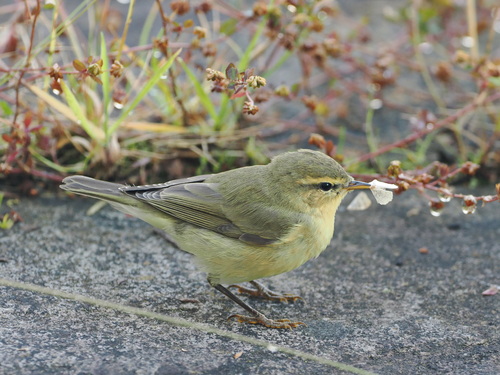 Willow Warbler
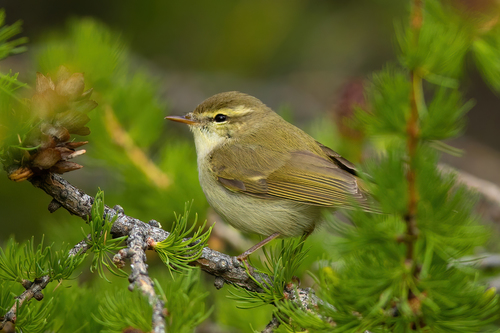 Greenish Warbler
In short
The most reliable field mark to separate Willow Warbler from Greenish Warbler is the presence or absence of a wing bar: Greenish Warbler (especially western and southern populations) shows a distinct pale wing bar on the greater coverts, while Willow Warbler always lacks any wing bar and has plain greenish-brown wings. This difference is especially clear in fresh juveniles and immatures, but also holds for adults. Willow Warbler is typically longer-winged with a more elegant shape and longer primary projection, while Greenish Warbler is a bit more compact and often shows a slightly greyer-green tone above. Leg color and bill structure can help, but are subtle. Both species are small, greenish leaf warblers, so careful attention to the wing and structure is essential in the field.
Identification tips
- Check for a wing bar: Greenish Warbler (especially western and southern forms) shows a distinct pale wing bar on the greater coverts in all plumages; Willow Warbler never shows a wing bar at any age. This is the most reliable field mark.
- Look for a second wing bar: Some eastern Greenish Warblers (trochiloides group) may show a faint second wing bar; Willow Warbler always lacks both.
- Assess the upperparts color: Willow Warbler is greenish-brown above, sometimes with a warmer or yellower tone; Greenish Warbler is typically greyer-green or duller, especially in eastern birds.
- Underparts hue: Juvenile Willow Warblers are distinctly yellower below than Greenish Warblers, which are more off-white or only faintly yellowish.
- Primary projection: Willow Warbler has a noticeably longer primary projection (the wingtip extends well beyond the tertials when perched), giving it a more elegant, elongated look; Greenish Warbler's projection is shorter, making it appear more compact.
- Bill structure: Willow Warbler has a longer, paler bill; Greenish Warbler's bill is thinner and lacks a dark tip to the lower mandible. This is subtle and best used in good light.
- Leg color: Willow Warbler has paler, pinkish-yellow legs; Greenish Warbler's legs are not as distinctly pale but this is variable and not always reliable.
- Overall shape ('jizz'): Willow Warbler often looks longer and more graceful, especially when perched; Greenish Warbler is a bit more compact and can look slightly rounder.
- Song: Willow Warbler sings a simple, descending, sweet whistle; Greenish Warbler's song is a high, jerky trill, sometimes with slurred notes. Song is diagnostic if heard well.
- Call: Willow Warbler's call is a soft, disyllabic 'hoo-eet'; Greenish Warbler's is sharper and more abrupt. Use with caution unless familiar.
- Habitat and context: In western and northern Europe, Willow Warbler is vastly more likely except during peak vagrancy periods. Greenish Warbler is a rare migrant or vagrant in these regions.
- Seasonal context: In late summer and autumn, juvenile Willow Warblers may look especially yellow below, but still never show a wing bar. Greenish Warbler juveniles always show at least one pale wing bar.
- Pitfalls: Do not confuse faint pale edges on Willow Warbler's wing coverts for a true wing bar; Greenish Warbler's wing bar is usually crisp and contrasts with the rest of the wing.
- Direct comparison: If you see both together, the difference in wing bar and primary projection is striking. Use these features first before relying on subtle color or structure differences.
- When in doubt: If you see a small Phylloscopus warbler with a clear pale wing bar, rule out Willow Warbler. If no wing bar is visible and the bird is long-winged and yellowish below, Willow Warbler is likely.
Size
Willow Warbler is slightly larger, measuring 11–12.5 cm in length and weighing 7–15 g [wikipedia]. Greenish Warbler is similar but marginally smaller overall, with some geographic variation (northern birds being smaller) [wikipedia]. In the field, this size difference is subtle and not usually diagnostic unless seen side-by-side. Both are typical small Phylloscopus warblers.
Plumage
- Juvenile and immature birds: Greenish Warbler (especially western and southern forms) shows a distinct pale wing bar on the greater coverts, sometimes with a trace of a second bar in some eastern birds. Willow Warbler juveniles and immatures never show a wing bar; their wings are plain greenish-brown. This is the single most useful plumage mark at all ages.
- Adults: Willow Warbler is greenish-brown above and off-white to yellowish below, with no wing bars. Greenish Warbler is grayish-green above and off-white below, with a single pale wing bar (sometimes faint, but usually visible in the field). Greenish Warbler may appear slightly greyer or duller above, especially in eastern birds.
- Underparts: Willow Warbler tends to be yellower below (especially in juveniles), while Greenish Warbler is more off-white or only faintly yellowish.
- Other marks: Willow Warbler has a longer, paler bill and paler pinkish-yellow legs; Greenish Warbler's bill is thinner and lacks a dark tip, leg color is less distinctive.
Behaviour
Both species are active, restless foragers in foliage, often flicking wings and tails. Willow Warbler may appear more elegant and elongated, moving with a smoother, more fluid motion, while Greenish Warbler is slightly more compact and may appear a bit more deliberate. Behavior is not a strong separator unless combined with structure and plumage.
Habitat
Willow Warbler breeds widely in open woodlands with trees and ground cover, especially birch, alder, and willow, across northern and temperate Europe into Siberia. Greenish Warbler breeds in northeastern Europe and across Asia, favoring lowland deciduous or mixed forests, and is more likely to be found as a rare vagrant in Western Europe. In autumn or spring, Greenish Warbler may be encountered in more varied habitats, including montane forests in its Asian range. Habitat overlap is possible, but Willow Warbler is much more likely in western and northern Europe outside vagrancy periods.
Voice
Willow Warbler's song is a simple, repetitive descending whistle, and its contact call is a disyllabic 'hoo-eet'. Greenish Warbler's song is a high, jerky trill, sometimes with down- and up-slurred notes, and is generally more complex and variable than Willow Warbler's. Calls are less often diagnostic in the field unless heard well; Willow Warbler's call is softer and more disyllabic, while Greenish Warbler's is sharper and more abrupt.