

White-vented Euphonia vs Yellow-throated Euphonia
Euphonia minuta versus Euphonia hirundinacea
Play a quiz with White-vented Euphonia and Yellow-throated Euphonia
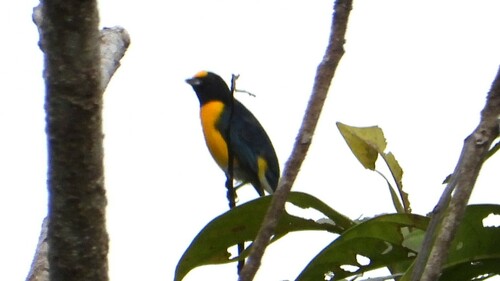 White-vented Euphonia
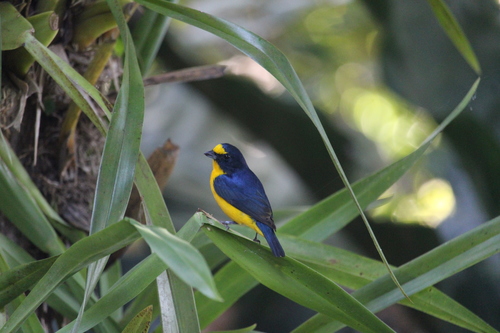 Yellow-throated Euphonia
In short
The most reliable field mark between White-vented Euphonia and Yellow-throated Euphonia is the color and extent of the vent and underparts: White-vented Euphonia (both sexes) shows a distinctly white vent and undertail coverts, while Yellow-throated Euphonia has dark gray or olive-yellow undertail coverts and no white vent. Males of both species are glossy blue-black above with yellow underparts, but the yellow forehead patch is smaller and does not reach the eye in White-vented, while it extends further back in Yellow-throated. Females are best separated by the extent of white on the underparts: White-vented females have a white belly and vent, while Yellow-throated females have a whitish to grayish-white center but olive-yellowish undertail coverts. White-vented is smaller and more compact, with a shorter bill and tail. In flight or quick views, focus on the vent and undertail color, and the size difference if both species are present.
Identification tips
- White vent/undertail coverts (all ages, both sexes): White-vented Euphonia always shows a white vent and undertail coverts, a unique feature not present in Yellow-throated.
- Undertail coverts (Yellow-throated): Yellow-throated Euphonia has dark gray or olive-yellow undertail coverts, never white.
- Belly color (females): Female White-vented has a white belly and vent, while female Yellow-throated has a whitish to grayish-white belly center but pale olive-yellowish undertail coverts.
- Forehead patch (adult males): White-vented male's yellow forehead patch is small and does not reach the eye; Yellow-throated's extends to about the middle of the eye.
- Underparts (adult males): White-vented has a white belly center and vent; Yellow-throated is yellow throughout below, with no white vent.
- Upperparts (adult males): Both are glossy blue-black above, but White-vented may show a purplish gloss on the head and nape.
- Size and structure: White-vented is smaller and more compact (10 g, 9 cm) with a shorter, thicker bill; Yellow-throated is larger (14 g, 10–12 cm), longer-tailed, and slightly longer-billed.
- Tail wagging (behavior): White-vented often wags its tail while foraging; Yellow-throated does not.
- Wing pattern in flight: Both species show white on the underside of outer tail feathers, but Yellow-throated's is a larger, oval-shaped patch; White-vented's is more restricted.
- Underwing coverts: Yellow-throated has white underwing coverts; not specified for White-vented.
- Immature males: Both start out resembling females, but Yellow-throated males develop yellow on the throat and belly first, then black on the head, with the back and wings last to turn blue-black. Use vent color if visible.
- Habitat: If in open woodland, edge, or plantation in Central America, both are possible; White-vented is more likely in humid forest canopy but not exclusive.
- Vocalizations: If you hear a high-pitched, choppy, or mimicking song, or explosive "weet" or "gleer," suspect Yellow-throated. Silence or unknown song does not rule out either.
- Direct comparison: If both species are present, White-vented will appear noticeably smaller and shorter-tailed.
- Pitfalls: Do not rely on the yellow forehead patch alone—both have it. Always check the vent and undertail color for the most reliable separation, especially in females and immatures.
Size
White-vented Euphonia is distinctly smaller and lighter, averaging about 10 g and 9 cm in length, while Yellow-throated Euphonia is larger at about 14 g and 10–12 cm. The difference is noticeable in direct comparison, with Yellow-throated appearing bulkier and longer-tailed. Bill size is also slightly larger in Yellow-throated, but this is subtle unless seen side by side.
Plumage
- Juveniles/Immatures: Both species' immature males resemble females, with olive-green upperparts and whitish or pale underparts. As Yellow-throated males mature, they first develop yellow on the throat and belly, then black on the head, with the back and wings the last to turn blue-black. White-vented immatures are less well described but likely similar to adult females, with olive above and white below.
- Adult Males: Both have glossy blue-black upperparts and yellow underparts, but White-vented has a small yellow forehead patch that does not reach the eye, while Yellow-throated's yellow forehead extends to about the middle of the eye. The most diagnostic mark is below: White-vented has a white belly center and white undertail coverts (vent), whereas Yellow-throated has yellow underparts throughout and dark gray or olive-yellow undertail coverts.
- Adult Females: White-vented females are olive above, with a dingy grayish-white throat, olive-yellow flanks, and a white belly and vent. Yellow-throated females are olive-green above with a faint gloss, a whitish to grayish-white throat and belly center, yellowish olive flanks, and pale olive-yellowish undertail coverts (not white). The white vent is unique to White-vented.
- Wings in Flight: Both have white on the inner webs of the outer tail feathers visible from below, but Yellow-throated's is described as a large, oval-shaped white area, while White-vented's is more restricted. Underwing coverts are white in Yellow-throated; not specified for White-vented.
Behaviour
Both species forage actively in the canopy, often in pairs or small groups, and join mixed-species flocks. White-vented Euphonia is noted for almost constantly wagging its tail while foraging, which may be a subtle behavioral clue. There is no strong behavioral difference in flight style or foraging jizz between the two, but White-vented may appear more compact and energetic due to its smaller size.
Habitat
Ranges overlap in Central America, especially from Mexico to Panama. White-vented Euphonia is more widespread, occurring from Mexico through Central America and into most of South America (except southern cone countries). Yellow-throated Euphonia is restricted to southeastern Mexico through western Panama and prefers forest edges, open woodland, and shaded plantations, while White-vented is more often in humid forest canopy. Both can occur together in Central America, so habitat alone is not diagnostic.
Voice
Yellow-throated Euphonia has a varied song with high-pitched, shrill, and squeaky notes, often in choppy 2–4 note patterns, and sometimes mimics other birds. Calls include rapid "pidgel-eece," "chi-bib-bib-bib-bib," and explosive "weet" or "gleer." Female calls are thin, high-pitched, and trilled. No specific vocal description is given for White-vented Euphonia in the notes, so voice is not a reliable separator unless Yellow-throated's distinctive calls are recognized.
White-vented Euphonia · Yellow-throated Euphonia · My Tricky Birds