

White-throated Mountain-gem vs Ruby-throated Hummingbird
Lampornis castaneoventris versus Archilochus colubris
Play a quiz with White-throated Mountain-gem and Ruby-throated Hummingbird
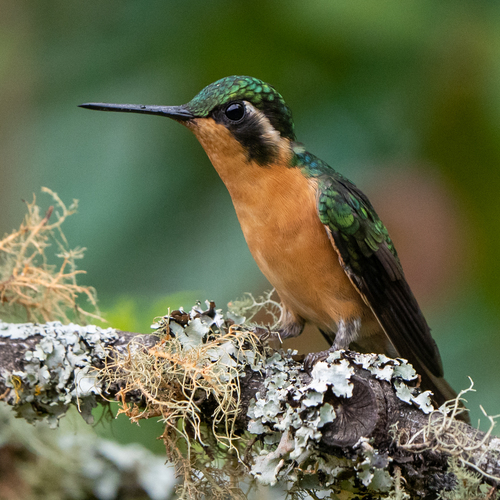 White-throated Mountain-gem
 Ruby-throated Hummingbird
In short
The most reliable field mark is throat color: adult male White-throated Mountain-gem shows a crisp white throat bordered by bright green sides, while adult male Ruby-throated Hummingbird has an iridescent ruby-red gorget (which can appear black from some angles). Females and immatures are trickier, but the Mountain-gem female and young have a rich rufous belly and throat, unlike the pale, lightly marked underparts of female/immature Ruby-throated. Tail shape and pattern also differ: Mountain-gem females have metallic green central tail feathers, while Ruby-throated females have notched tails with white tips. Structure and context help: Mountain-gem is a montane Central American specialty, Ruby-throated is widespread in North America. Juvenile/immature wing pattern is not a key separator based on current sources.
Identification tips
- Adult male throat color: White-throated Mountain-gem has a crisp white throat with bright green sides; Ruby-throated has an iridescent ruby-red gorget (appearing black from some angles). This is the single most reliable mark for adult males.
- Female/immature underparts: Female Mountain-gem shows a dark rufous throat and belly, while female Ruby-throated has a white throat (sometimes lightly spotted) and pale underparts. Juvenile Ruby-throated can have heavier throat markings but never rufous below.
- Tail pattern (female/immature): Mountain-gem females have metallic green central tail feathers and paler outer ones; Ruby-throated females have a notched tail with white tips on the outer feathers and banding in green, black, and white. This is best seen when the tail is spread.
- Tail shape (male): Ruby-throated male has a forked black tail with a faint violet sheen; Mountain-gem male has a black to bluish-black tail, not distinctly forked.
- Upperparts (female): Both species are green above, but Mountain-gem is described as 'entirely bright green' above, while Ruby-throated is less intensely colored.
- Belly color (female/immature): Mountain-gem has a dark rufous belly; Ruby-throated is pale below.
- Bill shape and length: Both have medium-length, straight, black bills; not a separator.
- Cheek and face pattern: Mountain-gem has dark cheeks and a white stripe behind the eye; Ruby-throated lacks a strong facial stripe.
- Crown color (male): Mountain-gem male has an emerald green crown; Ruby-throated male's crown is not distinctly colored.
- Habitat and range: Mountain-gem is only in highland forests of Costa Rica and Panama; Ruby-throated is widespread in North America and migrates to Central America in winter. Use location as a strong clue.
- Behavior at flowers: Mountain-gem males are more aggressive and territorial, especially in forest interiors; Ruby-throated is less dominant.
- Voice: Mountain-gem gives high-pitched 'ziit' or 'ziip' calls and a bubbly song; Ruby-throated is mostly silent with faint chips.
- Size: Mountain-gem is slightly larger and heavier, but this is subtle and not a reliable field mark unless both are together.
- Seasonal context: If you see a hummingbird in North America in summer, it is almost certainly Ruby-throated; in Costa Rican/Panamanian highlands, Mountain-gem is likely.
- No distinctive juvenile wing pattern: Neither species has a described age-specific upperwing pattern that is diagnostic in flight, so focus on throat, belly, and tail for immature birds.
Size
White-throated Mountain-gem is about 12 cm (4.7 in) long and weighs 5–6 g, while Ruby-throated Hummingbird is slightly smaller and lighter on average (males especially), but the difference is subtle and not always reliable in the field. Both are medium-small hummingbirds. Bill length and shape are similar: medium-length, straight, and black. Size is not a primary separator unless you have both species side by side.
Plumage
For adult males, throat color is diagnostic: Mountain-gem has a white throat with bright green sides of neck and upper breast, contrasting with a dark gray lower breast and vent; Ruby-throated male has an iridescent ruby-red gorget (which can look black when not catching the light), bordered by velvety black above, and a forked black tail. Female Mountain-gem is bright green above, with a dark rufous throat and belly, and metallic green central tail feathers; female Ruby-throated is green above but has a white throat (sometimes with faint dusky spots), pale underparts, and a notched tail with white tips on the outer feathers. Juvenile Ruby-throated resembles the female but may show heavier throat markings; Mountain-gem immatures are not described in detail, but rufous underparts are expected. No distinctive juvenile upperwing or flight pattern marks are described for either species.
Behaviour
Both species feed on nectar and small arthropods, but White-throated Mountain-gem males are more territorial and dominant at flower patches, especially in forest interiors, while females use shrubby edges. Ruby-throated Hummingbird is less aggressive and more likely to be seen feeding in gardens, open woods, and at feeders. Flight style is similar: rapid, agile, and hovering, with both species able to perch but shuffling along branches rather than walking. Courtship behavior is not a field separator.
Habitat
White-throated Mountain-gem is restricted to highland oak forests and shrubby clearings in the mountains of Costa Rica and western Panama, usually above 1,500 m. Ruby-throated Hummingbird breeds in a wide range of habitats across eastern North America, including gardens, wood edges, and open forests, and winters in Central America and Florida. If you are in a North American garden, you are almost certainly seeing Ruby-throated; if you are in a high-elevation cloud forest in Costa Rica or Panama, it is likely Mountain-gem.
Voice
White-throated Mountain-gem gives high-pitched 'ziit' or 'ziip' calls and a sputtery, bubbly song. Ruby-throated Hummingbird is generally quiet, with only faint chips and squeaks, and does not have a distinctive song. In practice, vocalizations are not a reliable separator for most birders.
White-throated Mountain-gem · Ruby-throated Hummingbird · My Tricky Birds