

White-throated Mountain-gem vs Purple-throated Woodstar
Lampornis castaneoventris versus Philodice mitchellii
Play a quiz with White-throated Mountain-gem and Purple-throated Woodstar
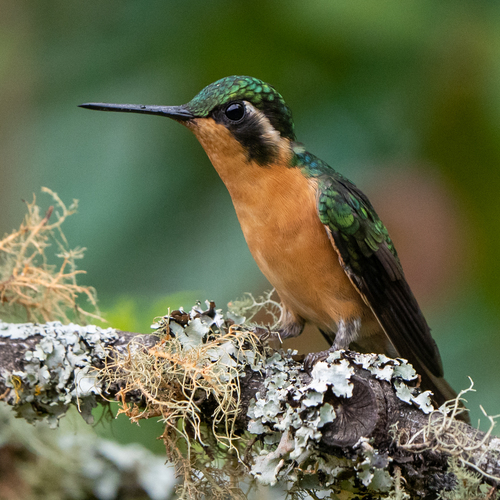 White-throated Mountain-gem
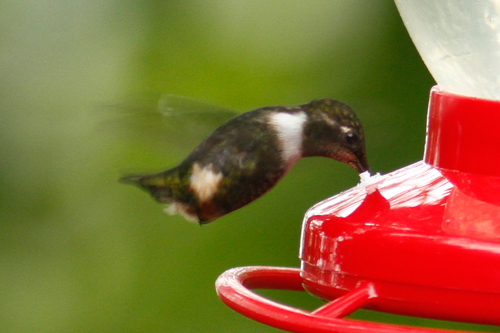 Purple-throated Woodstar
In short
The most reliable field mark to separate these two is size: the White-throated Mountain-gem is nearly twice as long and heavy as the tiny Purple-throated Woodstar. If you see a hummingbird with a white throat and bright green upperparts (male), or a female with a rufous belly and green back, check the bill length and overall size—mountain-gem is much larger and bulkier. In flight, the woodstar's short, forked tail and white rump patches are distinctive, while the mountain-gem has a straighter, darker tail and lacks any white rump. Sexes differ in both species, so note throat color and belly tone. Both can occur in Panama, but only the mountain-gem is found in Costa Rica.
Identification tips
- Size is the quickest separator: If the bird looks tiny, bee-like, and much smaller than a typical hummingbird, it's a Purple-throated Woodstar; if it appears medium-sized and robust, it's a White-throated Mountain-gem. This works for all ages and sexes.
- Tail shape in flight: Woodstar males have a deeply forked, brownish purple tail; females have cinnamon outer tail feathers with a black band. Mountain-gem tails are straighter and darker (male) or bronze-green with paler outers (female), never forked or cinnamon.
- White rump patches: Both sexes of woodstar show obvious white patches on the sides of the rump, visible in flight and often when perched. Mountain-gem never shows white on the rump.
- Bill length: Mountain-gem has a medium-length straight black bill; woodstar's bill is noticeably shorter and straight. Use this when size is hard to judge.
- Male throat color: Mountain-gem males have a white chin and throat; woodstar males have a shining violet-purple gorget with a white band below. This is diagnostic for adult males.
- Female throat and belly: Mountain-gem females have a dark rufous throat and belly; woodstar females have a buffy white throat with dusky speckles, a white band below, green lower breast, and rufous belly. The white throat and band are key for woodstar females.
- Upperparts: Mountain-gem males have an emerald green crown and dark bronzy green upperparts; woodstar upperparts are dusky bronze-green but lack the bright crown.
- Facial markings: Both have a white mark behind the eye, but in woodstar males it's a small spot, and in females a curved line. Mountain-gem has a white stripe behind the eye, but this alone is not diagnostic.
- Habitat and range: In Costa Rica, only mountain-gem is possible. In Panama, check elevation and habitat: mountain-gem prefers highland oak forests, woodstar can occur at lower elevations and in a wider range of habitats.
- Behavior: Woodstars hover and dart rapidly, often appearing insect-like. Mountain-gems are steadier and more robust in flight, often defending flower patches.
- Voice: Only mountain-gem's voice is described (high-pitched 'ziit' or 'ziip'); lack of woodstar vocalization means this is not a reliable separator.
- Sex differences: Always check throat and belly color for sexing, as both species show strong sexual dimorphism.
- Seasonal variation: No significant seasonal plumage changes are noted for either species, so these marks work year-round.
- Pitfalls: Female mountain-gems and woodstars can both show green upperparts and rufous bellies; use throat color and white rump patches to separate. Juvenile marks are not described, so rely on size, tail, and rump patches for immature birds.
- When in doubt: If the bird looks exceptionally small, with a forked tail and white rump patches, it's a woodstar. If it's larger, with a white throat (male) or rufous throat and belly (female), and no white rump, it's a mountain-gem.
Size
White-throated Mountain-gem is a medium-sized hummingbird, about 12 cm long and weighing 5–6 g. The Purple-throated Woodstar is much smaller, only 6.8–7.5 cm and 3.0–3.3 g. This difference is obvious in the field: the mountain-gem appears robust and noticeably larger than most hummingbirds, while the woodstar is tiny, compact, and 'bee-like' in flight. Bill length also differs: the mountain-gem's is medium and straight, the woodstar's is short and straight.
Plumage
- Juvenile/immature marks: No specific juvenile or upperwing pattern marks are described for either species, so focus on adult and sex-specific plumage.
- Adult males: Mountain-gem males have a white chin and throat, emerald green crown, dark bronzy green upperparts, and a black to bluish tail. Woodstar males have a shining violet-purple gorget with a white band below, bronze-green upperparts, white rump patches, and a brownish purple forked tail. Their belly and flanks are rufous.
- Adult females: Mountain-gem females have bright green upperparts, rufous throat and belly, and a tail with bronze-green central feathers and paler outers. Woodstar females have a buffy white throat with dusky speckles, a white band below, green lower breast, rufous belly, and a tail with bronze-green central feathers and cinnamon outers with a black band near the tip. Both sexes of woodstar show white rump patches, which are absent in mountain-gem.
- Tail: Mountain-gem has a straight, dark tail (male) or bronze-green with paler outers (female). Woodstar has a forked, brownish purple tail (male) or cinnamon with black band (female).
Behaviour
White-throated Mountain-gem males are territorial, often defending flower patches and feeding in the forest interior, while females feed more in shrubby areas. They are dominant over smaller hummingbirds. The Purple-throated Woodstar, being much smaller, is less likely to be dominant and is more likely to be seen darting quickly between flowers, often hovering in a bee-like manner. The woodstar's flight is typically rapid and agile, with frequent hovering and quick dashes, while the mountain-gem appears steadier and bulkier in flight.
Habitat
White-throated Mountain-gem is restricted to highland oak forests, edges, shrubby clearings, and nearby gardens in western Panama and south-central Costa Rica, at elevations from 1,500 m up to timberline. Purple-throated Woodstar occurs in Panama, Colombia, and Ecuador, but not Costa Rica, and is not restricted to high elevations. Overlap is possible only in Panama, where the mountain-gem is more likely in montane forest and the woodstar in a wider range of habitats.
Voice
White-throated Mountain-gem gives high-pitched 'ziit' or 'ziip' calls and a sputtery, bubbly song. No vocalization details are provided for the Purple-throated Woodstar in the notes, so voice is not a reliable separator here.
White-throated Mountain-gem · Purple-throated Woodstar · My Tricky Birds