

White-tailed Tropicbird vs Ainley's Storm-Petrel
Phaethon lepturus versus Hydrobates cheimomnestes
Play a quiz with White-tailed Tropicbird and Ainley's Storm-Petrel
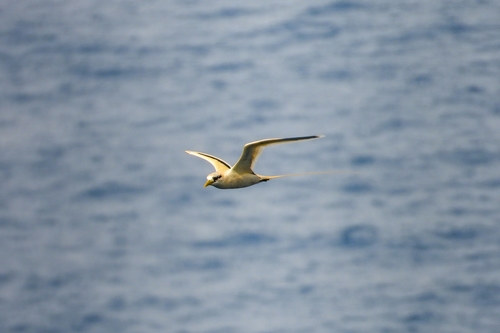 White-tailed Tropicbird
 Ainley's Storm-Petrel
In short
The most reliable field mark to separate White-tailed Tropicbird from Ainley's Storm-Petrel is overall color and structure: the tropicbird is a striking, mostly white, long-tailed seabird with black inner wing bars and a bright bill, while Ainley's Storm-Petrel is a much smaller, sooty-brown (appearing blackish at a distance) bird with a white rump and short, forked tail. Juvenile tropicbirds lack the long tail streamers and have a finely barred back, but remain mostly white with a contrasting black eye-mask and wing bar, unlike the uniformly dark storm-petrel. In flight, the tropicbird's long, elegant wings and tail are unmistakable compared to the storm-petrel's shorter, blunt-pointed wings and fluttery, bounding flight. Bill color (yellow/orange in tropicbird, black in storm-petrel) and tail length are key at all ages. These species are rarely confused in the field except at great distance or in poor light, but confusion may arise with immature tropicbirds or distant, pale-backed storm-petrels.
Identification tips
- Overall color: White-tailed Tropicbird is mostly white with black markings; Ainley's Storm-Petrel is sooty-brown to blackish with a white rump. No age of storm-petrel is ever mostly white.
- Tail shape and length: Tropicbird adults have extremely long, white central tail streamers, easily doubling body length. Juveniles lack streamers but still have a relatively long tail. Storm-petrel has a short, moderately forked tail, never with streamers.
- Bill color: Tropicbird has a bright orange-yellow to orange-red bill (adults), or green-yellow (juveniles); storm-petrel's bill is always black. Bill color is visible at moderate range in good light.
- Wing pattern: Tropicbird shows a black bar on the inner wing (all ages), contrasting with white wings. Storm-petrel's wings are uniformly dark, with no contrasting bars or panels.
- Eye-mask: Tropicbird has a bold black eye-mask; storm-petrel does not.
- Rump patch: Storm-petrel has a white rump (U-shaped, with central dark area); tropicbird's rump is white but not contrasting with rest of body.
- Back pattern (juveniles): Juvenile tropicbirds have a finely barred back, but this is subtle and not likely to cause confusion with the uniformly dark storm-petrel.
- Flight style: Tropicbird soars and glides with slow, deep wingbeats and long tail streamers trailing; storm-petrel flutters, bounds, and patters on the water, with quick, erratic movements.
- Size: Tropicbird is much larger (wingspan up to 96 cm) than storm-petrel (about 18 cm long). Even at distance, the tropicbird's size and proportions are distinctive.
- Legs and feet: Storm-petrel's legs and feet are black and do not extend beyond the tail in flight; tropicbird's legs are short and not usually visible in flight.
- Habitat: Tropicbird is usually seen near islands or cliffs, sometimes far at sea; storm-petrel is almost exclusively pelagic, far from land except at breeding islets.
- Vocalizations: Tropicbird gives loud, high-pitched screams; storm-petrel is silent at sea. Voice is rarely diagnostic in the field.
- Perched posture: Tropicbird perches on cliffs or open ground, often with tail streamers visible; storm-petrel is rarely seen perched except at night in burrows.
- Season and range: Overlap is rare; check local abundance and range if unsure. Tropicbird is much more widespread in the tropics, storm-petrel is highly localized.
- Common pitfalls: Distant, streamer-less juvenile tropicbirds may appear smaller and less distinctive, but still show white plumage and black wing bar. Storm-petrels never show white heads or bodies. In poor light, focus on structure and flight style.
Size
White-tailed Tropicbird is dramatically larger: adults measure 71–80 cm in total length (including extremely long central tail feathers), with a wingspan of 89–96 cm [wikipedia]. Ainley's Storm-Petrel is much smaller, about 18 cm long with a moderately long, forked tail and long wings [wikipedia]. The tropicbird's size and proportions are more reminiscent of a tern or small gannet, while the storm-petrel is closer in size to a swallow or small swift. In any direct comparison or mixed flock, the tropicbird will stand out as much larger and longer-tailed.
Plumage
- Juvenile/immature birds: Juvenile White-tailed Tropicbirds lack the long tail streamers and have a green-yellow bill and finely barred back, but are still mostly white with a black eye-mask and inner wing bar. Ainley's Storm-Petrel of all ages is sooty-brown to blackish overall, with a white rump (U-shaped, with a central dark area), and never shows extensive white on the head, body, or wings. No age of storm-petrel resembles the white tropicbird.
- Adults: Adult tropicbirds are pure white above and below, with a bold black bar on the inner wing, black eye-mask, and very long white tail streamers. Their bill is orange-yellow to orange-red. Adult storm-petrels are dark sooty-brown to blackish, with a white rump patch and black bill, legs, and feet. The storm-petrel's wings are uniformly dark, lacking any white or contrasting bars.
- In flight: Tropicbird shows white wings with a black inner bar, long white tail streamers, and a bright bill; storm-petrel is dark with a white rump, short forked tail, and never shows white in the wings or head.
Behaviour
White-tailed Tropicbird is a poor swimmer but an agile flier, often seen soaring or gliding with slow, graceful wingbeats and long tail streamers trailing behind. It feeds by plunging from height for fish and squid, sometimes hovering briefly. Ainley's Storm-Petrel has a fluttery, bounding flight, often pattering on the water surface or zig-zagging low over waves, typical of storm-petrels. It is rarely seen perched except at breeding colonies, where it is nocturnal. The tropicbird's flight is elegant and tern-like; the storm-petrel's is quick, erratic, and low to the water.
Habitat
White-tailed Tropicbird is found over tropical oceans worldwide, especially near islands and breeding cliffs, and can wander widely at sea. It breeds on tropical islands, including the Caribbean, Bermuda, and parts of the Indian and Pacific Oceans. Ainley's Storm-Petrel is much more localized, breeding only on a few islets off Guadalupe Island (Mexico) and ranging south to the Galápagos, mainly over open ocean. At sea, the storm-petrel is usually far from land except during breeding. The two species overlap only rarely in range, and are unlikely to be seen together except in exceptional pelagic conditions off western Mexico or Central America.
Voice
White-tailed Tropicbird gives a high, screamed 'keee-keee-krrrt-krrt-krrt' [wikipedia]. Ainley's Storm-Petrel is generally silent at sea; at breeding colonies, it is nocturnal and gives soft calls, but these are unlikely to be heard by birders. In the field, voice is rarely useful for separating these species.
White-tailed Tropicbird · Ainley's Storm-Petrel · My Tricky Birds