

Motmot

White-crested Elaenia vs Hammond's Flycatcher

Elaenia albiceps versus Empidonax hammondii

Play a quiz with White-crested Elaenia and Hammond's Flycatcher
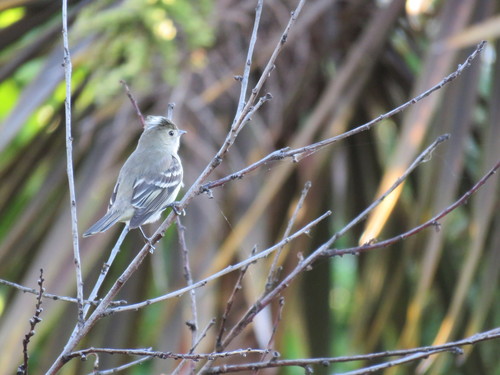
White-crested Elaenia (Elaenia albiceps) White-crested Elaenia
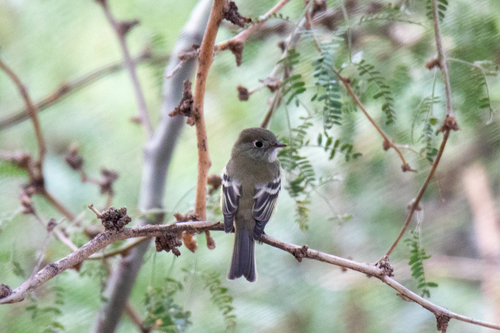
Hammond's Flycatcher (Empidonax hammondii) Hammond's Flycatcher

Media

Loading…

In short

The most reliable field mark between White-crested Elaenia and Hammond's Flycatcher is overall structure: the elaenia is bulkier with a bushy crest and a stouter bill, while Hammond's Flycatcher is more compact, with a smaller, thinner bill and a short tail. Both species show olive-gray upperparts, pale underparts, and two pale wing bars, making plumage alone tricky, especially in immatures. However, the partially hidden white crest stripe of the elaenia (sometimes visible when raised) is unique, while Hammond's Flycatcher has a consistently conspicuous white eyering and no crest. Habitat and range are also strong clues: White-crested Elaenia is a South American bird of woodland edges and valleys, while Hammond's Flycatcher is strictly a North American species of mature coniferous forests.

Identification tips

  1. Crest presence: Only White-crested Elaenia has a bushy crest with a partially hidden white or creamy stripe; this may be visible when the bird is agitated or raising its crown feathers. Hammond's Flycatcher never shows a crest.
  2. Eyering: Hammond's Flycatcher always has a bold, round, white eyering. White-crested Elaenia may show a pale eyering, but it is less crisp and can be indistinct, especially in some subspecies.
  3. Bill structure: The elaenia has a stouter, broader bill with a pale base to the mandible; Hammond's Flycatcher has a small, thin, all-dark bill (females slightly shorter and wider than males, but always small for a flycatcher).
  4. Wing bars: Both species have two pale wing bars, but in Hammond's Flycatcher, especially immatures, these are broader and can be buffy. In elaenia, wing bars are white or whitish, sometimes less distinct in some subspecies.
  5. Upperpart color: Both are olive-gray above, but elaenia is duller and more olive, while Hammond's can look slightly grayer, especially on the head.
  6. Underparts: White-crested Elaenia has a whiter belly and undertail coverts, with a light gray or grayish brown breast; Hammond's shows a gray-washed breast and yellowish flanks, giving a more muted, blended look below.
  7. Tail: Elaenia's tail is dusky with narrow olive edges; Hammond's is dark with little contrast, and the tail is shorter and more squared-off.
  8. Size and shape: Elaenia is bulkier and longer (13.5–15 cm, 15.6 g) versus Hammond's smaller, more compact build (12–14 cm, 8–12 g). The elaenia often looks more robust overall.
  9. Jizz in flight: Hammond's Flycatcher is more active, often sallying from high perches, with quick, fluttery flights. Elaenia is less acrobatic, foraging more deliberately, often at mid-level or edge.
  10. Habitat: If seen in mature coniferous forest in North America, it is almost certainly Hammond's. In South American woodland edge, valley, or scrub, especially above 800 m, it is likely White-crested Elaenia.
  11. Geographic range: White-crested Elaenia is never found in North America; Hammond's is never found in South America.
  12. Vocalization: Hammond's song is a hoarse, multi-versed series with a sharp 'peek' call; elaenia's is a series of burry, modulated notes and sneezing calls. Calls are diagnostic if well-heard.
  13. Sex and age: Both sexes are similar in both species. Immature Hammond's have broader, buffier wing bars, but otherwise look like adults. No age-specific upperwing pattern in elaenia is described; all ages similar.
  14. Pitfalls: In poor light, both can look olive-gray with pale wing bars and eyering. The crest (even if hidden) and bill shape are the best fallback marks. If you see a small flycatcher with a bushy crest, it's an elaenia; if the bird is tiny, short-tailed, with a round white eyering and no crest, it's Hammond's.
  15. When marks fail: If the crest is flattened and the eyering is faint (as in some elaenia subspecies), rely on bill structure, body bulk, and habitat context.

Size

White-crested Elaenia is distinctly larger and heavier (body mass ~15.6 g, length 13.5–15 cm) than Hammond's Flycatcher (8–12 g, 12–14 cm). The elaenia appears bulkier and more robust, while Hammond's is noticeably daintier and more compact, with a shorter tail and smaller bill. If seen side by side, the elaenia's greater mass and slightly longer body are apparent, but in the field, structure is a more reliable cue than length alone.

Plumage

For all ages, both species have olive-gray upperparts, pale underparts, and two pale wing bars, but there are subtle differences. The White-crested Elaenia has a dull olive to olive-gray head with a partially hidden white or creamy crest stripe (sometimes visible when the crest is raised), whitish lores and eyering (variable by subspecies), and a dusky tail with narrow olive edges. Its wing bars are white or whitish, and the flight feathers have narrow pale edges. Hammond's Flycatcher, adult and immature, shows a more consistent and conspicuous white eyering, white wing bars, and a small bill. Immature Hammond's have broader, more buffy wing bars than adults, but do not develop a crest. The elaenia's underparts are generally whiter, especially on the belly and undertail, while Hammond's has a gray-washed breast and yellowish flanks. The crest (even if not always visible) is unique to the elaenia; Hammond's never shows this feature.

Behaviour

White-crested Elaenia often forages singly, sometimes moving through the mid-canopy or edge, and may be seen in more open or scrubby habitats. Hammond's Flycatcher prefers to perch in the upper parts of dense coniferous or mixed forests, often sallying out to catch insects in flight (hawking) or gleaning from foliage while hovering. Hammond's typically appears more active and acrobatic in the canopy, while the elaenia may seem more deliberate and less arboreal. Both species may be seen flycatching, but context and foraging height can help.

Habitat

Habitat is a strong separator. White-crested Elaenia inhabits subtropical and temperate forest edges, open woodlands, secondary forest, and scrublands in South America (Bolivia, Chile, Colombia, Ecuador, Peru), often favoring drier intermontane valleys. Hammond's Flycatcher is restricted to coniferous and mixed forests of western North America, especially dense fir, aspen, and dogwood stands. If you are in mature coniferous forest in North America, Hammond's is the likely species; in drier, open, or edge habitats in the Andes, especially outside North America, you are likely seeing White-crested Elaenia.

Voice

Vocalizations differ notably. White-crested Elaenia gives a series of burry, rising-falling notes with sneezing or descending calls, varying by subspecies but generally lower-pitched and richer. Hammond's Flycatcher delivers a multi-versed, hoarse song (ssilit, greeep, silit, pweet) and a sharp 'peek' call, with higher frequency and a more abrupt, less burry quality. Hammond's does not sing on migration or wintering grounds, so song is most useful on breeding territory. Calls are diagnostic if well-heard: elaenia's are richer and more modulated, Hammond's sharper and more abrupt.

Submit a better description

Use the same sections as the comparison. Your text is published immediately.

The most reliable field mark between White-crested Elaenia and Hammond's Flycatcher is overall structure: the elaenia is bulkier with a bushy crest and a stouter bill, while Hammond's Flycatcher is more compact, with a smaller, thinner bill and a short tail. Both species show olive-gray upperparts, pale underparts, and two pale wing bars, making plumage alone tricky, especially in immatures. However, the partially hidden white crest stripe of the elaenia (sometimes visible when raised) is unique, while Hammond's Flycatcher has a consistently conspicuous white eyering and no crest. Habitat and range are also strong clues: White-crested Elaenia is a South American bird of woodland edges and valleys, while Hammond's Flycatcher is strictly a North American species of mature coniferous forests.

  1. Crest presence: Only White-crested Elaenia has a bushy crest with a partially hidden white or creamy stripe; this may be visible when the bird is agitated or raising its crown feathers. Hammond's Flycatcher never shows a crest.
  2. Eyering: Hammond's Flycatcher always has a bold, round, white eyering. White-crested Elaenia may show a pale eyering, but it is less crisp and can be indistinct, especially in some subspecies.
  3. Bill structure: The elaenia has a stouter, broader bill with a pale base to the mandible; Hammond's Flycatcher has a small, thin, all-dark bill (females slightly shorter and wider than males, but always small for a flycatcher).
  4. Wing bars: Both species have two pale wing bars, but in Hammond's Flycatcher, especially immatures, these are broader and can be buffy. In elaenia, wing bars are white or whitish, sometimes less distinct in some subspecies.
  5. Upperpart color: Both are olive-gray above, but elaenia is duller and more olive, while Hammond's can look slightly grayer, especially on the head.
  6. Underparts: White-crested Elaenia has a whiter belly and undertail coverts, with a light gray or grayish brown breast; Hammond's shows a gray-washed breast and yellowish flanks, giving a more muted, blended look below.
  7. Tail: Elaenia's tail is dusky with narrow olive edges; Hammond's is dark with little contrast, and the tail is shorter and more squared-off.
  8. Size and shape: Elaenia is bulkier and longer (13.5–15 cm, 15.6 g) versus Hammond's smaller, more compact build (12–14 cm, 8–12 g). The elaenia often looks more robust overall.
  9. Jizz in flight: Hammond's Flycatcher is more active, often sallying from high perches, with quick, fluttery flights. Elaenia is less acrobatic, foraging more deliberately, often at mid-level or edge.
  10. Habitat: If seen in mature coniferous forest in North America, it is almost certainly Hammond's. In South American woodland edge, valley, or scrub, especially above 800 m, it is likely White-crested Elaenia.
  11. Geographic range: White-crested Elaenia is never found in North America; Hammond's is never found in South America.
  12. Vocalization: Hammond's song is a hoarse, multi-versed series with a sharp 'peek' call; elaenia's is a series of burry, modulated notes and sneezing calls. Calls are diagnostic if well-heard.
  13. Sex and age: Both sexes are similar in both species. Immature Hammond's have broader, buffier wing bars, but otherwise look like adults. No age-specific upperwing pattern in elaenia is described; all ages similar.
  14. Pitfalls: In poor light, both can look olive-gray with pale wing bars and eyering. The crest (even if hidden) and bill shape are the best fallback marks. If you see a small flycatcher with a bushy crest, it's an elaenia; if the bird is tiny, short-tailed, with a round white eyering and no crest, it's Hammond's.
  15. When marks fail: If the crest is flattened and the eyering is faint (as in some elaenia subspecies), rely on bill structure, body bulk, and habitat context.

White-crested Elaenia is distinctly larger and heavier (body mass ~15.6 g, length 13.5–15 cm) than Hammond's Flycatcher (8–12 g, 12–14 cm). The elaenia appears bulkier and more robust, while Hammond's is noticeably daintier and more compact, with a shorter tail and smaller bill. If seen side by side, the elaenia's greater mass and slightly longer body are apparent, but in the field, structure is a more reliable cue than length alone.

For all ages, both species have olive-gray upperparts, pale underparts, and two pale wing bars, but there are subtle differences. The White-crested Elaenia has a dull olive to olive-gray head with a partially hidden white or creamy crest stripe (sometimes visible when the crest is raised), whitish lores and eyering (variable by subspecies), and a dusky tail with narrow olive edges. Its wing bars are white or whitish, and the flight feathers have narrow pale edges. Hammond's Flycatcher, adult and immature, shows a more consistent and conspicuous white eyering, white wing bars, and a small bill. Immature Hammond's have broader, more buffy wing bars than adults, but do not develop a crest. The elaenia's underparts are generally whiter, especially on the belly and undertail, while Hammond's has a gray-washed breast and yellowish flanks. The crest (even if not always visible) is unique to the elaenia; Hammond's never shows this feature.

White-crested Elaenia often forages singly, sometimes moving through the mid-canopy or edge, and may be seen in more open or scrubby habitats. Hammond's Flycatcher prefers to perch in the upper parts of dense coniferous or mixed forests, often sallying out to catch insects in flight (hawking) or gleaning from foliage while hovering. Hammond's typically appears more active and acrobatic in the canopy, while the elaenia may seem more deliberate and less arboreal. Both species may be seen flycatching, but context and foraging height can help.

Habitat is a strong separator. White-crested Elaenia inhabits subtropical and temperate forest edges, open woodlands, secondary forest, and scrublands in South America (Bolivia, Chile, Colombia, Ecuador, Peru), often favoring drier intermontane valleys. Hammond's Flycatcher is restricted to coniferous and mixed forests of western North America, especially dense fir, aspen, and dogwood stands. If you are in mature coniferous forest in North America, Hammond's is the likely species; in drier, open, or edge habitats in the Andes, especially outside North America, you are likely seeing White-crested Elaenia.

Vocalizations differ notably. White-crested Elaenia gives a series of burry, rising-falling notes with sneezing or descending calls, varying by subspecies but generally lower-pitched and richer. Hammond's Flycatcher delivers a multi-versed, hoarse song (ssilit, greeep, silit, pweet) and a sharp 'peek' call, with higher frequency and a more abrupt, less burry quality. Hammond's does not sing on migration or wintering grounds, so song is most useful on breeding territory. Calls are diagnostic if well-heard: elaenia's are richer and more modulated, Hammond's sharper and more abrupt.

Discard your changes?

You have unsaved edits. If you leave now, those changes will be lost.

White-crested Elaenia · Hammond's Flycatcher · My Tricky Birds