

White-cheeked Pintail vs Northern Pintail
Anas bahamensis versus Anas acuta
Play a quiz with White-cheeked Pintail and Northern Pintail
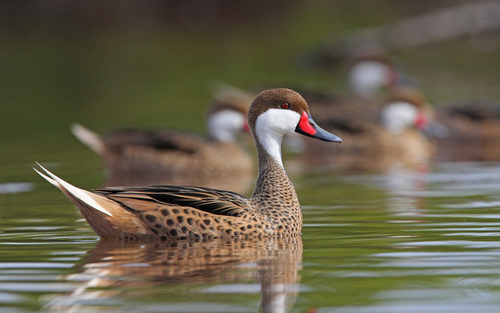 White-cheeked Pintail
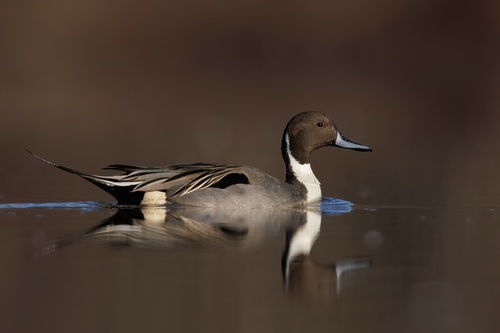 Northern Pintail
In short
The most reliable field mark to separate White-cheeked Pintail from Northern Pintail is the face: White-cheeked Pintail always shows crisp white cheeks and a red-based bill, while Northern Pintail lacks both, showing a plain brown or chocolate head and a blue-grey bill. In flight or at rest, Northern Pintail is much larger, with a longer neck and (in males) a dramatically longer, pointed tail. Juvenile and female Northern Pintails are drabber and lack the white cheek, but even then, their size, bill color, and overall shape are distinctive. Both species have pointed tails, but the Northern Pintail's is much more pronounced, especially in adult males.
Identification tips
- Face pattern is key: White-cheeked Pintail always has clear white cheeks, even in juveniles and females; Northern Pintail never shows white on the face at any age or sex.
- Bill color: White-cheeked Pintail has a red-based grey bill (duller in juveniles), while Northern Pintail has a blue-grey bill with no red at the base.
- Size and structure: Northern Pintail is much larger and more elongated, with a longer neck and, in males, a dramatically longer central tail feather. White-cheeked Pintail is smaller and more compact.
- Tail shape: Both have pointed tails, but the Northern Pintail male's tail is extremely long and sharp, especially in breeding plumage. White-cheeked Pintail's tail is pointed but less exaggerated.
- Speculum color: In flight, White-cheeked Pintail shows an iridescent green speculum; Northern Pintail has a dark brown or black speculum with a white trailing edge (female/juvenile) or white border (male).
- Head and neck: Northern Pintail male has a chocolate-brown head with a thin white stripe up the neck and white underparts; White-cheeked Pintail is brown overall with white cheeks and no neck stripe.
- Body pattern: Northern Pintail female and juvenile are mottled and scalloped brown with a plain grey-brown head; White-cheeked Pintail is more uniformly brown with a distinct white cheek patch.
- Swimming posture: Northern Pintail sits lower in the water with a forward-leaning neck; White-cheeked Pintail has a more typical dabbling duck posture.
- Flight profile: Northern Pintail flies with wings swept slightly back and appears longer-necked and more streamlined; White-cheeked Pintail has a more compact, typical duck flight silhouette.
- Habitat context: In the Caribbean and South America, expect White-cheeked Pintail; in northern temperate or arctic zones, expect Northern Pintail. Vagrancy is rare but possible.
- Sex differences: Both species show less contrast between sexes than many ducks, but Northern Pintail males are much more striking in breeding plumage, while White-cheeked Pintail sexes are similar, with females slightly duller.
- Juvenile confusion: Even juvenile White-cheeked Pintails retain the white cheek and (though duller) red-based bill, while juvenile Northern Pintails lack these and have a plain face and blue-grey bill.
- Eclipse plumage: Male Northern Pintail in eclipse resembles the female but keeps the long tail and upperwing pattern; White-cheeked Pintail does not show such a dramatic seasonal change.
- Voice: Only Northern Pintail's calls are described (female quack, male whistle); White-cheeked Pintail's voice is not distinctive in the notes.
- Aviculture note: White-cheeked Pintail is sometimes seen as an escapee in Europe; check for the white cheek and red-based bill if you suspect a captive origin.
Size
Northern Pintail is substantially larger than White-cheeked Pintail. The average body mass for Northern Pintail is about 945.5 g [wikidata], while White-cheeked Pintail subspecies range from roughly 474–710 g for males and 505–670 g for females [wikipedia]. Northern Pintail also has a longer neck and, in males, a much longer central tail feather, giving it a more elongated and graceful appearance compared to the more compact White-cheeked Pintail.
Plumage
-
Juveniles and females: White-cheeked Pintail of all ages shows a brown body with clear white cheeks and a red-based grey bill (duller in juveniles). Northern Pintail juveniles and females are mottled and scalloped brown, with a plain grey-brown head and blue-grey bill, lacking any white on the face or red at the bill base. Their speculum is dark brown (female/juvenile) or black (male) with a white trailing edge, while White-cheeked Pintail shows an iridescent green speculum.
-
Adult males (breeding): Northern Pintail drake is unmistakable with a chocolate-brown head, thin white neck stripe, white underparts, and very long central tail feathers. White-cheeked Pintail male is overall brown, with white cheeks and a red-based bill, and does not have the striking contrast or long tail of the Northern Pintail.
-
Flight/wing pattern: Both have pointed tails, but the Northern Pintail's is much longer and more pronounced in adult males. Speculum color differs: iridescent green (White-cheeked) vs. dark brown/black with white borders (Northern).
Behaviour
Both species are dabbling ducks, but Northern Pintail is noted for a more elongated, forward-leaning swimming posture, with the base of the neck nearly flush with the water. Its flight is very fast, with wings swept slightly back, unlike the more typical duck profile of White-cheeked Pintail. Both walk and swim well, but Northern Pintail's longer neck and tail make its movements appear more elegant and streamlined.
Habitat
White-cheeked Pintail is patchily distributed in South America and the Caribbean, often in brackish or saline lagoons and coastal wetlands. Northern Pintail breeds in northern Europe, Asia, and North America, and winters much farther south, often in freshwater wetlands, lakes, and flooded fields. If seen in the Caribbean or South America, a pintail is almost certainly White-cheeked; in temperate or arctic regions, it will be Northern Pintail.
Voice
Northern Pintail hens make a rough quack, while drakes give a flute-like whistle. There is no specific vocal description for White-cheeked Pintail in the notes, so voice is not a reliable field mark for separation.