

White-browed Shrike-Babbler vs White-bellied Erpornis
Pteruthius aeralatus versus Erpornis zantholeuca
Play a quiz with White-browed Shrike-Babbler and White-bellied Erpornis
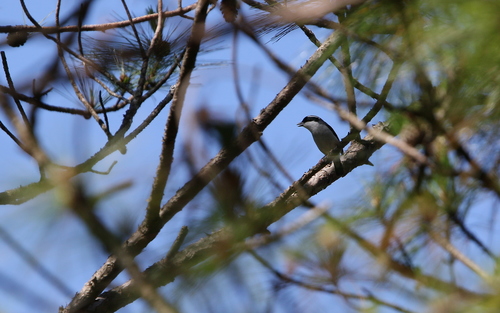 White-browed Shrike-Babbler
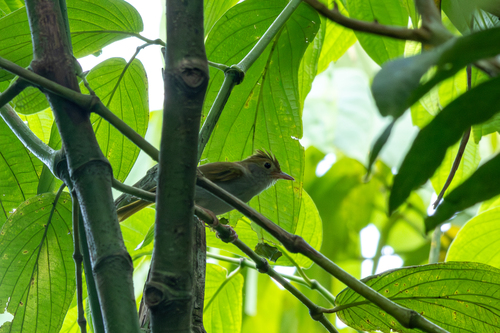 White-bellied Erpornis
In short
The most reliable field mark to separate White-browed Shrike-Babbler from White-bellied Erpornis is the strong sexual dimorphism and variable rufous-fulvous tertials in male shrike-babblers (except subspecies validirostris), versus the uniform, olivaceous or golden-brown upperparts and prominent crest of the erpornis. Shrike-babblers are much heavier-bodied, with a chunkier build and heavier bill, while erpornis is notably smaller, more slender, and has a distinctive crested head. In the field, shrike-babblers may show complex plumage variation by sex and subspecies, while erpornis is more uniform, with white underparts and no strong sexual differences. Both species can occur in similar montane forests, but their structure and behavior are quite different.
Identification tips
- Check for a crest: White-bellied Erpornis always shows a prominent crest, giving the head a peaked appearance; White-browed Shrike-Babbler never has a crest, and its head is smoothly rounded.
- Look for rufous-fulvous tertials (males): Male shrike-babblers (except validirostris) show tertials that are partly rufous and partly fulvous, a unique mark not present in erpornis. This is most visible when perched or in good flight views.
- Assess sexual dimorphism: Shrike-babblers are strongly sexually dimorphic, with males and females differing in plumage. Erpornis shows little to no sexual dimorphism—both sexes look alike.
- Note overall size and build: Shrike-babbler is much bulkier and heavier, with a thickset body and large, hooked bill. Erpornis is small, slim, and delicate, with a thin, straight bill.
- Check underparts: Erpornis always has clean white underparts, contrasting with the olivaceous or golden-brown upperparts. Shrike-babbler plumage varies, but underparts are not as crisply white and may show more pattern or color variation.
- Observe head pattern: Shrike-babbler often has a strong white brow and more complex head markings, while erpornis has a simpler face, dominated by the crest and plain coloration.
- Watch behavior: Erpornis is very active, acrobatic, and often forages by prying bark or hanging upside down. Shrike-babbler is more deliberate, perching upright and moving less energetically.
- Bill shape: Shrike-babbler has a heavier, hooked bill suited for insectivory and some frugivory; erpornis has a finer, straight bill, but with strong musculature for gaping.
- Plumage variation: Shrike-babbler shows considerable variation across its range and between sexes, so beware of local forms. Erpornis is much more consistent in appearance.
- Flight style: Erpornis moves quickly and nimbly between branches, often in mixed flocks. Shrike-babbler is less likely to join flocks and moves with slower, more direct flights.
- Habitat overlap: Both species can be found in the same forest types, so do not rely on habitat alone for identification.
- Juvenile/immature confusion: No detailed descriptions are available, but the lack of crest in shrike-babbler and the absence of rufous-fulvous tertials in erpornis should help even in young birds.
- Voice: Not described in the notes, so do not rely on vocalizations for separation in this context.
- Subspecies confusion: Some shrike-babbler subspecies are less distinctive; in these cases, structure, size, and the absence of a crest remain reliable.
- Mixed flocks: If the bird is moving with a flock of small, acrobatic insectivores, erpornis is more likely; a solitary, chunky bird is more likely a shrike-babbler.
Size
White-browed Shrike-Babbler is substantially larger and heavier (36.0g) than White-bellied Erpornis (11.2g) [wikidata]. The shrike-babbler has a much bulkier, more robust body, and a heavier, hooked bill, giving it a stocky, almost shrike-like appearance. In contrast, erpornis is small, slim, and more delicate overall, with a lighter, thinner bill and a more agile, vireo-like jizz. The size difference is often obvious when seen side by side or with experience, but can be harder to judge in isolation or at a distance.
Plumage
Juvenile and immature plumages are not described in detail for either species, but the adult male White-browed Shrike-Babbler (except for subspecies validirostris) is distinctive for having tertials that are partly rufous and partly fulvous—a mark not present in erpornis at any age or sex [wikipedia]. The shrike-babbler is sexually dimorphic, with males and females differing in plumage, and there is considerable variation among subspecies, making some individuals tricky to assign. In contrast, White-bellied Erpornis is much more uniform: both sexes have a prominent crest, olivaceous or golden-brown upperparts, and clean white underparts. The erpornis lacks any rufous or fulvous tones on the wings or tertials and does not show strong sexual dimorphism. The shrike-babbler may sometimes be confused with erpornis due to overall coloration, but the shrike-babbler never shows a crest, and its head patterning and wing coloration are more complex and variable.
Behaviour
White-bellied Erpornis is acrobatic and often behaves like a vireo, moving nimbly through foliage, sometimes hanging upside down or prying bark with its strong bill muscles. It often joins mixed-species flocks and is very active. White-browed Shrike-Babbler is more deliberate, perching upright in the mid-story or canopy, and often sits still for longer periods. Its heavier build and less acrobatic movements contrast with the lively, agile actions of erpornis. Shrike-babblers may also appear more solitary or in pairs, while erpornis is more likely to be seen in small groups or flocks.
Habitat
Both species can be found in montane forests across Southeast Asia and the eastern Himalayas, with overlapping ranges in many regions [wikipedia]. Habitat alone is not a reliable separator, though shrike-babblers may be more closely associated with dense, mature forest and erpornis can be found in a wider range of wooded habitats, including forest edges and secondary growth. However, both are primarily forest birds and often occur together, so context is only weakly diagnostic.
White-browed Shrike-Babbler · White-bellied Erpornis · My Tricky Birds