

Whiskered Tern vs Sandwich Tern
Chlidonias hybrida versus Thalasseus sandvicensis
Play a quiz with Whiskered Tern and Sandwich Tern
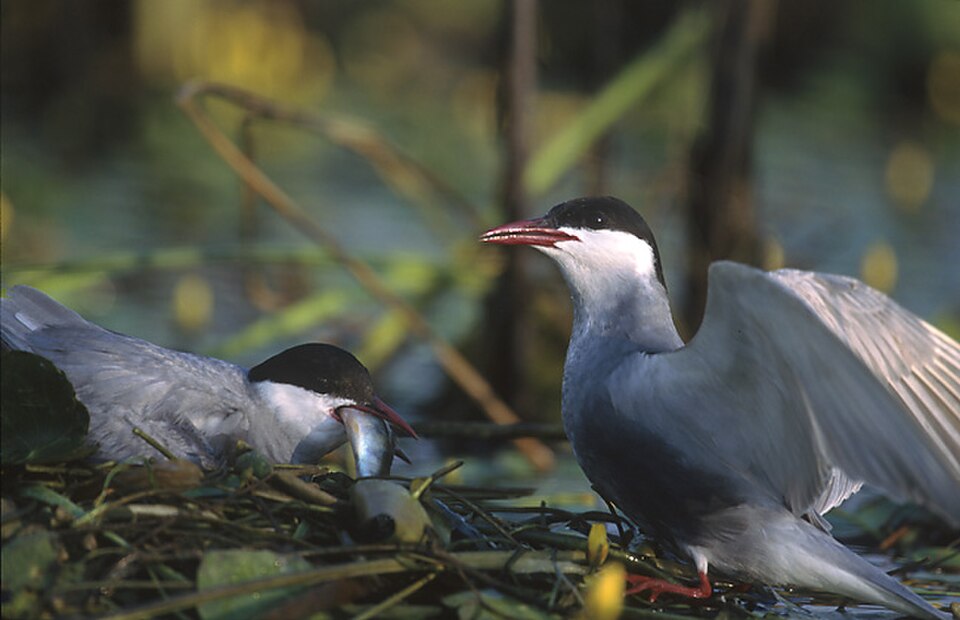 Whiskered Tern
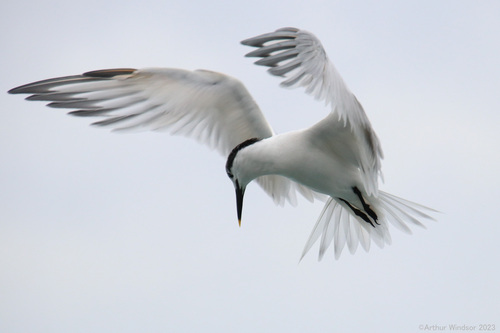 Sandwich Tern
In short
Juvenile and first-winter Whiskered Terns show a ginger or buff-scaled back and dark brown scapulars with broad pale edges, while juvenile Sandwich Terns have a scaly pattern but also show a dark-tipped tail and an all-blackish bill. In all plumages, Sandwich Tern is much larger, with a long, thin black bill tipped yellow, black legs, and a very pale, silvery appearance in flight. Whiskered Tern is smaller, with a stubbier red bill (breeding), red legs, and a darker, more uniform grey body in breeding plumage. The tail of Whiskered Tern is short and shallowly forked, while Sandwich Tern’s is longer and more deeply forked. When perched, bill and leg color are key; in flight, note the overall darkness and structure.
Identification tips
- Size: Sandwich Tern is much larger and heavier than Whiskered Tern; use direct comparison with nearby gulls or terns if possible. (All ages)
- Bill color and shape: Whiskered Tern has a strong, stubby red bill in breeding plumage (shorter and stubbier in females), while Sandwich Tern has a long, thin black bill with a yellow tip (adults) or all-blackish (juveniles). (All ages, but especially adults)
- Leg color: Whiskered Tern has red legs in breeding plumage; Sandwich Tern’s legs are always black. (All ages)
- Tail shape: Whiskered Tern’s tail is short and only shallowly forked, while Sandwich Tern’s is longer and more deeply forked. Juvenile Sandwich Tern shows a dark tip to the tail. (All ages)
- Juvenile back pattern: Juvenile Whiskered Tern has a ginger or buff scaly back with broad pale edges to dark brown scapulars; Sandwich Tern juvenile is also scaly but less so, and the tail tip is dark. (Juveniles)
- Crown pattern: Whiskered Tern juvenile has a crown flecked with white and a more uniformly dark hindcrown; Sandwich Tern juvenile has less black on the crown. (Juveniles)
- Wing pattern: Sandwich Tern’s upperwings are pale grey with darkening primaries in summer and a broad white margin on the inner web of the primaries, which wears to a 'hook tip' in late summer. Whiskered Tern’s wings are more uniformly grey. (Adults)
- Overall coloration: Whiskered Tern in breeding plumage is dark grey above and below with white cheeks; Sandwich Tern is much paler, with white underparts and pale grey upperwings. (Adults)
- Non-breeding head: Both species develop white on the forehead in winter, but Sandwich Tern’s is more extensive, while Whiskered Tern’s crown is flecked with white. (Non-breeding adults)
- Flight jizz: Sandwich Tern appears longer-winged and more elongated in flight, while Whiskered Tern is more compact and swallow-like. (All ages)
- Perched posture: Sandwich Tern stands taller and more upright; Whiskered Tern is more compact. (All ages)
- Habitat: Whiskered Tern is found over inland marshes and wetlands; Sandwich Tern is coastal. (All ages)
- Voice: Whiskered Tern gives a 'krekk'; Sandwich Tern’s call is a loud, grating 'kear-ik' or 'kerr ink'. (All ages)
- Bill color in juveniles: Juvenile Sandwich Tern has an all-blackish bill (sometimes yellowish at base), while Whiskered Tern’s bill is never black. (Juveniles)
- Seasonal context: In late summer and autumn, Sandwich Tern’s primaries develop a distinctive 'hook tip' as the white fringe wears off, a feature not shown by Whiskered Tern. (Adults, late summer/autumn)
Size
Sandwich Tern is substantially larger and heavier (body mass 200–300 g) than Whiskered Tern (body mass 84 g) [wikidata]. Sandwich Tern is also longer (36–41 cm vs. much smaller for Whiskered), with a wingspan of 95–105 cm. Whiskered Tern is the largest marsh tern, but still dwarfed by Sandwich Tern, which has a more elongated, rangy appearance both at rest and in flight.
Plumage
- Juvenile/First-winter: Whiskered Tern juveniles have a ginger or buff 'scaly' back, with dark brown scapulars edged broadly pale, and often some new grey mantle feathers appearing by fall. Their crown is flecked with white, and the hindcrown is more uniformly dark. Sandwich Tern juveniles also show a scaly pattern on the back and wings, but have a dark-tipped tail and an all-blackish bill (sometimes yellowish at base), and less black on the crown. The scaly look is less pronounced than in Whiskered, and the tail tip is a key mark.
- Adult breeding: Whiskered Tern is dark grey above and below with a black cap, white cheeks, red bill and legs. Sandwich Tern is much paler, with pale grey upperwings, white underparts, and a black cap, but with a thin, long black bill with a yellow tip and black legs.
- Adult non-breeding: Both species develop white on the forehead, but Sandwich Tern’s forehead becomes extensively white after the summer moult, while Whiskered Tern’s black crown is flecked with white. Whiskered Tern becomes paler grey overall, but still darker than Sandwich Tern.
- Tail: Whiskered Tern’s tail is short and only shallowly forked, while Sandwich Tern’s is longer and more deeply forked, with juveniles showing a dark tip.
- Wings: Sandwich Tern’s upperwings are pale grey with darkening primaries in summer, and a broad white margin on the inner web of the primaries. Whiskered Tern has a more uniform grey wing and body, lacking the crisp pale-and-dark contrast of Sandwich.
Behaviour
Both species are terns with agile, buoyant flight. Sandwich Tern often appears more elongated and rangy, with longer wings and tail, and is typically seen in coastal environments, often in larger, noisier colonies. Whiskered Tern is more swallow-like in flight, with a shorter tail and more compact build, and is usually found over inland marshes or wetlands, sometimes among Black-headed Gulls. Perched, Sandwich Tern stands taller and more upright, while Whiskered Tern appears more compact.
Habitat
Whiskered Tern breeds and forages mainly over inland marshes and freshwater wetlands, often in colonies with Black-headed Gulls. Sandwich Tern is a coastal species, breeding on sandy or shingle islands and foraging at sea or along coasts. Finding a tern over freshwater marshes in the interior is more likely to be Whiskered; on the coast, especially in large, noisy colonies, Sandwich Tern is expected.
Voice
Whiskered Tern gives a characteristic 'krekk' call. Sandwich Tern is very vocal, with a loud, grating 'kear-ik' or 'kerr ink'. Sandwich Tern’s call is sharper and more piercing, often heard in noisy colonies, while Whiskered Tern’s call is softer and less harsh.