

Western Marsh Harrier vs Eastern Marsh Harrier
Circus aeruginosus versus Circus spilonotus
Play a quiz with Western Marsh Harrier and Eastern Marsh Harrier
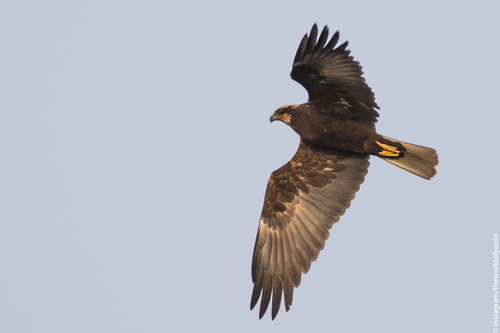 Western Marsh Harrier
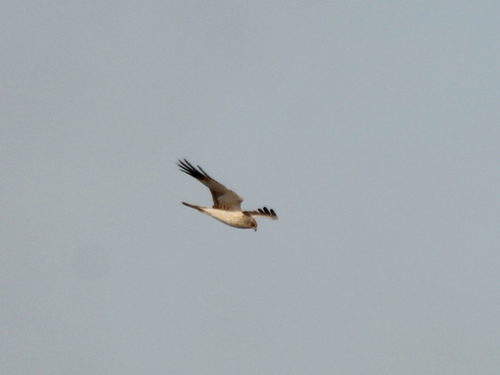 Eastern Marsh Harrier
In short
Separating Western and Eastern Marsh Harriers in the field hinges on careful attention to age and plumage, especially in flight. Adult males are most reliably told apart: Western Marsh Harrier males show a three-toned brown-grey-black wing pattern with a mostly reddish-brown body, while Eastern Marsh Harrier males are darker above with a distinctive white leading edge to the wing and a white rump. Females and juveniles are trickier, but Eastern Marsh Harrier often shows a whitish rump and more extensive pale on the underwing, whereas Western Marsh Harrier females and juveniles are more uniformly chocolate-brown with less contrast. Both species are large, broad-winged harriers with similar hunting flight, so structure alone is rarely diagnostic. Always prioritize wing and rump pattern in flight, especially for immatures.
Identification tips
- Adult male plumage in flight is the most reliable separator: Western Marsh Harrier males show a three-toned wing (brown forewing, grey secondaries and tail, black wingtips), while Eastern Marsh Harrier males have a darker, blackish head and coverts, a white leading edge to the wing, white rump, and mostly white underparts.
- Check for a white rump in flight: Eastern Marsh Harrier of all ages often shows a whitish rump, especially obvious in males and females; Western Marsh Harrier lacks this feature, showing a more uniform back and rump.
- Juvenile underwing pattern: Juvenile Eastern Marsh Harrier has a pale patch on the underwing and a pale head, while juvenile Western Marsh Harrier is more uniformly dark brown with less contrast and little or no pale on the underwing.
- Female tail pattern: Eastern Marsh Harrier females have a barred tail, while Western Marsh Harrier females have a more uniform tail without obvious barring.
- Head and shoulder contrast in females: Western Marsh Harrier females have a conspicuously paler head and shoulders, sometimes sharply demarcated, but the eye area remains dark; Eastern Marsh Harrier females have more diffuse buff streaking on the head and underparts.
- Body color in males: Western Marsh Harrier males are reddish-brown overall, while Eastern Marsh Harrier males are darker, with blackish upperparts and paler underparts.
- Leading edge of the wing in males: Look for the white front edge on the wing of Eastern Marsh Harrier males, absent in Western Marsh Harrier.
- Barred vs. plain tail: Tail barring is a good mark for female and immature Eastern Marsh Harrier; Western Marsh Harrier is more uniform.
- Hypermelanic morphs: If you see an almost entirely black harrier, consider hypermelanic Western Marsh Harrier, but this is rare and mostly eastern.
- Flight style and structure: Both are large, broad-winged, and fly with a shallow V and dangling legs; structure is not a safe separator.
- Habitat: Both use similar open wetland habitats; do not use habitat for separation.
- Voice: Calls are rarely heard and not diagnostic.
- Size: Overlap is extensive; do not use size for field separation.
- Season and range: Where both species occur, rely on plumage, not location or time of year.
- Beware of worn or aberrant birds: Worn females of both species can lose contrast and resemble each other; always look for multiple field marks.
Size
Both species are large, bulky harriers with broad wings and long tails. Western Marsh Harrier measures 48–56 cm in length with a wingspan of 115–130 cm, while Eastern Marsh Harrier is 48–58 cm long with a wingspan of 113–137 cm. Females are larger than males in both. The size overlap is considerable, and in the field, size alone is not a reliable separator between these two species. [wikipedia][avonet]
Plumage
Juvenile and immature birds are the most challenging. Juvenile Western Marsh Harriers are dark brown overall with some yellowish on the head and shoulders, but this is often less marked than in adults and can be quite limited. Juvenile Eastern Marsh Harriers are also dark brown but typically have a more prominent buff or pale patch on the head and a pale area on the underwing, plus a whitish rump. Adult males are the easiest: Western Marsh Harrier males are reddish-brown with pale streaks, a pale head, grey tail and secondaries, and black wingtips, giving a three-toned effect. Eastern Marsh Harrier males are darker above with blackish head, breast, and wing coverts, pale streaks, a white leading edge to the wing, white rump, grey tail, and mostly white underparts. Females of both are dark brown, but Eastern Marsh Harrier females have more buff streaking on the head and underparts, a whitish rump, and a barred tail, while Western Marsh Harrier females are more uniform with a paler head and shoulders but lack the white rump and tail barring. Hypermelanic morphs occur in Western Marsh Harrier but are rare and mostly in the east of its range.
Behaviour
Both species hunt in typical harrier fashion, gliding low over open ground with wings held in a shallow V and often with dangling legs. Their flight style and hunting behavior are very similar and not a reliable field mark for separation. Both take similar prey and can be seen quartering over marshes and reedbeds.
Habitat
Habitat preferences are nearly identical: both species favor open wetlands, reedbeds, and marshes. There is no significant habitat difference that can be used for field identification where their ranges overlap or in vagrant situations.
Voice
Vocalizations are not a practical field mark. Eastern Marsh Harrier is usually silent but has a mewing call at roosts; Western Marsh Harrier is not described as vocal in the field notes. Calls are rarely heard and not reliable for separation.
Western Marsh Harrier · Eastern Marsh Harrier · My Tricky Birds