

Motmot

Wedge-tailed Shearwater vs Pied Cormorant

Ardenna pacifica versus Phalacrocorax varius

Play a quiz with Wedge-tailed Shearwater and Pied Cormorant
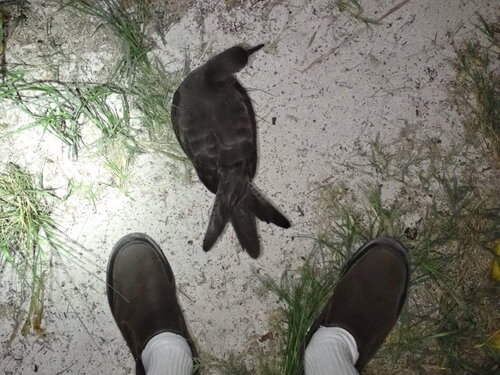
Wedge-tailed Shearwater (Ardenna pacifica) Wedge-tailed Shearwater
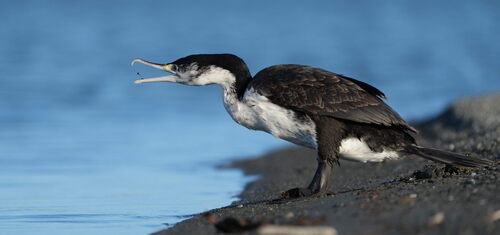
Pied Cormorant (Phalacrocorax varius) Pied Cormorant

Media

Loading…

In short

The most reliable field mark to separate Wedge-tailed Shearwater from Pied Cormorant is overall structure and flight style: shearwaters are slim, long-winged, and glide low over the sea with stiff, rapid wingbeats, while cormorants are much heavier-bodied, fly with slower wingbeats and a kinked neck, and often perch upright on rocks or posts. In plumage, Wedge-tailed Shearwater comes in both pale and dark morphs, but never shows the sharp black-and-white contrast of the Pied Cormorant, which has a striking white belly and black upperparts. The wedge-shaped tail of the shearwater is diagnostic in flight, while the cormorant has a more typical rounded tail. If you see a bird drying its wings, it is a cormorant. Size is also a major clue: Pied Cormorant is about four times heavier than Wedge-tailed Shearwater.

Identification tips

  1. Flight style: Wedge-tailed Shearwater flies with stiff, rapid wingbeats and long glides low over the water; Pied Cormorant has slower, deeper wingbeats, and often flies with a kinked neck. This is a strong field mark in all ages and seasons.
  2. Perching behavior: If the bird is perched upright on a rock, post, or tree, especially with wings spread to dry, it is a Pied Cormorant. Shearwaters do not perch in this manner except at breeding colonies, and never spread wings to dry.
  3. Tail shape: Wedge-tailed Shearwater has a long, wedge-shaped tail visible in flight; Pied Cormorant has a more typical rounded tail. Look for the tail shape when the bird banks or lands.
  4. Bill shape: The shearwater has a thin, dark bill suited for catching fish at sea; the cormorant's bill is much heavier, hooked at the tip, and pale with a yellow patch at the base.
  5. Leg color and position: Wedge-tailed Shearwater has salmon-pink legs set far back on the body (adapted for swimming); Pied Cormorant has black legs and feet, placed more centrally.
  6. Plumage contrast: Pied Cormorant is sharply bicolored—black above, white below, with a white face and yellow facial patch. Wedge-tailed Shearwater is either uniformly dark or pale above and whitish below, but never with sharp contrast or a white face.
  7. Facial pattern: Only Pied Cormorant has a white face with a yellow patch between bill and eye; shearwater's face is always plain.
  8. Size: Pied Cormorant is much larger and bulkier than Wedge-tailed Shearwater. If seen together, the size difference is obvious.
  9. Habitat: Shearwaters are only seen at sea or at remote breeding colonies; cormorants are common on coasts, estuaries, lakes, and rivers, and often perch on man-made structures.
  10. Wing drying: Only Pied Cormorant spreads its wings to dry after diving. Shearwaters never do this.
  11. Underwing pattern: Pied Cormorant has white underwings contrasting with black primaries; shearwater's underwing is never sharply patterned.
  12. Voice: If you hear long, moaning calls at night near a colony, it is likely Wedge-tailed Shearwater. Otherwise, both species are usually silent in the field.
  13. Feeding behavior: Shearwaters feed by dipping and surface seizing while flying; cormorants dive from the surface, often seen surfacing with fish.
  14. Group behavior: Shearwaters are often seen in flocks over the open ocean; cormorants may gather in groups but are more often seen singly or in small groups near shore or inland.
  15. Context: If you are far from land, especially in tropical waters, a slim, gliding bird is likely a shearwater. In estuaries, lakes, or perched on structures, it is almost certainly a cormorant.

Size

Pied Cormorant is substantially larger and bulkier than Wedge-tailed Shearwater. The cormorant averages about 1955 g in body mass, compared to 465 g for the shearwater—a fourfold difference. Pied Cormorant stands 65–85 cm tall with a wingspan of 110–130 cm, while Wedge-tailed Shearwater is medium-large for a shearwater but still much smaller and more slender than the cormorant. In the field, the cormorant's size and mass are immediately apparent, especially when perched or flying near other birds.

Plumage

No age-specific upperwing patterns are described for either species that would cause confusion in flight. Wedge-tailed Shearwater occurs in two morphs: pale morphs have grey-brown upperparts and whiter underparts, while dark morphs are uniformly dark grey-brown. Both morphs lack any sharp color boundaries. Pied Cormorant, by contrast, is always sharply bicolored: black above (back and upperwings), white below (belly and underwings), and a distinctive white face with a small yellow patch between the bill and eye. The cormorant's bill is large and hooked, and its legs and feet are black, while the shearwater has a thin, dark bill and salmon-pink legs set far back on the body. In all ages and seasons, the cormorant's black-and-white pattern is diagnostic, while the shearwater never shows this level of contrast.

Behaviour

Wedge-tailed Shearwaters are almost always seen flying low over the open ocean, gliding and banking with stiff, rapid wingbeats, rarely perching except at breeding colonies. They are highly pelagic and rarely seen inland or perched on structures. Pied Cormorants, on the other hand, are often seen perched upright on rocks, posts, or trees near water, frequently spreading their wings to dry. They dive from the surface to catch fish and are comfortable both in saltwater and freshwater habitats. In flight, cormorants have a slower, deeper wingbeat and often fly with a kinked neck, unlike the straight-necked, gliding shearwater.

Habitat

Wedge-tailed Shearwater is strictly pelagic, found over tropical and subtropical oceans, and only comes to land at breeding colonies, usually on remote islands. It is not seen inland or on freshwater bodies. Pied Cormorant is a coastal and sometimes inland species, found around estuaries, lakes, rivers, and sheltered bays, as well as along the seashore. It is often seen perched near water and is much more likely to be encountered on land or in freshwater habitats than the shearwater.

Voice

Wedge-tailed Shearwater is known for its long, moaning calls at breeding colonies, with a distinctive inhaling and exhaling component. These calls are usually heard at night near colonies and are not given at sea. Pied Cormorant is generally silent away from the nest and does not have a distinctive flight or feeding call that would be heard by most birders. Thus, voice is rarely useful for separating these species in the field.

Submit a better description

Use the same sections as the comparison. Your text is published immediately.

The most reliable field mark to separate Wedge-tailed Shearwater from Pied Cormorant is overall structure and flight style: shearwaters are slim, long-winged, and glide low over the sea with stiff, rapid wingbeats, while cormorants are much heavier-bodied, fly with slower wingbeats and a kinked neck, and often perch upright on rocks or posts. In plumage, Wedge-tailed Shearwater comes in both pale and dark morphs, but never shows the sharp black-and-white contrast of the Pied Cormorant, which has a striking white belly and black upperparts. The wedge-shaped tail of the shearwater is diagnostic in flight, while the cormorant has a more typical rounded tail. If you see a bird drying its wings, it is a cormorant. Size is also a major clue: Pied Cormorant is about four times heavier than Wedge-tailed Shearwater.

  1. Flight style: Wedge-tailed Shearwater flies with stiff, rapid wingbeats and long glides low over the water; Pied Cormorant has slower, deeper wingbeats, and often flies with a kinked neck. This is a strong field mark in all ages and seasons.
  2. Perching behavior: If the bird is perched upright on a rock, post, or tree, especially with wings spread to dry, it is a Pied Cormorant. Shearwaters do not perch in this manner except at breeding colonies, and never spread wings to dry.
  3. Tail shape: Wedge-tailed Shearwater has a long, wedge-shaped tail visible in flight; Pied Cormorant has a more typical rounded tail. Look for the tail shape when the bird banks or lands.
  4. Bill shape: The shearwater has a thin, dark bill suited for catching fish at sea; the cormorant's bill is much heavier, hooked at the tip, and pale with a yellow patch at the base.
  5. Leg color and position: Wedge-tailed Shearwater has salmon-pink legs set far back on the body (adapted for swimming); Pied Cormorant has black legs and feet, placed more centrally.
  6. Plumage contrast: Pied Cormorant is sharply bicolored—black above, white below, with a white face and yellow facial patch. Wedge-tailed Shearwater is either uniformly dark or pale above and whitish below, but never with sharp contrast or a white face.
  7. Facial pattern: Only Pied Cormorant has a white face with a yellow patch between bill and eye; shearwater's face is always plain.
  8. Size: Pied Cormorant is much larger and bulkier than Wedge-tailed Shearwater. If seen together, the size difference is obvious.
  9. Habitat: Shearwaters are only seen at sea or at remote breeding colonies; cormorants are common on coasts, estuaries, lakes, and rivers, and often perch on man-made structures.
  10. Wing drying: Only Pied Cormorant spreads its wings to dry after diving. Shearwaters never do this.
  11. Underwing pattern: Pied Cormorant has white underwings contrasting with black primaries; shearwater's underwing is never sharply patterned.
  12. Voice: If you hear long, moaning calls at night near a colony, it is likely Wedge-tailed Shearwater. Otherwise, both species are usually silent in the field.
  13. Feeding behavior: Shearwaters feed by dipping and surface seizing while flying; cormorants dive from the surface, often seen surfacing with fish.
  14. Group behavior: Shearwaters are often seen in flocks over the open ocean; cormorants may gather in groups but are more often seen singly or in small groups near shore or inland.
  15. Context: If you are far from land, especially in tropical waters, a slim, gliding bird is likely a shearwater. In estuaries, lakes, or perched on structures, it is almost certainly a cormorant.

Pied Cormorant is substantially larger and bulkier than Wedge-tailed Shearwater. The cormorant averages about 1955 g in body mass, compared to 465 g for the shearwater—a fourfold difference. Pied Cormorant stands 65–85 cm tall with a wingspan of 110–130 cm, while Wedge-tailed Shearwater is medium-large for a shearwater but still much smaller and more slender than the cormorant. In the field, the cormorant's size and mass are immediately apparent, especially when perched or flying near other birds.

No age-specific upperwing patterns are described for either species that would cause confusion in flight. Wedge-tailed Shearwater occurs in two morphs: pale morphs have grey-brown upperparts and whiter underparts, while dark morphs are uniformly dark grey-brown. Both morphs lack any sharp color boundaries. Pied Cormorant, by contrast, is always sharply bicolored: black above (back and upperwings), white below (belly and underwings), and a distinctive white face with a small yellow patch between the bill and eye. The cormorant's bill is large and hooked, and its legs and feet are black, while the shearwater has a thin, dark bill and salmon-pink legs set far back on the body. In all ages and seasons, the cormorant's black-and-white pattern is diagnostic, while the shearwater never shows this level of contrast.

Wedge-tailed Shearwaters are almost always seen flying low over the open ocean, gliding and banking with stiff, rapid wingbeats, rarely perching except at breeding colonies. They are highly pelagic and rarely seen inland or perched on structures. Pied Cormorants, on the other hand, are often seen perched upright on rocks, posts, or trees near water, frequently spreading their wings to dry. They dive from the surface to catch fish and are comfortable both in saltwater and freshwater habitats. In flight, cormorants have a slower, deeper wingbeat and often fly with a kinked neck, unlike the straight-necked, gliding shearwater.

Wedge-tailed Shearwater is strictly pelagic, found over tropical and subtropical oceans, and only comes to land at breeding colonies, usually on remote islands. It is not seen inland or on freshwater bodies. Pied Cormorant is a coastal and sometimes inland species, found around estuaries, lakes, rivers, and sheltered bays, as well as along the seashore. It is often seen perched near water and is much more likely to be encountered on land or in freshwater habitats than the shearwater.

Wedge-tailed Shearwater is known for its long, moaning calls at breeding colonies, with a distinctive inhaling and exhaling component. These calls are usually heard at night near colonies and are not given at sea. Pied Cormorant is generally silent away from the nest and does not have a distinctive flight or feeding call that would be heard by most birders. Thus, voice is rarely useful for separating these species in the field.

Discard your changes?

You have unsaved edits. If you leave now, those changes will be lost.

Wedge-tailed Shearwater · Pied Cormorant · My Tricky Birds