

Wedge-tailed Shearwater vs Black-vented Shearwater
Ardenna pacifica versus Puffinus opisthomelas
Play a quiz with Wedge-tailed Shearwater and Black-vented Shearwater
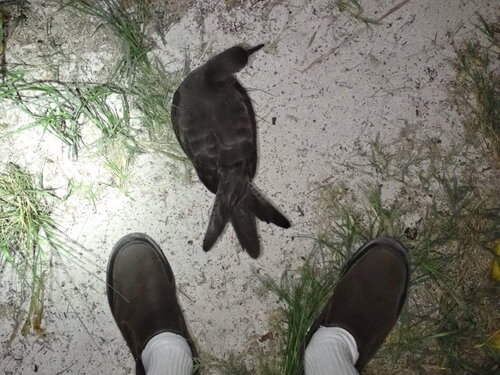 Wedge-tailed Shearwater
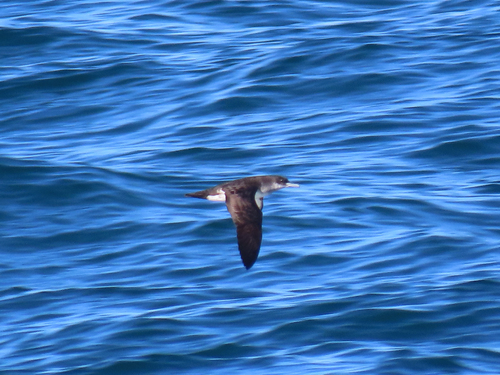 Black-vented Shearwater
In short
The most reliable field mark to separate Wedge-tailed Shearwater from Black-vented Shearwater is the distinctive wedge-shaped tail of the Wedge-tailed, which is especially noticeable in flight. Wedge-tailed Shearwaters also show a broader range of plumage morphs (pale and dark), while Black-vented Shearwaters are more uniformly dark above and white below, with subtle smudging. Size is another clue: Wedge-tailed is bulkier and longer-winged. Both species can show superficially similar dark upperparts and pale underparts, so careful attention to tail shape, overall structure, and subtle plumage differences is key, especially for birds in flight or at a distance.
Identification tips
- Tail shape in flight: Wedge-tailed Shearwater has a distinctly wedge-shaped tail, broad at the base and tapering to a point, visible both in direct flight and when banking. Black-vented Shearwater's tail is more squared or slightly rounded, lacking the pronounced wedge.
- Overall size and bulk: Wedge-tailed is noticeably larger and heavier-bodied than Black-vented, with a longer wingspan and more robust appearance. Use this in mixed flocks or when seen alongside other shearwaters.
- Plumage morphs (adults and immatures): Wedge-tailed can be pale (grey-brown above, white below) or dark (uniformly dark grey-brown). Black-vented is always dark above and white below, with some brownish smudging but never as pale as the palest Wedge-tailed.
- Contrast on underparts: Black-vented shows a sharp contrast between dark upperparts and white underparts, sometimes with brown smudges on the belly. Wedge-tailed pale morphs can look similar, but the contrast is often less stark, and the head is less sharply demarcated from the underparts.
- Head and face pattern: Both species have dark heads, but Black-vented's is more uniformly dark brown, while Wedge-tailed's pale morph may show a slightly paler face and throat.
- Bill color and shape: Wedge-tailed has a dark, slender bill; Black-vented's bill is also dark but may appear slightly shorter and stubbier. This is subtle and not always reliable at sea.
- Leg color: Wedge-tailed has salmon-pink legs, but these are rarely visible in flight or at sea. Not a practical field mark.
- Flight style: Wedge-tailed often soars with long, gliding arcs, using its wedge tail for stability. Black-vented is more likely to show quick, shallow wingbeats and a more direct flight path.
- Habitat and range: In the eastern Pacific, a shearwater seen close to shore off California in winter is more likely Black-vented. Wedge-tailed is tropical and rarely strays north.
- Colony behavior: Both species attend colonies at night, but Wedge-tailed is more likely to be seen resting outside burrows during the day in tropical breeding areas.
- Vocalizations: Wedge-tailed's moaning 'OOO-err' is distinctive at colonies, but calls are rarely heard at sea. Black-vented's call is a moaning growl, but also not typically heard away from colonies.
- Juvenile plumage: Black-vented juveniles are darker and more contrasted than adults, but this is subtle and not a strong field mark for separation from Wedge-tailed.
- Plumage wear: Black-vented adults can appear paler and more worn later in the season, but still retain the dark cap and upperparts. Wedge-tailed's morphs do not relate to age or wear.
- Pitfalls: Dark morph Wedge-tailed can look very similar to Black-vented, especially at distance. Focus on tail shape and size for best separation.
- Sex and age: Neither species is sexually dimorphic; plumage differences are not related to sex. Juvenile and adult Black-vented are similar, with juveniles slightly darker.
Size
Wedge-tailed Shearwater is the larger species, with an average body mass of 465 g [wikidata], compared to Black-vented Shearwater's approximately 400 g [wikipedia]. Wedge-tailed also appears longer and more robust, with a proportionally longer, wedge-shaped tail. Black-vented Shearwater is smaller overall, with a length of 30–38 cm and a wingspan of 76–89 cm, and tends to look more compact and less elongated in flight.
Plumage
Juvenile and immature plumages are not strongly distinctive between these two species, as both show dark upperparts and paler underparts, but there are subtle differences: Black-vented Shearwater juveniles are darker and more contrasted than worn adults, with a dark brown head and back, and white underparts with brownish smudges. Wedge-tailed Shearwater comes in two morphs: pale birds show grey-brown upperparts and whiter underparts, while dark morphs are uniformly dark grey-brown. Both morphs can occur in the same population. The wedge-shaped tail of Wedge-tailed is a structural feature but can sometimes be accentuated by the pattern of the tail feathers. Black-vented lacks this wedge and has a more typical rounded or slightly squared tail. Bill and leg color are not highly distinctive at a distance, but Wedge-tailed has a dark bill and salmon-pink legs, while Black-vented's bill and legs are less often visible in the field.
Behaviour
Both species are pelagic and often seen gliding low over the ocean, but Wedge-tailed Shearwater is more likely to be seen soaring with long, steady glides, using its wedge-shaped tail for control. Black-vented Shearwater tends to forage closer to shore and may appear more fluttery or direct in flight. Wedge-tailed is often seen attending breeding colonies at night but can be seen resting outside burrows during the day. Black-vented is also nocturnal at colonies and is most active in low light, but is more likely to be seen nearshore during the day in non-breeding season.
Habitat
Wedge-tailed Shearwater is widespread throughout the tropical Pacific and Indian Oceans, breeding on islands and attending colonies nocturnally. Black-vented Shearwater is much more localized, breeding mainly on offshore islands off Baja California and foraging in the Pacific and Gulf of California, often closer to the mainland coast. In North America, Black-vented is relatively common off California in winter, while Wedge-tailed is rare north of its tropical range.
Voice
Wedge-tailed Shearwater gives a long, moaning call with inhaled and exhaled components, often described as a mournful 'OOO-err', especially at colonies at night. Black-vented Shearwater's call is less well known but is likened to a moaning growl or the sound of a dentist's drill and suction, also given at night and likely important for mate recognition. In the field, vocalizations are rarely heard away from colonies, so they are not usually helpful for at-sea identification.
Wedge-tailed Shearwater · Black-vented Shearwater · My Tricky Birds