

Verreaux's Eagle Owl vs African Barred Owlet
Ketupa lactea versus Glaucidium capense
Play a quiz with Verreaux's Eagle Owl and African Barred Owlet
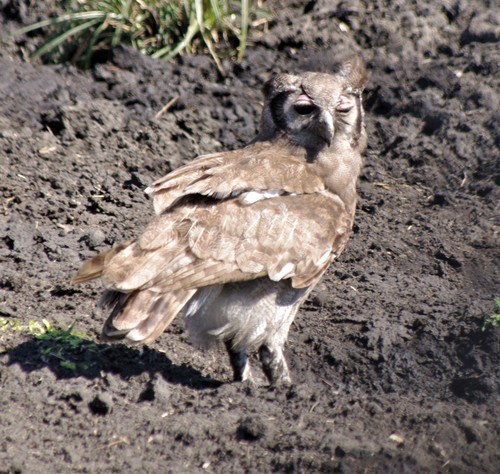 Verreaux's Eagle Owl
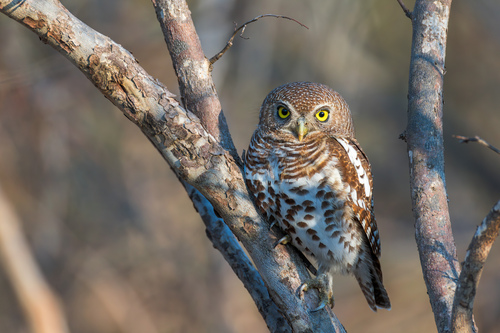 African Barred Owlet
In short
The most reliable way to separate Verreaux's Eagle Owl from African Barred Owlet is by size and structure: Verreaux's is a huge, thick-set owl, while African Barred Owlet is tiny and compact. Even at a distance or in poor light, the eagle-owl's massive bulk and long, broad wings stand out, contrasting with the owlet's small, short-winged jizz. In perched views, Verreaux's Eagle Owl appears pale and imposing, while African Barred Owlet shows fine barring and a distinctive white scapular stripe. There are no confusing age-specific upperwing patterns between these two; all ages are easily separated by size and structure. Habitat overlap is possible, but the eagle-owl favors more open, wooded savanna, while the owlet is often in denser woodland or forest edge.
Identification tips
- Size is the single most reliable field mark: Verreaux's Eagle Owl is enormous, even compared to other large owls, while African Barred Owlet is tiny and compact. If you can judge size against a branch, other birds, or even by the apparent bulk in flight, confusion is almost impossible.
- Structure and jizz: The eagle-owl has a massive head, thick neck, and long, broad wings; perched, it looks imposing and heavy. The owlet is small, with a rounded head and short, stubby wings and tail, giving it a compact, almost toy-like appearance.
- Plumage pattern: African Barred Owlet shows fine barring above and below, a narrow white eyebrow, and a bold white scapular and wing covert stripe across the shoulder when perched. Verreaux's Eagle Owl lacks these features, appearing plainer and paler overall.
- Facial features: The eagle-owl has a large, pale face with dark eyes and lacks the white eyebrow of the owlet. The owlet's face is smaller, with a more expressive look due to the eyebrow and barring.
- Underparts: The owlet's breast and flanks are white with brown spots, and the underwing coverts, legs, and vent are white. The eagle-owl is much plainer below, with a milky or pale gray tone and little pattern.
- Wing and tail in flight: The owlet shows brown flight feathers barred with rufous, but its short, rounded wings and rapid, bounding flight are distinctive. The eagle-owl's wings are long, broad, and slow-beating, with no rufous barring.
- Perched posture: The eagle-owl sits upright and appears massive, often on large, exposed branches. The owlet perches lower, often in cover or on smaller branches, and may be seen in tree cavities.
- Activity period: African Barred Owlet is partly diurnal and can be seen hunting or perching in daylight, sometimes being mobbed. Verreaux's Eagle Owl is almost always nocturnal and rarely visible by day.
- Habitat context: If seen in dense woodland or forest edge, especially during the day, African Barred Owlet is more likely. In open, dry savanna with scattered trees, especially at night, Verreaux's Eagle Owl is more probable.
- Bill and feet color: The owlet has a dull greenish-yellow bill and yellow eyes, legs, and feet. The eagle-owl's bill and feet are not described in detail here, but its overall coloration is paler and less colorful.
- Mobbing behavior: If you see an owl being mobbed by small birds in daylight, it's more likely to be an African Barred Owlet. The eagle-owl's size usually deters mobbing.
- No age-specific confusion: There are no juvenile or immature plumage patterns in either species that would cause confusion; all ages are separated by size and structure.
- Vocalization: Not diagnostic with the information provided, but both species call mainly at dusk and dawn.
- Sex and season: No significant sexual dimorphism or seasonal plumage change in either species that would affect identification.
- If in doubt, use multiple marks: If you can't judge size, look for the white scapular stripe, fine barring, and diurnal behavior for the owlet; for the eagle-owl, look for massive size, pale coloration, and nocturnal habits.
Size
Verreaux's Eagle Owl is the largest African owl, reaching up to 66 cm (26 in) in length and possessing a massive, powerful build. In contrast, African Barred Owlet is among the smallest African owls at about 17 cm (6.7 in) long with a wingspan of just 40 cm (16 in). The eagle-owl is nearly four times the length and vastly heavier; even a juvenile eagle-owl dwarfs the largest owlet. Size alone is diagnostic at any range where both species could be confused.
Plumage
There are no age-specific upperwing or flight marks that would cause confusion between these two: both adults and immatures are easily separated by overall appearance. Verreaux's Eagle Owl is generally pale grayish with a milky cast, lacking fine barring, and shows a plain, pale face with dark eyes. African Barred Owlet is finely barred above and below, with a white eyebrow and a striking white scapular and wing covert stripe across the shoulder when perched. The underparts of the owlet are white with brown spots, and the underwing coverts, legs, and vent are white. In flight, the owlet shows brown flight feathers barred with rufous, but its tiny size and short, rounded wings are unmistakable. The eagle-owl, by contrast, is much plainer and bulkier, with no white scapular stripe or fine barring.
Behaviour
African Barred Owlet is partly diurnal and often perches in the open during the day, sometimes being mobbed by smaller birds. It hunts from exposed perches and is frequently seen scanning for prey in daylight. Verreaux's Eagle Owl is primarily nocturnal and more secretive by day, often roosting in dense cover and rarely seen hunting in daylight. The eagle-owl's hunting style is adapted for much larger prey, and it is seldom mobbed due to its size. Both species may call at dusk and dawn, but the owlet is more likely to be active or visible during the day.
Habitat
Both species occur in sub-Saharan Africa, but Verreaux's Eagle Owl is most often found in dry, wooded savanna, favoring open areas with scattered trees. African Barred Owlet prefers denser woodland, forest edge, and well-wooded habitats, sometimes venturing into gardens or plantations. While their ranges can overlap, the eagle-owl is less likely in dense forest, and the owlet is less likely in open, treeless savanna.
Verreaux's Eagle Owl · African Barred Owlet · My Tricky Birds