

Veraguan Mango vs Hispaniolan Mango
Anthracothorax veraguensis versus Anthracothorax dominicus
Play a quiz with Veraguan Mango and Hispaniolan Mango
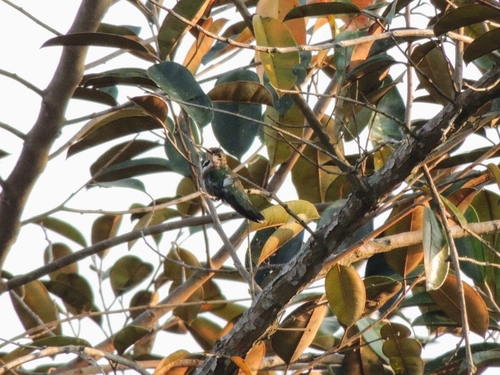 Veraguan Mango
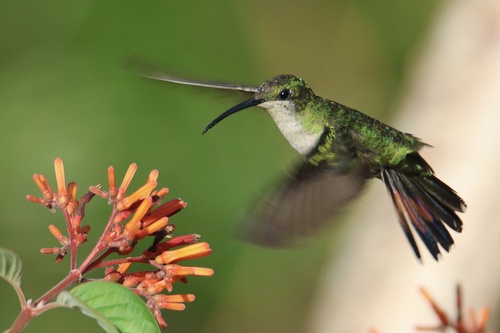 Hispaniolan Mango
In short
The most reliable field mark to separate Veraguan Mango from Hispaniolan Mango is the color and pattern of the underparts, especially in adult males: Veraguan Mango males have a blueish breast and belly, while Hispaniolan Mango males show a metallic green throat and chin with the rest of the underparts velvety black with a bluish tinge. Females also differ: Veraguan Mango females have a white-cream belly with a dark teal central stripe, whereas Hispaniolan Mango females have grayish underparts that lighten to pale white on the abdomen, lacking any dark central stripe. Tail coloration and pattern provide additional clues, especially in females and juveniles. Both species are medium-sized, metallic green hummingbirds, but their ranges do not overlap: Veraguan Mango is found in Panama and Costa Rica, while Hispaniolan Mango is endemic to Hispaniola.
Identification tips
- Adult male underparts: Look for a blueish breast and belly in Veraguan Mango males, versus a metallic green throat and chin with extensive velvety black underparts in Hispaniolan Mango males. This is the single most reliable mark in good light.
- Adult female underparts: Veraguan Mango females have a white-cream belly with a dark teal (not black) central stripe; Hispaniolan Mango females are grayish below, paling to white on the abdomen, and lack any central stripe.
- Juvenile Hispaniolan Mango: Juveniles resemble females but show a black line down the center of the underparts, which could be confused with the female Veraguan Mango's teal stripe. Check for the color (teal vs black) and the overall tone of the underparts (grayish vs white-cream).
- Tail pattern (female/immature): Veraguan Mango has black tail feathers with a red circle central to each feather. Hispaniolan Mango females have a reddish violet tail with broad black marks near the end and white tips on the outermost feathers. Male Hispaniolan Mango tails are mostly violet with coppery inner webs and blue-black tips.
- Upperparts: Both species are metallic green above, so this is not a useful separator.
- Bill: Both have a slightly decurved, dark bill; bill shape and color are not diagnostic.
- Range: If seen in Panama or Costa Rica, it is Veraguan Mango; if on Hispaniola, it is Hispaniolan Mango. There is no overlap.
- Behavior: Both species feed on nectar and insects, and males defend territories. Hispaniolan Mango may forage higher in the canopy (up to 20 m), but this is not a reliable field mark.
- Sexual dimorphism: Both species show clear differences between males and females, but the pattern and color of the underparts are the best clues.
- Tail color in flight: In good light, note the overall tail color—black with red circles (Veraguan) vs violet/reddish violet with black and white (Hispaniolan, especially female).
- Central ventral stripe: Only Veraguan Mango females have a teal (not black) central stripe; Hispaniolan Mango females and most juveniles lack this, except for the black line in juveniles.
- Underpart tone: Veraguan Mango females are distinctly white-cream below, while Hispaniolan Mango females are grayish, paling to white only on the abdomen.
- No black throat in Veraguan Mango: If you see black on the throat or extensive black on the underparts, it is not Veraguan Mango.
- No vocal differences described: Voice is not a reliable separator with current information.
- Overall impression: If you see a hummingbird with a strong, dark central stripe on a pale belly in Central America, think Veraguan Mango; if you see a hummingbird with a mostly dark or blackish belly and metallic green throat in the Caribbean, think Hispaniolan Mango.
Size
Both species are similar in size, with Veraguan Mango reaching 11–12 cm in length and Hispaniolan Mango slightly larger at 11.5–13.5 cm. Adult male Hispaniolan Mangos are heavier (6.0–8.2 g) than females (4.0–7.0 g), but there is no weight data for Veraguan Mango. In the field, size is not a reliable separator between these two.
Plumage
- Juvenile/Immature: Hispaniolan Mango juveniles resemble females but with a black line down the center of the underparts. There is no specific juvenile plumage described for Veraguan Mango, but females and immatures are likely similar.
- Adult Males: Veraguan Mango males have a blueish breast and belly, lacking any black on the throat or belly. Hispaniolan Mango males have metallic green on the chin and throat, with the rest of the underparts velvety black with a bluish tinge.
- Adult Females: Veraguan Mango females show a white-cream belly with a distinct dark teal (not black) stripe down the breast. Hispaniolan Mango females have grayish underparts that lighten to pale white on the abdomen, with no central stripe. Their tails are reddish violet with broad black marks near the end and white tips on the outermost feathers, while Veraguan Mango females have black tails with a red circle central to each feather.
- Tail: Veraguan Mango has black tail feathers with a central red circle; Hispaniolan Mango has a mostly violet tail (reddish violet in females), with coppery inner webs and blue-black tips in males, and broad black marks near the end in females.
Behaviour
Both species feed on nectar and arthropods, with males defending nectar-rich territories. Hispaniolan Mango is noted for foraging as high as 20 m and is a primary pollinator for certain Heliconia species. There is no specific behavioral difference noted for Veraguan Mango that would aid field separation.
Habitat
Veraguan Mango is found in Panama and recently in Costa Rica, while Hispaniolan Mango is strictly endemic to Hispaniola (Dominican Republic and Haiti). If you are outside these ranges, the species can be ruled out accordingly. Both occur in habitats where flowering plants are present, but range is the key separator.