

Veery vs Spectacled Thrush
Catharus fuscescens versus Turdus nudigenis
Play a quiz with Veery and Spectacled Thrush
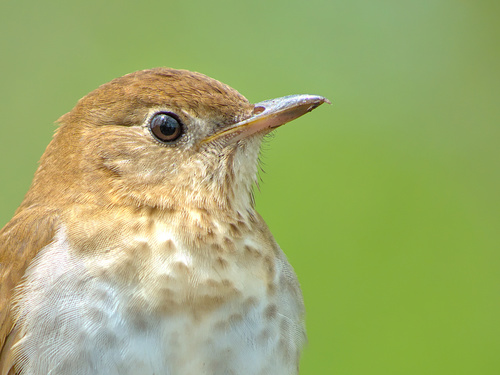 Veery
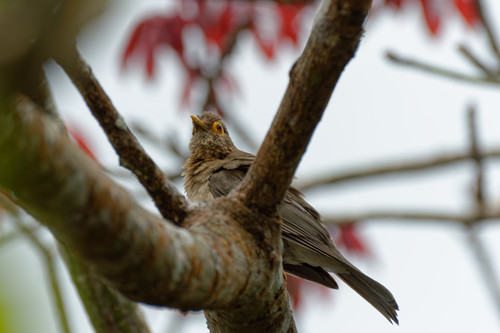 Spectacled Thrush
In short
The most reliable field mark to separate Veery from Spectacled Thrush is the presence of a bold yellow eye ring on the Spectacled Thrush, which is absent or only faintly present on the Veery. Veery is noticeably smaller and slimmer, with a warmer, more cinnamon-brown upperpart color (especially in eastern birds), while Spectacled Thrush is larger, heavier, and plainer olive-brown above. Veery shows faint, blurry breast spots on a whitish background, whereas Spectacled Thrush has a brown-streaked throat and paler brown underparts. Juvenile Spectacled Thrushes are flecked above and spotted below, but even then, the yellow eye ring is present (though thinner), helping with identification. Habitat and range also differ greatly, as Veery is a North American migrant and Spectacled Thrush is a South American and Caribbean resident.
Identification tips
- Check the eye ring: Spectacled Thrush always shows a bold, bright yellow eye ring (adults and juveniles), which is diagnostic. Veery's eye ring is faint, pale, and never yellow.
- Assess overall size and build: Spectacled Thrush is much larger and bulkier than Veery. If the bird appears big and heavy for a thrush, Veery is unlikely.
- Upperpart color: Veery (especially eastern birds) is warm cinnamon-brown above, while Spectacled Thrush is plain olive-brown. Western Veeries can be more olive, but still usually warmer than Spectacled Thrush.
- Breast and throat pattern: Veery has faint, blurry brownish spots on a whitish breast, with a clean white belly. Spectacled Thrush has a brown-streaked off-white throat, paler brown underparts, and lacks the distinct spot pattern of Veery.
- Juvenile patterns: Juvenile Spectacled Thrushes are flecked above and spotted below, but still show a yellow eye ring (though thinner). Veery juveniles are similar to adults but never have a bold eye ring or heavy streaking on the throat.
- Leg color: Veery has pink legs, which can be a subtle clue if seen well. Spectacled Thrush leg color is not described here, but the eye ring is a stronger mark.
- Bill structure: Veery's bill is relatively short (1.2–1.9 cm), fitting its smaller size. Spectacled Thrush has a proportionately larger bill, but this is less reliable than the eye ring or size.
- Habitat and range: If you are in North America in summer, Veery is possible; in the Caribbean or northern South America, Spectacled Thrush is the default. Veery is a rare vagrant outside its normal range.
- Behavior: Veery is shy, staying low in dense cover. Spectacled Thrush is often bold and visible, foraging in open gardens and parks.
- Voice: Spectacled Thrush's song is a slow, musical warble, with a cat-like call. Veery's song is a downward-spiraling, ethereal flute (not described here), but the eye ring is a more practical field mark.
- Seasonality: Veery is present in North America only during the breeding season and on migration; Spectacled Thrush is resident year-round in its range.
- Context: If you see a thrush with a bold yellow eye ring in the Caribbean or northern South America, it is almost certainly Spectacled Thrush. If the bird is small, warm brown, and has only a faint eye ring, Veery is likely—if you are within its range.
- Pitfalls: Western Veeries can appear more olive-brown, approaching Spectacled Thrush in color, but never show the yellow eye ring or the same size. Juvenile Spectacled Thrushes may have less obvious eye rings, but still brighter than Veery.
- Flight views: No distinctive upperwing pattern is described for either species, so rely on size, structure, and facial pattern in flight.
- Multiple marks: Always use a combination of size, eye ring, upperpart color, and breast/throat pattern for the most reliable identification, especially if viewing conditions are poor.
Size
Veery is significantly smaller, measuring 16–19.5 cm in length and weighing 26–39 g ([wikipedia]). In contrast, Spectacled Thrush is much larger at 23–24 cm and about 60 g. The difference is obvious in the field: Spectacled Thrush looks bulkier and longer-bodied, with a heavier build. Veery's wingspan averages 28.5 cm, while Spectacled Thrush's is not specified, but its overall proportions are much more robust. If both are seen together (unlikely due to range), size alone is a strong clue.
Plumage
- Juvenile/immature birds: Juvenile Spectacled Thrushes are flecked above and spotted below, with a thinner but still present yellow eye ring. Veery juveniles are not described in detail here, but adults and young share the general pattern of faint brownish spots on a whitish breast, never with the bold facial markings of Spectacled Thrush.
- Adults: Veery is light brown above (cinnamon in the east, olive-brown in the west), with a poorly defined or faint eye ring, white underparts, and a light tawny breast with faint, blurry brownish spots. Spectacled Thrush is plain olive-brown above, paler brown below, with a brown-streaked off-white throat and a prominent yellow eye ring. The underparts of Spectacled Thrush are never as clean white as Veery's, and the breast spots are replaced by streaks on the throat.
- Key contrast: The yellow eye ring of Spectacled Thrush (all ages) is never matched by Veery, whose eye ring is faint and not brightly colored. Veery's breast spots are always blurry and faint, while Spectacled Thrush shows streaking only on the throat.
Behaviour
Both species are typical thrushes in their habits, foraging on the ground or in low vegetation. Veery is more secretive, often staying in dense understory and close to water, and may be harder to see well. Spectacled Thrush is bolder and more conspicuous, often seen in gardens and open woodlands, sometimes even in urban areas. Veery is a long-distance migrant, while Spectacled Thrush is resident and does not migrate.
Habitat
Veery breeds in humid deciduous forests with dense understory near water in southern Canada and the northern United States ([wikipedia]). It is a migrant, wintering in the Amazon basin and northern South America. Spectacled Thrush is a resident breeder in the Lesser Antilles and northern South America (Colombia, Venezuela, northern Brazil), and is common in open woodlands, gardens, and even urban parks. Their ranges do not overlap, and Veery is not expected in the Caribbean or tropical South America outside migration. If you are in the Antilles or northern South America, Veery is extremely unlikely.
Voice
Spectacled Thrush sings a musical warble, slower and lower-pitched than Cocoa Thrush, and gives a cat-like 'queeoow' call and a harsh 'kereel' when alarmed ([wikipedia]). Veery is famous for its ethereal, downward-spiraling song, but song is not described in the provided notes. Calls and songs are quite different, but unless you know Veery's distinctive song, the yellow eye ring remains a more reliable field mark.