
Twite vs Common Redpoll
Linaria flavirostris versus Acanthis flammea
Play a quiz with Twite and Common Redpoll
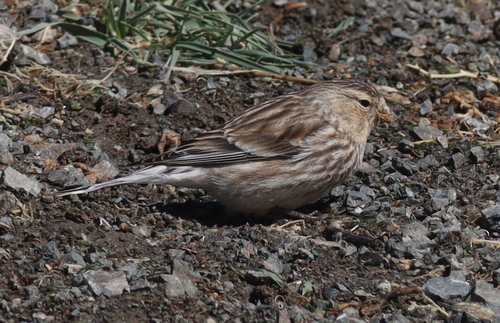 Twite
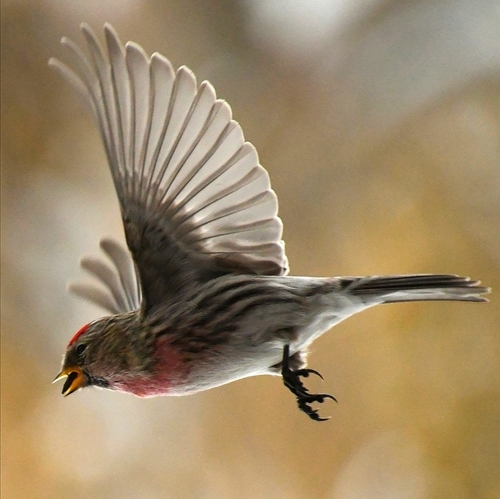 Common Redpoll
In short
The most reliable field mark to separate Twite from Common Redpoll is the presence of a bright red forehead patch and black bib on the redpoll—features entirely lacking in Twite of all ages. In flight or perched, Twite shows a plain face and, in adult males, a pink rump, while redpolls have a streaked rump and always show the red forehead. Both are small, streaky finches, but Twite lacks any red on the head or breast and has a yellow bill in winter. Juvenile and female Twite can be especially confusing with redpolls, but careful attention to head and rump coloration, as well as bill color and wing pattern, will resolve most field encounters. Habitat and flocking behavior can help, but plumage and structure are the most reliable clues.
Identification tips
- Red Forehead Patch: Only Common Redpoll shows a bright red forehead patch in all plumages; Twite never shows any red on the head. This is the single most reliable field mark.
- Black Bib: Redpolls have a black bib below the bill; Twite always lack this feature. Even in poor light, a smudgy black throat points to redpoll.
- Rump Color: Adult male Twite have a pink rump (especially in spring/summer), visible in flight or when perched with tail cocked. Redpolls have a streaked rump with no pink; females and juvenile Twite have a plain brown rump.
- Breast Color: Male redpolls often show a pinkish suffusion on the breast; Twite never show any red or pink on the breast.
- Wingbars: Redpolls have two pale, distinct wingbars; Twite's wingbars are less obvious and the wings appear plainer overall.
- Bill Color: Twite has a yellow bill in winter, turning grey in summer; redpolls have a yellowish bill with a dark tip year-round. Bill color is subtle but can help in close views.
- Face Pattern: Twite has a plain face with no red or black; redpolls always have a red forehead and black bib, giving a more marked facial expression.
- Underpart Streaking: Both are streaky below, but Twite is generally buffier and less grey, with coarser streaking. Redpolls are paler and more finely streaked.
- Size and Structure: Both are similar in size and shape; do not rely on this for separation in the field.
- Habitat: In coastal saltmarshes or upland grasslands, Twite is more likely; in birch or alder groves, especially in winter, redpoll is more likely. However, range overlap can occur.
- Flocking Behavior: Twite often form large, tight flocks on the ground; redpolls are more arboreal and may be seen feeding in small groups in trees.
- Vocalizations: Listen for the nasal 'twaa-it' of Twite versus the twittering calls of redpoll. Voice can be diagnostic if heard well.
- Seasonal Movement: Twite are more coastal in winter, redpolls more widespread in weedy fields and birch groves. Consider the context, but do not rely solely on habitat.
- Sex and Age Pitfalls: Female and immature Twite are most easily confused with redpolls; always check for the red forehead and black bib, which are present on all redpolls regardless of age or sex.
- Mixed Flocks: Both species can occur together in winter flocks; check every individual carefully, especially in flight, for the key head and rump features.
Size
Both species are similar in size and structure, but there are subtle differences: Twite measures 13–13.5 cm in length [wikipedia], while Common Redpoll ranges from 11.5–14 cm [wikipedia]. Their weights overlap, with redpolls at 12–16 g. In the hand or at close range, these differences are negligible and not useful for field separation. Both have a typical finch shape, but jizz is not a strong separator.
Plumage
- Juvenile/Immature birds: Both species are streaky brown above and below, but only redpolls (all ages) have a red forehead patch and a black bib. Twite juveniles and females have a plain face and lack any red or black on the head or bib. Rump color is key: male Twite show a pink rump (especially in spring/summer), while redpolls have a streaked rump with no pink flush.
- Adults: Male Common Redpolls often have a pinkish suffusion on the breast, in addition to the red forehead and black bib. Twite males never show red on the head or breast, only a pink rump. Female and immature Twite have a brown rump and plain face, while female redpolls retain the red forehead and black bib, though breast color is less vivid. Both species are streaky below, but Twite is generally buffier and less grey.
- Wing pattern: Redpolls have two pale wingbars; Twite's wingbars are less distinct and the overall wing is plainer. Bill color is also a clue: Twite shows a yellow bill in winter, turning grey in summer, while redpolls have a yellowish bill with a dark tip year-round.
Behaviour
Both species feed mainly on small seeds and often form flocks outside the breeding season. Twite are more likely to be found in large, tight flocks on saltmarshes and coastal grasslands, sometimes mixed with other finches. Redpolls also flock, often in birch or alder trees, and are more arboreal in their feeding habits. Both species forage on the ground, but redpolls are more frequently seen feeding in trees.
Habitat
Twite breed in upland grasslands, coastal machair, and low shrubland, especially in the UK and western Europe, and at high altitudes in Asia. In winter, they move to coasts and saltmarshes. Common Redpolls breed in boreal forests and tundra across the Holarctic, favoring birch, spruce, and larch. In winter, redpolls are found in weedy fields, birch groves, and sometimes gardens, especially where birch or alder seeds are abundant. Overlap is possible in winter, but Twite are more coastal and redpolls more associated with trees.
Voice
Twite has a distinctive nasal call, 'twaa-it', which is diagnostic if heard; its song is a fast series of trills and twitters. Common Redpoll gives a variety of twittering calls and rattles, but always lacks the nasal quality of Twite. If you hear the 'twaa-it' call, you are almost certainly hearing a Twite.