

Tufted Duck vs Greater Scaup
Aythya fuligula versus Aythya marila
Play a quiz with Tufted Duck and Greater Scaup
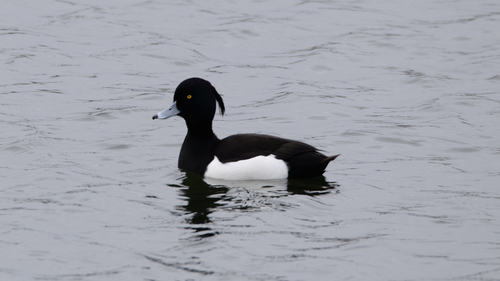 Tufted Duck
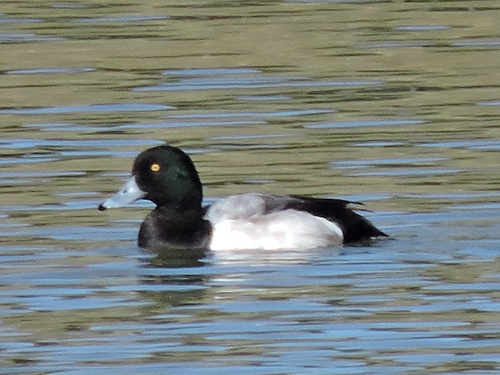 Greater Scaup
In short
The most reliable field mark between Tufted Duck and Greater Scaup is the presence of a distinct head tuft on Tufted Duck of all ages and sexes, which Greater Scaup never shows. In flight, Greater Scaup of all ages show a broad white wing stripe extending from the secondaries well into the primaries, while Tufted Duck’s white wing stripe is limited to the secondaries and does not reach the primaries. Adult males are easier to separate, but females and immatures can be confusing, especially on water. Bill shape and facial pattern offer additional clues: Greater Scaup has a broader, bluer bill with a larger black nail and (in females/immatures) a more extensive white patch at the bill base. Size and structure help at close range, but overlap can make these less reliable in the field.
Identification tips
- Head tuft (all ages, sexes): Only Tufted Duck shows a distinct head tuft or crest; Greater Scaup never has a tuft. Even a short or ragged tuft on a female or immature points to Tufted Duck.
- Wing stripe in flight (all ages): Greater Scaup shows a broad white stripe extending from the secondaries through the primaries to the wingtip; Tufted Duck’s white is limited to the secondaries, with dark primaries. This is the most reliable mark in flight, especially for females and immatures.
- Bill shape and color: Greater Scaup has a broader, paler blue bill with a larger black nail at the tip. Tufted Duck’s bill is more slender and blue-grey. This is most helpful at close range or in good light.
- Facial white patch (females/immatures): Female Greater Scaup shows a bold white band and oval patches at the bill base; Tufted Duck females may have a small white area, but it is never as extensive or well-defined.
- Head shape: Greater Scaup has a smoothly rounded head profile; Tufted Duck’s head is more angular, especially with the tuft visible at the rear.
- Male flank and back color: Tufted Duck males have pure white flanks and a black back; Greater Scaup males have bright white flanks but a pale grey, vermiculated back.
- Eye color: Both species have yellow eyes in adults, so this is not a reliable separator.
- Body size and bulk: Greater Scaup is larger and bulkier, but beware overlap and lone birds.
- Group size and context: Large, dense flocks on coastal waters favor Greater Scaup; smaller groups on inland lakes are more likely Tufted Duck, but both can mix.
- Leg and foot color: Both have grey legs and feet; not useful for separation.
- Juvenile/immature confusion: Juvenile Greater Scaup look like adult females and retain the broad white wing stripe; young Tufted Ducks always show some tuft development and limited white on the wing.
- Eclipse plumage: Greater Scaup males in eclipse are duller but still show the white wing stripe; Tufted Duck eclipse males retain the tuft and dark upperparts.
- Vocalizations: Tufted Duck females give a harsh "karr"; Greater Scaup’s calls are not distinctive in this context.
- Bill nail: Greater Scaup’s black nail is larger and more obvious, especially at close range.
- When in doubt: Look for the tuft (present = Tufted Duck), then check the wing stripe in flight (broad and reaching primaries = Greater Scaup).
Size
Greater Scaup is noticeably larger and heavier than Tufted Duck, being about 10% longer and 20% heavier ([wikipedia]). Greater Scaup measures 39–56 cm in length with a 71–84 cm wingspan and weighs 726–1,360 g. Tufted Duck is a small diving duck, smaller and lighter than Greater Scaup. While there is overlap, side-by-side the scaup will appear bulkier, with a broader body and proportionally larger bill. However, lone birds or distant views may make this difference subtle.
Plumage
-
In flight (all ages): Greater Scaup shows a strong white wing stripe running from the secondaries through the primaries to the wingtip; Tufted Duck’s white is confined to the secondaries, with the primaries appearing dark ([wikipedia]). This is the most consistent separation in flight, especially for females and immatures.
-
Adult males: Tufted Duck drakes are strikingly black with white flanks and a prominent head tuft; Greater Scaup drakes have a rounded dark head with a greenish or purplish gloss, a paler grey back, and bright white flanks and belly, but lack any head tuft. Both have yellow eyes, but Tufted Duck’s bill is blue-grey and more slender, while Greater Scaup’s is broader and paler blue with a larger black nail.
-
Adult females and immatures: Both are brown with pale flanks, but Tufted Duck females may show a small white patch at the bill base, never as extensive as the bold white band and oval patches on Greater Scaup females. Juvenile Greater Scaup resemble adult females. Tufted Duck females always show a hint of a head tuft, even if short. Greater Scaup females have a rounder head profile and lack any crest.
-
Eclipse males: Greater Scaup males in eclipse are duller but still show the broad white wing stripe; Tufted Duck eclipse males retain the tuft and dark upperparts.
Behaviour
Both are diving ducks, often seen in mixed flocks on large water bodies. Greater Scaup tends to form much larger rafts, sometimes numbering in the thousands, and is more likely to be seen in coastal waters in winter. Tufted Duck is more common on inland lakes and smaller water bodies. In flight, Greater Scaup appears bulkier and more powerful, while Tufted Duck is slightly more compact.
Habitat
Tufted Duck is widespread across northern Eurasia and favors freshwater lakes, ponds, and reservoirs, often inland. Greater Scaup breeds farther north and is more coastal in winter, especially in large flocks on estuaries and bays, but can overlap with Tufted Duck on large lakes. If seen on a small inland pond, Tufted Duck is more likely; on a coastal bay, Greater Scaup is more probable, but both can occur together in migration or winter.
Voice
Tufted Duck females give a harsh, growling "karr" call, especially in flight; males are mostly silent except for a simple "wit-oo" whistle in courtship. Greater Scaup vocalizations are not described in detail here, but are different from Tufted Duck. Voice is rarely diagnostic in the field for these species.