

Tropical Kingbird vs Couch's Kingbird
Tyrannus melancholicus versus Tyrannus couchii
Play a quiz with Tropical Kingbird and Couch's Kingbird
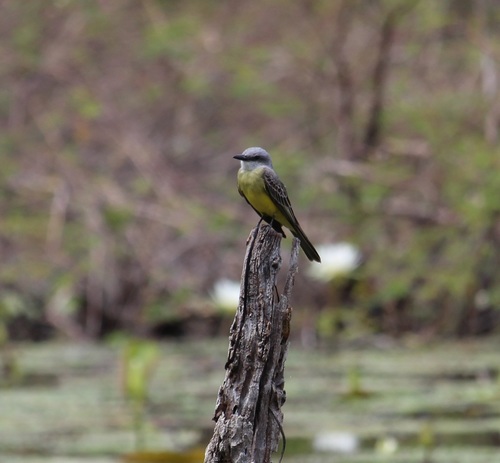 Tropical Kingbird
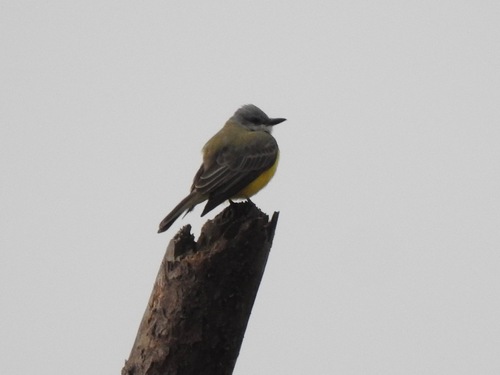 Couch's Kingbird
In short
The most reliable way to separate Tropical Kingbird from Couch's Kingbird is by voice, as their calls are distinctively different. In the field, both species are extremely similar in size, structure, and general coloration, but subtle differences in head pattern, breast color, and habitat preference can help. Juveniles of both species show pale edges to the wing coverts, so age-specific upperwing marks are not a strong separator. Careful attention to the shade and extent of gray on the head and breast, as well as the context of the sighting, can improve your chances of a correct ID.
Identification tips
- Listen first: If you hear the bird, Couch's Kingbird gives a raspier, more varied call; Tropical Kingbird's call is a high-pitched, twittering trill. This is the best field separator.
- Head pattern: Tropical Kingbird has a pale gray head with a darker eye mask and sometimes a concealed orange crown stripe. Couch's Kingbird's head is pale gray but with more contrasting darker cheeks, giving a slightly hooded look. This is subtle but can be seen in good light.
- Breast color and pattern: Couch's Kingbird has a darker, more sharply demarcated breast above the yellow belly, while Tropical Kingbird's breast is olive blending more gradually into yellow. Look for a clear cutoff in Couch's versus a more blended transition in Tropical.
- Throat color: Both have pale throats, but the contrast with the breast is often stronger in Couch's Kingbird due to the darker upper breast.
- Tail shape: Both species have dark, slightly forked tails. Tail shape is not a reliable separator.
- Juvenile wing coverts: Both species' juveniles have pale edges to the wing coverts, so this feature does not help distinguish them.
- Juvenile underparts: Juvenile Couch's Kingbird has browner underparts than the adult, but this is subtle and not always obvious in the field.
- Bill size and shape: Both have large, heavy bills; structure is not a strong separator.
- Perching behavior: Tropical Kingbird often perches higher and more exposed, while Couch's Kingbird may be lower or in more wooded settings, but this is not absolute.
- Habitat context: In open country, especially away from water, Tropical Kingbird is more likely. In lightly wooded areas, forest edges, or near water, especially in southern Texas and the Yucatán, Couch's Kingbird is more likely.
- Geographic range: If you are outside southern Texas or the lower Rio Grande Valley, check local status—Tropical Kingbird is widespread in Central and South America, while Couch's is more restricted to the Gulf Coast and Yucatán region.
- Sex and season: Sexes are similar in both species; no seasonal plumage differences are diagnostic.
- Feeding behavior: Both sally for insects from perches, but Tropical Kingbird may hover more to glean from vegetation.
- Aggression: Both are territorial and will chase larger birds, so this is not a separator.
- When in doubt: If the bird is silent and habitat is ambiguous, rely on the combination of head pattern, breast contrast, and context, but be honest about the high potential for overlap and uncertainty.
Size
Tropical Kingbird and Couch's Kingbird are nearly identical in size, with Tropical Kingbird averaging 37 g and Couch's Kingbird 39 g in body mass. Both are large, robust flycatchers with similar overall dimensions. Length and wingspan overlap completely in the field, so size is not a useful separator.
Plumage
- Juveniles: Both species' juveniles have pale buff or pale edges to the wing coverts, making this mark non-diagnostic between them. Juvenile Couch's Kingbird also has browner underparts than the adult.
- Adults: Both have pale gray heads, olive-tinged backs, brown wings, and bright yellow underparts. Tropical Kingbird shows a more uniform pale gray head with a darker eye mask and sometimes an orange crown stripe (often concealed), while Couch's Kingbird has a pale gray head with more contrasting darker cheeks. The breast of Couch's Kingbird is darker above the yellow belly, creating a sharper demarcation, whereas Tropical Kingbird's breast is olive blending into yellow. Both have dark, slightly forked tails. Sexes are similar in both species.
Behaviour
Both species perch conspicuously in open areas and sally out to catch insects in flight, often returning to the same perch. Tropical Kingbird is noted for using higher, more exposed perches and is more likely to be seen in open country, while Couch's Kingbird prefers lightly wooded or edge habitats. Both will aggressively defend their territories against larger birds.
Habitat
Tropical Kingbird is most often found in open areas with scattered trees and shrubs, including gardens and roadsides, and tends to stay in the upper levels of trees. Couch's Kingbird prefers more wooded environments, such as sparse forests, thorn forests, wooded stream edges, and suburban areas, often near water. In overlap zones (southern Texas, lower Rio Grande Valley), habitat can be a clue: open for Tropical, wooded for Couch's, but there is some overlap, especially near forest edges and water.
Voice
Vocalization is the most reliable field mark. Tropical Kingbird gives a high-pitched, twittering trill ("tree-e-e-e-e-e"), while Couch's Kingbird has a raspier, more complex call with more varied pitch. If you hear the bird, identification is straightforward; if silent, rely on subtle plumage and habitat clues.