

Trinidad Euphonia vs Lesser Goldfinch
Euphonia trinitatis versus Spinus psaltria
Play a quiz with Trinidad Euphonia and Lesser Goldfinch
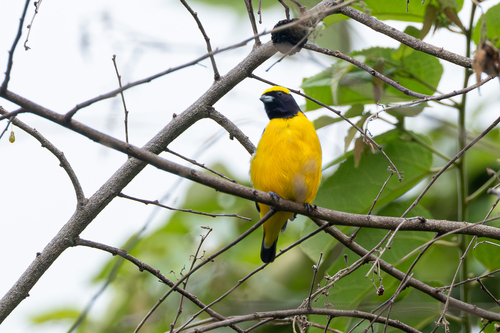 Trinidad Euphonia
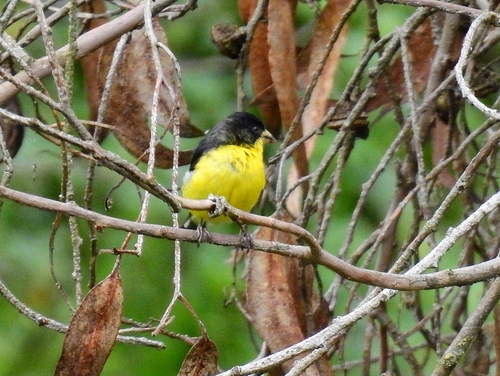 Lesser Goldfinch
In short
The most reliable field mark to separate Trinidad Euphonia from Lesser Goldfinch is the combination of wing and tail pattern in flight: adult male Trinidad Euphonias show a bold white stripe on the underwing and large white ovals on the undertail, while Lesser Goldfinches display prominent white patches at the base of the primaries and outer tail feathers, but not the same underwing stripe. Both species are small, short-tailed, and yellow below, but male Trinidad Euphonias have a glossy blue-black upperpart with a yellow crown, while male Lesser Goldfinches have variable black or green backs and a black forehead. Females and immatures of both species are olive above and yellowish below, but the euphonia female has a diagnostic grayish central belly and a finer bill. Beware: female and immature Trinidad Euphonias are nearly inseparable from female/immature Purple-throated Euphonia, but not Lesser Goldfinch. Structure and bill shape also help: euphonias are stockier with a shorter, finer bill, while goldfinches have a more typical finch bill and a slightly longer tail.
Identification tips
- White underwing stripe (male Trinidad Euphonia): In flight, look for a bold white stripe on the underwing—unique to male Trinidad Euphonia and absent in Lesser Goldfinch.
- Undertail ovals (male Trinidad Euphonia): Two large white ovals on the undertail are visible in flight or when the tail is spread; Lesser Goldfinch has white only on the outer tail feathers, not as ovals.
- White wing patches (Lesser Goldfinch): Male Lesser Goldfinch shows big white patches at the base of the primaries and outer tail feathers, visible in flight and when perched; Trinidad Euphonia lacks these wing patches.
- Crown color (adult males): Trinidad Euphonia males have a bright yellow crown extending behind the eyes; Lesser Goldfinch males have a black or green crown and forehead, never yellow.
- Back color (adult males): Trinidad Euphonia is glossy blue-black above; Lesser Goldfinch varies from black to green-backed, depending on region, but never blue-black.
- Bill shape: Trinidad Euphonia has a small, fine, short bill; Lesser Goldfinch has a more robust, conical finch bill. This is especially useful in close views.
- Female/immature belly color: Female and immature Trinidad Euphonias have a grayish patch down the center of the breast and belly; Lesser Goldfinch females/immatures are more evenly yellowish below.
- Female/immature wing and tail pattern: Female/immature Lesser Goldfinch shows only a narrow white wing stripe and little or no white on the tail; female/immature Trinidad Euphonia lacks strong wing/tail markings but may show yellow undertail coverts.
- Tail length and shape: Trinidad Euphonia is short-tailed and compact; Lesser Goldfinch is slightly longer-tailed and slimmer, especially in southern populations.
- Habitat context: In Trinidad or adjacent Venezuela/Colombia, especially in fruiting trees or forest edge, suspect euphonia; in open, weedy, or riparian habitats, especially in North America, suspect goldfinch.
- Feeding behavior: Goldfinches are often seen feeding on seeds in open, weedy areas; euphonias focus on berries, especially mistletoe, and may forage more in the canopy.
- Vocalizations: If you hear a harsh 'chig chig chig' or high-pitched whistle, it's likely Lesser Goldfinch; euphonia vocalizations are less distinctive in the field.
- Sexual dimorphism: Both species are sexually dimorphic, but the differences are sharper in Trinidad Euphonia (yellow crown and blue-black upperparts in males vs olive/yellowish females with gray belly patch).
- Geographic range: Trinidad Euphonia is rare on Trinidad and local on the adjacent mainland; Lesser Goldfinch is widespread from the western U.S. to northern South America.
- Pitfall: Female and immature Trinidad Euphonias are virtually inseparable from female/immature Purple-throated Euphonia, but not Lesser Goldfinch—so if you are only choosing between these two, focus on the gray belly patch and bill shape for females/immatures.
Size
Both species are among the smallest passerines in their respective ranges. Trinidad Euphonia averages 11.4 g in body mass and measures 9.7–11 cm in length, while Lesser Goldfinch is similar in length (9–12 cm) but slightly lighter on average (8–11.5 g). The difference is subtle and not reliable in the field, though goldfinches may appear a bit slimmer and longer-tailed, especially in southern populations. Both are noticeably small, but the euphonia is typically more compact and short-tailed.
Plumage
- Juvenile/Immature/First-year birds: Both species' immatures are olive-green above and yellowish below, but Trinidad Euphonia females and immatures have a grayish patch down the center of the breast and belly, which is lacking in Lesser Goldfinch. Immature goldfinches are buffier below and have less white in the wings and tail than adults, but still show a narrow white wing stripe.
- Adult males: Trinidad Euphonia males are glossy blue-black above with a bright yellow forehead and crown extending well behind the eyes, and bright yellow underparts. They show a bold white underwing stripe (from white underwing coverts) and two large white ovals on the undertail (from white on the inner webs of the outer tail feathers). Lesser Goldfinch males have a black forehead and variable black or green back, with bright yellow underparts and big white patches at the base of the primaries and on the outer tail feathers, but lack the euphonia's underwing stripe and undertail ovals. Their yellow crown is absent, replaced by a black or green crown.
- Adult females: Female Trinidad Euphonias are olive-green above, yellow-olive below, with a distinctive grayish central belly and a small, fine bill. Female Lesser Goldfinches are also olive-green above and yellowish below, but lack the grayish belly patch and have a more robust, finch-like bill. Their wing and tail markings are much reduced: only a narrow white wing stripe and little or no white on the tail.
- Flight views: Trinidad Euphonia males show a white underwing stripe and undertail ovals; Lesser Goldfinch males show white wing patches and outer tail edges, but not the same underwing or undertail pattern.
Behaviour
Both species are active, often moving through foliage in small groups or pairs. Trinidad Euphonia pairs remain together year-round and may be seen flicking wings and bowing during courtship. Lesser Goldfinches often feed acrobatically on seed heads and show undulating flight with frequent calls. Both can be confiding, but goldfinches are more likely to be seen feeding openly on thistle or sunflower heads, while euphonias focus more on mistletoe berries and may forage more discreetly.
Habitat
Trinidad Euphonia is found in northern Colombia, northern Venezuela, and rarely on Trinidad, preferring forest edges, second growth, and gardens with fruiting trees, especially mistletoe. Lesser Goldfinch has a much broader range, from the western United States to northern South America, and is common in open woodlands, scrub, gardens, and weedy fields, often near water. If you are in Trinidad or adjacent mainland areas and see a small yellow-and-black bird in a fruiting tree, euphonia is more likely; in open, weedy habitats or further north, goldfinch dominates.
Voice
Lesser Goldfinch gives a harsh 'chig chig chig' call and a very high-pitched, drawn-out whistle, often rising in pitch, especially in flight. Trinidad Euphonia's vocalizations are not detailed in the notes, so voice is not a primary separator here; rely on visual marks unless you know the local calls.