

Tree Swallow vs Barn Swallow
Tachycineta bicolor versus Hirundo rustica
Play a quiz with Tree Swallow and Barn Swallow
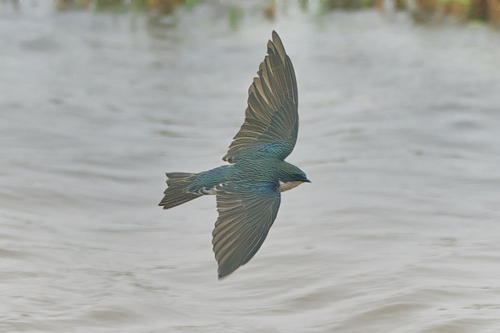 Tree Swallow
 Barn Swallow
In short
The most reliable field mark between Tree Swallow and Barn Swallow is the tail: Barn Swallow has a long, deeply forked tail with elongated streamers (especially in adults), while Tree Swallow’s tail is shorter and only slightly notched. In flight, Barn Swallow’s long tail streamers and blue breast band are distinctive, whereas Tree Swallow shows a compact, clean white underside with no breast band. Juvenile Tree Swallows are brown above and lack any rufous on the face, while juvenile Barn Swallows are browner overall but show a pale rufous face and a hint of a breast band. Both species are aerial insectivores, but Barn Swallow often perches on wires and forages over open fields, while Tree Swallow is more likely over water or marshes.
Identification tips
- Tail shape and length: Barn Swallow (adult) has a long, deeply forked tail with elongated streamers and white spots near the tip; Tree Swallow’s tail is short and only slightly notched. This is the single most reliable mark, especially in flight or when perched with the tail visible.
- Breast band: Barn Swallow (all ages except very young juveniles) shows a dark blue breast band separating the rufous throat from the pale belly; Tree Swallow always has a clean, unmarked white breast.
- Face color: Barn Swallow has a rufous (reddish) forehead, chin, and throat; Tree Swallow’s face is white, sometimes with a dusky cheek patch, but never rufous.
- Upperparts gloss: Tree Swallow (adult male) is glossy blue-green above; Barn Swallow is steel blue above. In poor light, this difference may be subtle, but Tree Swallow is generally brighter and greener.
- Juvenile confusion: Juvenile Tree Swallow is brown above with a gray-brown breast, lacking any rufous or breast band. Juvenile Barn Swallow is brownish above but always shows a pale rufous face and a faint breast band. If you see a brown swallow with a rufous face, it is Barn Swallow.
- Tail in juveniles: Juvenile Barn Swallow lacks the long tail streamers, but the tail is still more deeply forked than Tree Swallow’s, and the rufous face and breast band remain helpful.
- Perched posture: Barn Swallow appears more elongated and slender, often perching on wires or fences; Tree Swallow is compact and short-tailed, often perched on branches near water.
- Flight style: Barn Swallow’s flight is acrobatic and sweeping, with the long tail streamers trailing behind; Tree Swallow’s flight is more direct and compact, with quick, shallow wingbeats.
- Underwing color: Tree Swallow has gray-brown underwing coverts, but this is rarely visible in the field and not a primary mark.
- Female/immature Tree Swallow: Second-year females may show brown upperparts with some blue feathers, but never show rufous on the face or a breast band. This can confuse observers, but the lack of facial color and breast band is key.
- Habitat context: If seen over open water or marshes, especially early in the season, Tree Swallow is more likely. Barn Swallow is more likely around open fields, farmland, and human structures.
- Bill and legs: Both have small, black bills, but this is not a useful field mark for separation.
- Vocalizations: Calls are not reliably separable in the field unless you are very familiar with both species.
- Size impression: Barn Swallow appears longer and more slender, especially with the tail streamers visible; Tree Swallow is shorter and chunkier.
- Seasonal context: In early spring, Tree Swallow often arrives before Barn Swallow in northern areas, but there is much overlap.
Size
Barn Swallow is noticeably longer overall (17–19 cm) than Tree Swallow (12–14 cm), mainly due to its elongated outer tail feathers. However, their wingspans are similar (Barn Swallow: 32–34.5 cm; Tree Swallow: 30–35 cm), and their weights overlap (Barn Swallow: 16–22 g; Tree Swallow: 17–25.5 g). The difference in length is most obvious when the Barn Swallow’s tail streamers are visible. When perched, Barn Swallow appears more slender and elongated, while Tree Swallow is compact and short-tailed.
Plumage
-
Juvenile/immature birds: Juvenile Tree Swallow is brown above with a gray-brown wash on the breast and lacks any rufous on the face or throat. Juvenile Barn Swallow is also brownish above but shows a paler rufous face and whiter underparts, and even young birds show a hint of the dark breast band. Juvenile Barn Swallows lack the long tail streamers of adults, which can make them superficially similar to Tree Swallow, but the rufous face and breast band remain distinctive.
-
Adult males: Tree Swallow males are glossy blue-green above, with white underparts and cheeks, and a clean, unmarked breast. Barn Swallow males are steel blue above, with a rufous forehead, chin, and throat, separated from the off-white belly by a broad blue breast band. The long, deeply forked tail with white spots is diagnostic.
-
Adult females: Female Tree Swallow is duller than the male, sometimes with a brownish forehead or upperparts, but still lacks any rufous or breast band. Female Barn Swallow is similar to the male but with shorter tail streamers, less glossy upperparts, and paler underparts; the rufous face and breast band are still present.
-
Second-year/immature females: Tree Swallow second-year females may show a mix of brown and blue on the upperparts, but never show a rufous face or breast band. Barn Swallow immatures always show some rufous on the face and a breast band.
Behaviour
Both species are agile aerial insectivores, but Barn Swallow often perches on wires, fences, or open branches, and is more likely to be seen foraging over open fields and farmland. Tree Swallow is more closely associated with water and marshes, often seen skimming low over ponds or lakes. Barn Swallow’s flight is more acrobatic and sweeping, accentuated by its long tail streamers, while Tree Swallow’s flight is direct and compact.
Habitat
Tree Swallow breeds in North America, favoring open areas near water, marshes, and fields with available nest cavities (natural or artificial). Barn Swallow is more cosmopolitan, breeding across the Northern Hemisphere and favoring open country, farmland, and human structures for nesting (barns, bridges, eaves). In North America, Barn Swallow is more likely around human habitation and open fields, while Tree Swallow is more often found near water.
Voice
Both species have twittering calls, but the notes do not provide detailed descriptions of their vocalizations for field separation. Barn Swallow’s calls include a sharp 'siflitt' for predators and a 'flitt-flitt' for birds of prey, but these are not typically diagnostic in the field unless the observer is familiar with them.